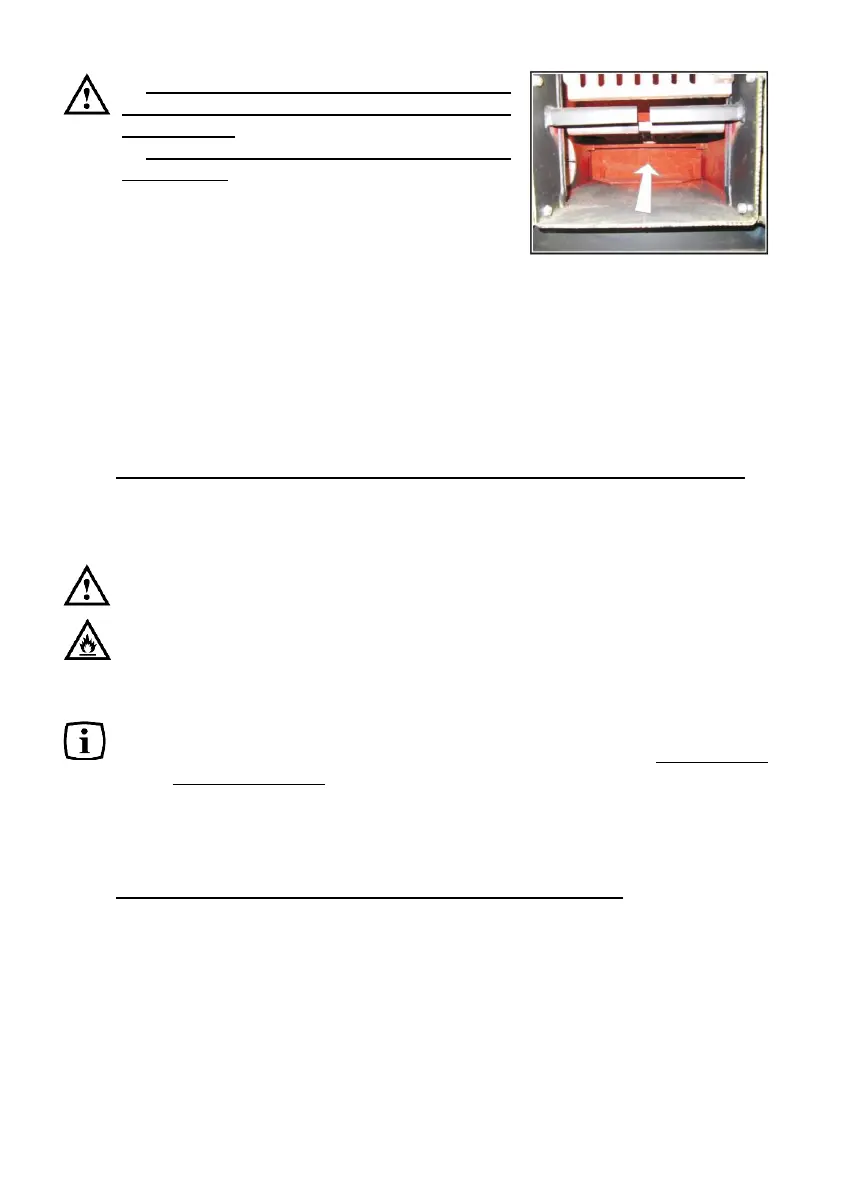
After installation and each cleaning of
the boiler make sure that the ash cleaning
lid is closed.
Combustion and draft efficiency de-
pends on it.
Fig. 11.
We advise, before the start of heating season and at least every 3 months
during the heating season, clean the boiler connection flue pipe and chimney.
Check fuel pipe connection status, look for leaks, eliminate them if found.
6.8. Frequently asked questions
I. What can happen in the case of electric power failure during stoking?
Without forced water circulation, there is the danger of water boiling;
boiler overheating; if safety valve is in bad order boiler or pipeline may
explode; boiling water may cause injuries.
a) Reduce burning intensity: close air supply valve; as far as possible
close the smoke draft valve but don’t let smoke to enter the room.
b) In the case of emergency, extinguish the boiler by removing fuel from
the combustion chamber (for there was less smoke in the room, put
burning fuel into a container with water, open doors and windows).
Don’t pour water into the combustion chamber, this may cause
irreparable damage to the boiler.
c) When emergency is over, when pressure in the system drops down,
refill the boiler and heating system with technical water, only after the
boiler cools down.
d) In winter, when there is no electric power for longer period and there
is danger of freezing, discharge water from the system.
II. Why, when stoking, strange (boiling) sounds are heard?
The boiler is operating at a higher than nominal capacity, the circulation
pump operation is disturbed, the pressure in the heating system is too
low.
a) Check that the air draft controller is correctly adjusted or not set at too
high temperatures.
b) Check that the chimney draft is not too large, close smoke draft valve.
c) Water circulation may have stopped: check the circulation pump for
operation; is the water level (pressure) in the system sufficient;
whether the system is properly deaerated; are there closed system
valves or there are clogged water filters.


 To Next Page