This document is a care and instruction manual for the Kenroy Home Pilaster Floor Fountain, model 51049SL. It provides detailed instructions for assembly, operation, maintenance, and troubleshooting, ensuring users can effectively set up and enjoy their water feature.
Function Description:
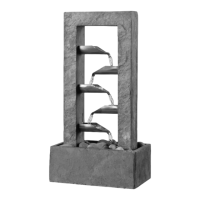
The Kenroy Home Pilaster Floor Fountain is a freestanding water feature designed to enhance indoor or outdoor living spaces with peaceful displays of flowing water. It consists of multiple stacked components, including a lower base, upper base, reservoir, tray, and columns, creating a multi-tiered design. Water is circulated by a pump, creating a continuous flow over the fountain's surfaces, often accompanied by decorative river stones. The fountain is designed for both aesthetic appeal and to provide the soothing sound of moving water.
Important Technical Specifications:
- Power Source: The pump and light cord (if applicable) extend 8 feet from the bottom of the fountain body and require connection to a grounded 110V outlet.
- Water Capacity: The reservoir requires 1 gallon of distilled water for optimal operation.
- Outdoor/Indoor Use: The water feature is designed for outdoor use but can also be used indoors. Users should be aware that splashing may occur, especially indoors.
- Pump Type: The pump features an overheating protection feature that will turn off if it becomes too hot or is not covered by water. It may cycle on and off as it cools and heats if not fully submerged.
- Flow Control: The pump includes a flow control valve (slider or knob) to adjust the water flow rate from minimum to maximum.
Usage Features:
- Placement Flexibility: The fountain can be placed in the center of a space or against a wall, offering versatility in décor.
- Easy Assembly: The manual outlines a step-by-step assembly process, starting with placing the upper base onto the lower base, then the reservoir onto the upper base. The pump cord is fed through a plastic tube, and the pump is placed into the reservoir. Subsequent steps involve placing the tray onto the reservoir, the lower column onto the tray, and finally the upper column.
- Decorative Elements: Decorative river stones (H) are placed onto the tray (D) as a final step to enhance the aesthetic.
- Water Filling: The reservoir (C) should be filled with 1 gallon of distilled water.
- Power Connection: The pump (G) is plugged into an outlet to initiate water circulation.
- Leveling: Shims (I) are provided to level the fountain as necessary, ensuring proper water flow and stability on uneven surfaces.
- Pump Speed Adjustment: Users can adjust the pump speed using a slider or knob on the pump, allowing customization of the water flow rate.
- Separate Light Control: If the water feature includes lights, they will have a separate plug and switch, allowing them to be turned on or off independently of the pump.
Maintenance Features:
- Pump Cleaning: To clean the pump, it must be unplugged from the electrical outlet. A small soft brush or a stream of water can be used to remove debris. For a more thorough cleaning, the pump cover/filter can be removed, and the impeller/rotor assembly can be gently pulled out and rinsed with clean water. If a sponge filter is present, it should also be rinsed. Algae buildup can be flushed out with a garden hose.
- Water Quality: Distilled water is recommended to reduce mineral deposits, bacteria buildup, and algae, which can damage the water feature basin and pump. Periodically changing the water helps prevent algae buildup.
- General Cleaning: Oils, dirt, and algae can accumulate over time. To restore the fountain, all water should be emptied, and a mild soap (like dish detergent) and an acrylic brush can be used to clean all parts.
- Winterization: For regions where temperatures drop below 33°F, the fountain should be winterized. This involves fully draining all water, disconnecting hoses, pumps, and lights, thoroughly cleaning all components (especially the pump), allowing all parts to dry, and storing them in a safe, weather-free environment.
- Regular Inspection: Weekly inspection of the water feature, floor, and adjacent walls for moisture buildup is recommended, especially in humid environments, and cleaning as necessary.
- Troubleshooting Abnormal Noise: If abnormal noise occurs, disconnect the power, remove the pump front cover and impeller cover, gently pull out the impeller/rotor assembly, and rinse it with clean water. If breakage or damage is found, contact Customer Service for a replacement.
- Troubleshooting Uneven Water Flow: Oil and dirt can interrupt proper water flow. A water guiding pad (if included) or a mildly abrasive scrub pad with mild soap can be used to clean the surface of the water feature.
- Troubleshooting Low Flow Rate/Burping: Check that the water level is sufficient to completely submerge the pump. Water should always be above the minimum fill line (if present).
- Troubleshooting Pump Failure: If the pump fails to run, check if it's air-locked (unplug and plug several times), check the circuit breaker or try a different outlet, check tubing for kinks or obstructions, clean out algae, and ensure the rotor is not broken or jammed by removing the front and impeller covers.
- Hose Length Adjustment: If the plastic tube is too long, it can be cut to the desired length with a sharp blade or scissors.

 Need help?
 General


 To Next Page