EasyManua.ls Logo

Kenwood KAC-608S - User Manual

Kenwood KAC-608S
11 pages
Print Icon
To Next Page IconTo Next Page
Loading...
KENWOOD
KAC-728S
KAC-628
KAC-608S
KAC-428S
INSTRUCTION
MANUAL
MODE
D’EMPLO!__
AMPLIFICADOR
DE
POTENCIA
®
Page
22-31
MANUAL
DE
INSTRUCCIONES
KENWOOD
CORPORATION
Take
the
time
to
read
through
this
instruction
manual.
Familiarity
with
installation
and
operation
procedures
willhelp
__.
you
obtain
the
best
performance
from
your
new
power
amplifier.
.
For
your
records
Record
the
serial
number,
found
on the
back
of
the
unit,
in
the
spaces
designated
on
the
warranty
card,
and
in
the
space
provided
below.
.
Refer
to
the
model
and
serial
numbers
whenever
you
call
upon
your
KENWOOD
dealer
for
information
or
service
on
the
product.
Model
KAC-728S/628/608S/428S
Serial
number
.
©
PRINTED
IN
USA
B64-1359-00
(KM)
gee
Question and Answer IconNeed help?

Do you have a question about the Kenwood KAC-608S and is the answer not in the manual?

Summary

Safety Precautions

General Safety Warnings

Covers warnings and cautions to prevent injury, fire, or damage to the unit.

Cleaning and FCC Compliance

Details safe cleaning methods and FCC warning for radio frequency energy.

Included Accessories

Lists the accessories provided with the power amplifier unit.

Protection Function

Understanding the Protection Circuit

Explains the power indicator and scenarios that activate the protection function.

Installation Procedure

Installation Steps and Cautions

Details the sequence of installation steps and important precautions to follow.

Controls and Terminals Overview

Filter and Operation Switches

Explains the function of the FILTER and OPERATION switches for signal processing.

Input Sensitivity and Signal Terminals

Details the input sensitivity control and various input/output terminals.

Power and Speaker Terminals

Describes the power supply, ground, remote, and speaker output terminals.

Connection Guide

RCA and Speaker Level Connections

Instructions for connecting the unit using RCA cables or speaker level inputs.

Speaker Wire Connections

Details stereo and bridged speaker wire connections and speaker selection criteria.

Power Wire Connection

Provides instructions and warnings for connecting the power supply wires.

Installation Guidelines

Amplifier Installation and Wiring

Covers fuse, wiring gauge recommendations, and general installation advice.

Installation Location Cautions

Details precautions for selecting installation locations to ensure heat dissipation and safety.

System Examples

System Configuration Examples

Illustrates various system setups like 2-channel, bridged, and tri-mode configurations.

Tri-mode Principle and Calculation

Explains frequency band division for tri-mode and provides crossover calculation formulas.

Troubleshooting and Specifications

Troubleshooting Common Problems

Identifies common issues like no sound or poor sound quality and their solutions.

Technical Specifications

Lists detailed audio and general specifications for the amplifier models.

Overview

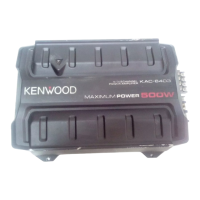
This document serves as an instruction manual for the KENWOOD KAC-728S, KAC-628, KAC-608S, and KAC-428S power amplifiers. It provides essential information regarding the device's function, usage, and maintenance to ensure optimal performance and longevity.

Function Description

The KENWOOD power amplifiers are designed to amplify audio signals, delivering enhanced sound output to speakers in a vehicle. These units are equipped with a protection function to safeguard both the amplifier and connected speakers from various electrical issues and accidents. When this protection function is activated, the Power indicator will turn off, and the amplifier will cease operation.

The protection function can be triggered by several situations:

  • Speaker wire short-circuit: If a speaker wire is short-circuited, the protection function will activate to prevent damage.
  • Speaker output contact with ground: Should a speaker output come into contact with the vehicle's ground, the amplifier will shut down.
  • Unit malfunction with DC signal output: In the event of an internal malfunction causing a DC signal to be sent to the speaker output, the protection function will engage.
  • Overheating: If the internal temperature of the amplifier exceeds 120°C (248°F), the unit will enter protection mode to prevent thermal damage.
  • Improper grounding: If the ground wire of the center unit (cassette receiver, CD receiver, etc.) or the amplifier itself is not properly connected to a metal part of the car chassis that serves as an electrical ground to the battery's negative terminal, the protection function may activate.

The amplifiers feature a FILTER switch that allows for filtering of the speaker output signals. For KAC-728S/608S/428S models, options include OFF (no filtering) and LPF (Low Pass Filter), which outputs frequencies of 80 Hz or lower, cutting frequencies above 80 Hz. For the KAC-628 model, additional options include HPF (High Pass Filter), which outputs frequencies of 150 Hz or higher, cutting frequencies below 150 Hz. The Lch and Rch signals are mixed before output when LPF is selected, regardless of the operation switch setting.

An OPERATION switch is also provided to select the amplification method for input signals. For KAC-728S/608S/428S models, options are STEREO (for stereo amplification) and MONO (Lch) (amplifies only the left input signal, suitable for high-power monaural bridged connections). The KAC-628 model includes STEREO, MONO (Lch), and L+R, where L+R combines left and right input signals before amplification, ideal for subwoofer or monaural sound applications.

The INPUT SENSITIVITY control allows users to adjust the amplifier's input sensitivity to match the pre-output level of the connected center unit or the maximum power output of the car stereo. This ensures proper signal matching and prevents distortion.

The amplifiers support both stereo and bridged connections for speakers. For stereo connections, speakers should have an impedance of 2Ω or greater per channel. For bridged connections, which provide high-output monaural amplification, speakers should have an impedance of 4Ω or greater. When connecting multiple speakers, it is crucial to calculate the combined impedance to ensure it meets these requirements.

Usage Features

Installation Procedure:

  1. Safety First: Before starting, remove the ignition key and disconnect the negative terminal of the battery to prevent short circuits.
  2. Unit Placement: Position the amplifier according to the intended usage.
  3. Cable Connections: Connect the input and output cables of the units.
  4. Speaker Wiring: Connect the speaker wires.
  5. Power Connections: Connect the power wire, power control wire, and grounding wire in this specific order.
  6. Mounting: Install the unit securely in the car.
  7. Final Connection: Reconnect the negative terminal of the battery.

Important Installation Precautions:

  • Always turn off the power before changing any switch settings.
  • If a fuse blows, check for shorts in the wiring before replacing it with a new fuse of the same rating.
  • Ensure no unconnected wires or connectors touch the car body to prevent short circuits.
  • Connect speaker wires to appropriate, separate speaker connectors. Sharing a negative speaker wire or grounding speaker wires to the car body can cause unit failure.
  • After installation, verify that all electrical equipment, such as brake lamps, turn signals, and wipers, function correctly.
  • Do not install the unit under carpets, as this can lead to heat build-up and damage.
  • Install the unit in a location that allows for easy heat dissipation, and avoid placing any objects on top of it.
  • The amplifier's surface can become hot during use, so install it away from people, resins, and other heat-sensitive substances.
  • When drilling holes, check for hazardous components like gasoline tanks, brake pipes, or wiring harnesses on the opposite side.
  • Avoid installing near the dashboard, rear tray, or airbag safety parts.
  • Securely fasten the unit to prevent it from dislodging during shocks, which could cause injury or accidents.

Wiring Guidelines:

  • If buzzing noise is heard from speakers when the engine is running, consider connecting an optional line noise filter to each battery wire.
  • Use grommets to prevent cords from directly contacting sharp edges of iron plates.
  • Connect the ground wire to a metal part of the car chassis that serves as an electrical ground to the battery's negative terminal. Do not power on the unit if the ground wire is not connected.
  • Attach a protective fuse to the battery wire close to the battery. The fuse capacity should be about 10A higher than the maximum current drawn by the amplifier.
  • Use vehicle-type (fire-resistant) power supply wiring for the battery and ground wires. The current capacity should be about 10A higher than the protective fuse capacity (approximately 20A higher than the maximum current drawn by the amplifier).
  • If using multiple power amplifiers, use a power supply wiring wire and protective fuse with greater current-handling capacity than the total maximum current drawn by all amplifiers.

Speaker Selection:

  • The rated input power of connected speakers must be greater than the amplifier's maximum output power (in Watts) to prevent smoke emission and damage.
  • For stereo connections, speaker impedance should be 2Ω or greater. For bridged connections, it should be 4Ω or greater. When using multiple speakers, calculate the combined impedance.

Tri-mode System: The manual describes a tri-mode system that uses a coil and capacitor for frequency band division (6dB/oct. slope).

  • Coil (L): Acts as a low-pass filter, passing low frequencies and blocking high frequencies.
  • Capacitor (C): Acts as a high-pass filter, passing high frequencies and blocking low frequencies.
  • When bridge-connecting a speaker, ensure its impedance is no less than 4 ohms to prevent damage.
  • Connect capacitors to speakers receiving high frequencies to avoid a drop in combined impedance with the subwoofer.
  • Verify that the withstand voltage and current ratings of capacitors and coils are sufficient.

Maintenance Features

Cleaning the Unit:

  • If the front panel becomes dirty, turn off the power and wipe it with a dry silicon cloth or a soft cloth.
  • Caution: Do not use hard cloths or cloths dampened with volatile solvents like paint thinner or alcohol, as these can scratch the panel surface or cause indicator letters to peel off.

Troubleshooting Guide: The manual provides a troubleshooting guide for common issues:

  • No sound (or sound from one side):
    • Possible Cause: Disconnected input/output cables, activated protection circuit, or blown fuse due to high volume.
    • Solution: Reconnect cables, check protection function status, or replace the fuse with a new one and use a lower volume.
  • Output level too small (or too large):
    • Possible Cause: Input sensitivity adjusting control not set correctly.
    • Solution: Adjust the control referring to the "Controls" section.
  • Bad sound quality (distorted sound):
    • Possible Cause: Incorrect speaker wire polarity (+/-), speaker wire pinched by a screw, or improperly set switches.
    • Solution: Connect wires with correct polarity, ensure speaker wire is not pinched, and set switches properly referring to "System examples."

This comprehensive guide ensures users can effectively install, operate, and maintain their KENWOOD power amplifiers for a superior audio experience.

Kenwood KAC-608S Specifications

General IconGeneral
BrandKenwood
ModelKAC-608S
CategoryAmplifier
LanguageEnglish

Related product manuals