11
6. Recommended Locations For Smoke And Carbon
Monoxide Alarms
• Locate smoke alarms in all sleeping areas. Try to monitor the exit path as the bedrooms are usually
farthest from the exit. If more than one sleeping area exists, locate additional alarms in each
sleeping area.
• Locate additional alarms in stairways, because stairways act like chimneys for smoke and heat.
• Locate at least one alarm on every floor level.
• Locate an alarm in every bedroom.
• Locate an alarm in every room where electrical appliances are operated (i.e. portable heaters or
humidifiers).
• Locate an alarm in every room where someone sleeps with the door closed. The closed door may
prevent an alarm not located in that room from waking the sleeper.
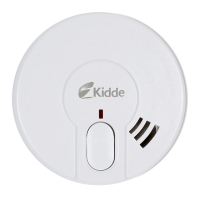
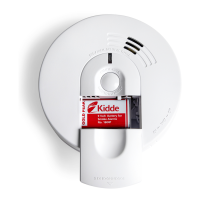
• Smoke, heat, and combustion products rise to the ceiling and spread horizontally. Mounting the
smoke alarm on the ceiling in the center of the room places it closest to all points in the room.
Ceiling mounting is preferred in ordinary residential construction.
• For all alarm locations, be sure to choose a flat, solid surface for mounting, with no holes or gaps
under the mounting bracket.
• For mobile home installation, select locations carefully to avoid thermal barriers that may form at
the ceiling. For more details, see MOBILE HOME INSTALLATION section.
• When mounting the alarm on the wall, use an inside wall with the top edge of the alarm at a
maximum of 12” (30.5 cm) below the ceiling.
• Put smoke alarms at both ends of a bedroom hallway or large room if the hallway or room is more
than 30ft (9.1 m) long.
• Install Smoke Alarms on sloped, peaked or cathedral ceilings at or within 3ft (0.9m) of the highest
point (measured horizontally).
• Industry experts recommend a CO alarm be installed on each level of the home -- ideally on any
level with fuel burning appliances and outside of sleeping areas.
This equipment should be installed in accordance with the National Fire Protection Association’s 72
(National Fire Protection Association, Batterymarch Park, Quincy, MA 02269).
Mobile Home Installation
Modern mobile homes have been designed and built to be energy efficient. Install smoke alarms
as recommended above. In older mobile homes that are not well insulated compared to present
standards, extreme heat or cold can be transferred from the outside to the inside through poorly
insulated walls and roof. This may create a thermal barrier which can prevent the smoke from reaching
an alarm mounted on the ceiling. In such units, install the smoke alarm on an inside wall with the top
edge of the alarm a maximum of 12” (30.5 cm) below the ceiling.


 To Next Page