Onboard Diagnostics
DIAGNOSTIC TROUBLE CODES (DTCs)
The Basic Engine Computer Control System
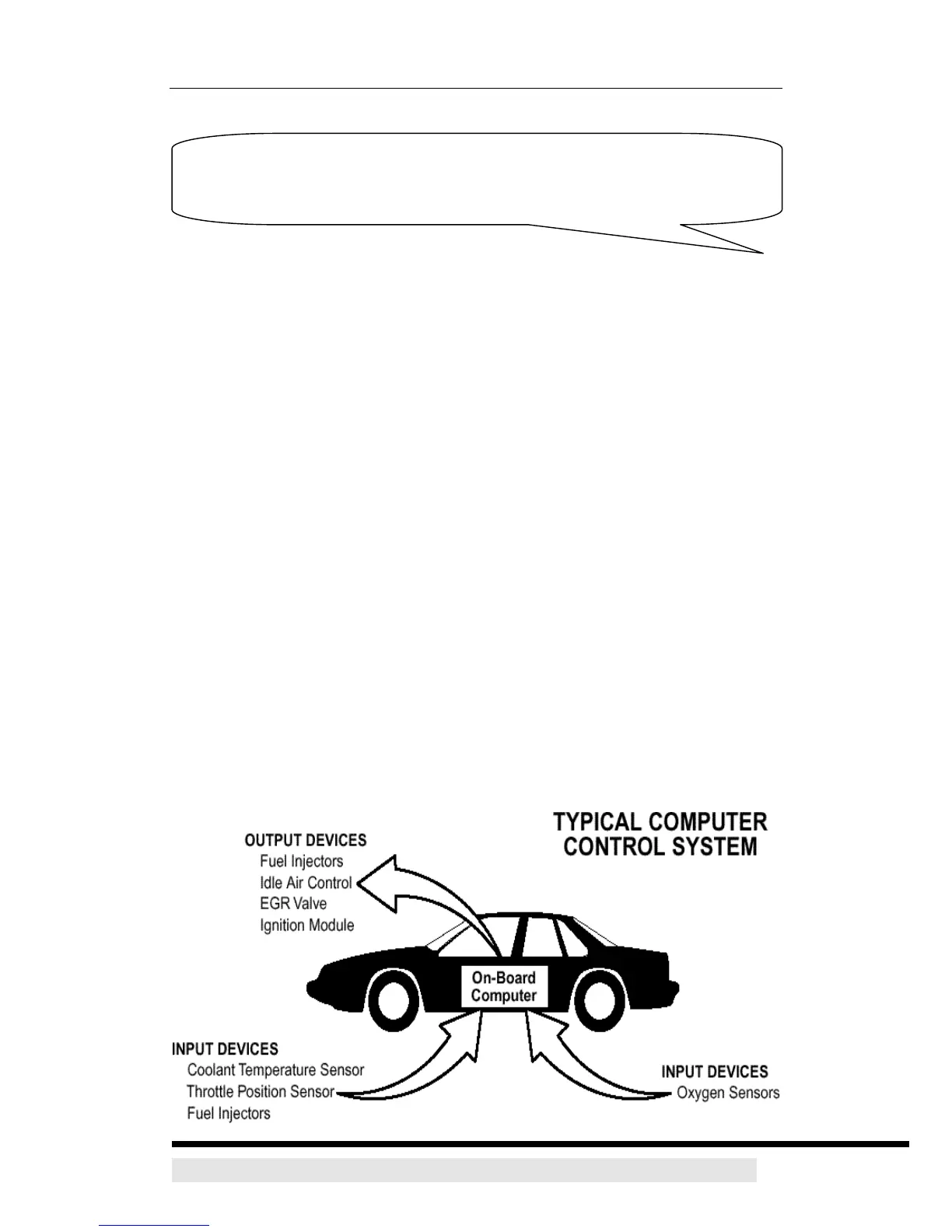
The Computer Control System consists of an on-board computer
and several related control devices (sensors, switches, and
actuators).
The on-board computer is the heart of the Computer Control System. The
computer contains several programs with preset reference values for air/fuel
ratio, spark or ignition timing, injector pulse width, engine speed, etc. Separate
values are provided for various driving conditions, such as idle, low speed
driving, high-speed driving, low load, or high load. The preset reference values
represent the ideal air/fuel mixture, spark timing, transmission gear selection,
etc., for any driving condition. These values are programmed by the vehicle
manufacturer, and are specific to each vehicle model.
Most on-board computers are located inside the vehicle behind the dashboard,
under the passenger’s or driver’s seat, or behind the right kick panel. However,
some manufacturers may still position it in the engine compartment.
Vehicle sensors, switches, and actuators are located throughout the engine,
and are connected by electrical wiring to the on-board computer. These
devices include oxygen sensors, coolant temperature sensors, throttle position
sensors, fuel injectors, etc. Sensors and switches are input devices. They
provide signals representing current engine operating conditions to the
computer. Actuators are output devices. They perform actions in response to
commands received from the computer.
The on-board computer receives information inputs from sensors and switches
located throughout the engine. These devices monitor critical engine
conditions such as coolant temperature, engine speed, engine load, throttle
position, air/fuel ratio etc.
D900 CanScan 13


 To Next Page