TemperatureChange
Theoventemperaturecanbechangedwhentheoven(s)arein
theSabbathMode.Notoneswillsound,andthedisplaywillnot
change.Theheatingelementswillnotturnonoroffforarandom
time,anywherefrom16to24seconds.Itmaytakeuptoone-half
hourfortheoventochangetemperature.
Numberkeys1through0representtemperatures.
Usethefollowingchartasaguide.
NUMBER KEY OVEN TEMPERATURE
1 170°F (76°C)
2 200°F (93°C)
3 225°F (107°C)
4 250°F (121 °C)
5 300°F (148°C)
6 325°F (162°C)
7 350°F (176°C)
8 375°F (190°C)
9 400°F (204°C)
0 450°F (232°C)
To Change Temperature:
Initially on double ovens, the cavities can be set for independent
temperatures. However, once Sabbath Mode is running, if the
temperature is changed both cavities will use the new
temperature.
1. Touch the number key from the chart.
2. Touch START.
OVEN USE
Odors and smoke are normal when the oven is used the first few
times, or when it is heavily soiled.
During oven use, the heating elements will not remain on, but will
cycle on and off throughout oven operation.
IMPORTANT: The health of some birds is extremely sensitive to
the fumes given off. Exposure to the fumes may result in death to
certain birds. Always move birds to another closed and well-
ventilated room.
IMPORTANT: To avoid permanent damage to the oven bottom
finish, do not line the oven bottom with any type of foil or liner.
• For best cooking results, do not cover entire rack with foil
because air must be able to move freely.
• To catch spills, place foil on rack below dish. Make sure foil is
at least 1/2"(1.3 cm) larger than the dish and that it is turned
up at the edges.
IMPORTANT: To avoid permanent damage to the porcelain
finish, do not place food or bakeware directly on the oven door or
bottom.
RACKS
• Position racks before turning on the oven.
• Do not position racks with bakeware on them.
• Make sure racks are level.
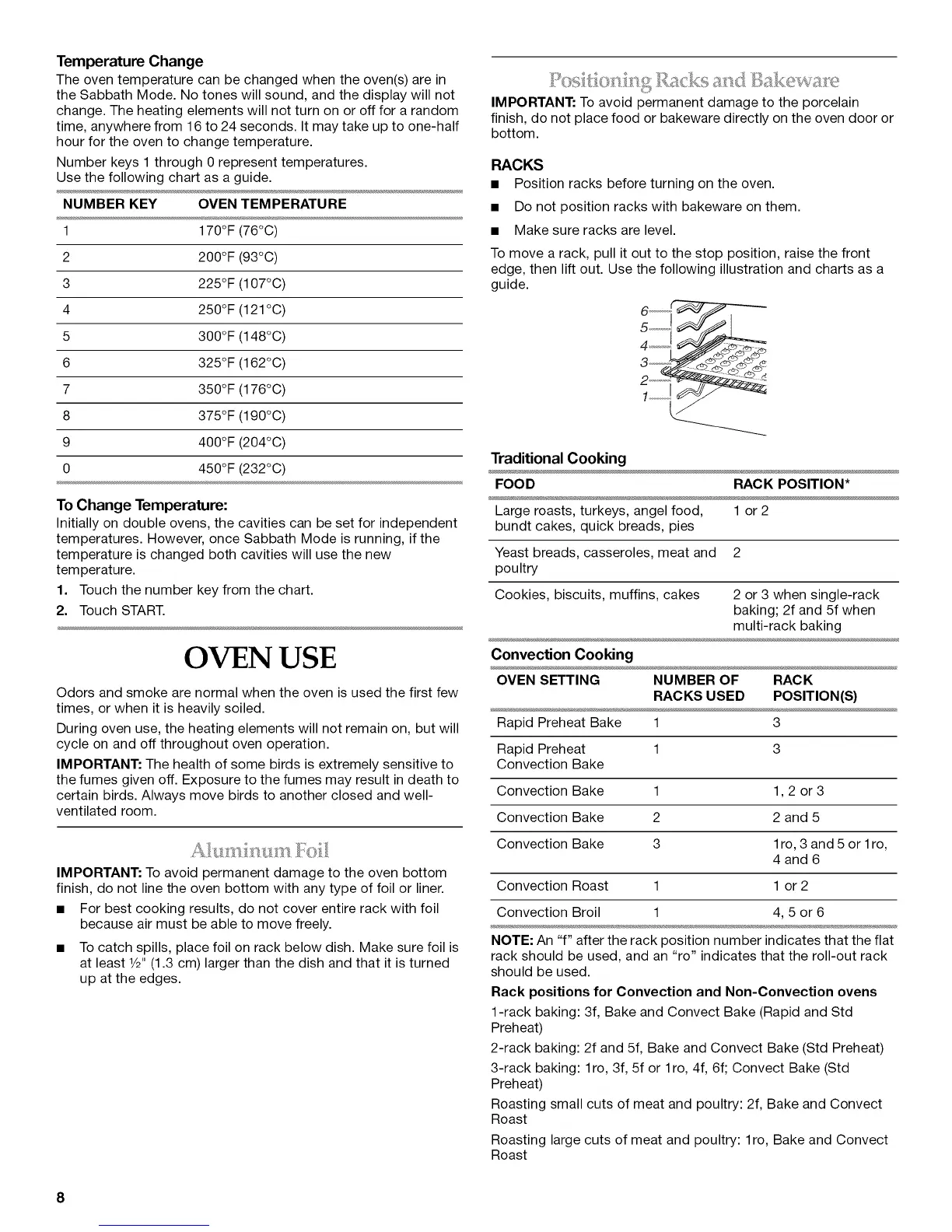
To move a rack, pull it out to the stop position, raise the front
edge, then lift out. Use the following illustration and charts as a
guide.
Traditional Cooking
FOOD RACK POSITION*
Large roasts, turkeys, angel food, 1 or 2
bundt cakes, quick breads, pies
Yeast breads, casseroles, meat and 2
poultry
Cookies, biscuits, muffins, cakes 2 or 3 when single-rack
baking; 2f and 5f when
multi-rack baking
Convection Cooking
OVEN SETTING NUMBER OF RACK
RACKS USED POSITION(S)
Rapid Preheat Bake 1 3
Rapid Preheat 1 3
Convection Bake
Convection Bake 1 1,2 or 3
Convection Bake 2 2 and 5
Convection Bake 3 1ro, 3 and 5 or 1ro,
4 and 6
Convection Roast 1 1 or 2
Convection Broil 1 4, 5 or 6
NOTE: An "f" after the rack position number indicates that the flat
rack should be used, and an "ro" indicates that the roll-out rack
should be used.
Rack positions for Convection and Non-Convection ovens
1-rack baking: 3f, Bake and Convect Bake (Rapid and Std
Preheat)
2-rack baking: 2f and 5f, Bake and Convect Bake (Std Preheat)
3-rack baking: 1ro, 3f, 5f or 1ro, 4f, 6f; Convect Bake (Std
Preheat)
Roasting small cuts of meat and poultry: 2f, Bake and Convect
Roast
Roasting large cuts of meat and poultry: lro, Bake and Convect
Roast
8






 To Next Page