This document is a Maintenance Manual for the Frydenbö RV-2 and RV-3 Steering Gear, manufactured by Kongsberg Maritime. It provides comprehensive information for the operation, maintenance, and troubleshooting of these steering gear systems.
Function Description:
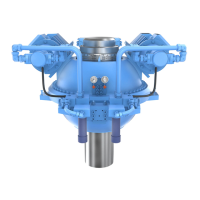
The Frydenbö RV Steering Gear is a critical component for vessel navigation, responsible for controlling the rudder. The main components include the actuator and the power pack. The actuator features a rotor with vanes that respond to oil pressure, generating turning torque. This movement is mechanically limited by stoppers within the housing, which also serve as hard-over rudder stoppers. Electrical limit switches further restrict turning movement at predetermined angles. The rudder carrier bearing, lubricated by system oil, supports the full weight of the rudder, rudderstock, and rotor, eliminating the need for a separate bearing. A synthetic oil-resistant sealing system prevents internal and external oil leakage.
The Power Pack comprises two pump units, which can operate independently or simultaneously. Typically, one pump unit is active while the other serves as a standby. Running both units concurrently doubles the turning rate, useful when rapid steering is required. Pump units are usually controlled remotely, but manual operation from the Steering Gear room is possible for emergencies, though installations may vary.
Important Technical Specifications:
The manual provides approximate weights for the actuator cover and rotor for various RV Steering Gear models, ranging from RV450-2 to RV4200-2. For instance, an RV450-2 has a cover weight of 1000 kg and a rotor weight of 2000 kg, while an RV4200-2 has a cover weight of 3180 kg and a rotor weight of 7425 kg.
System oil volumes are also detailed for different RV Steering Gear series and Power Pack configurations. For RV 450-series, oil volumes range from approximately 130 to 170 liters. For RV 700-series, volumes are between 210 and 470 liters. RV 1100-series require 340 to 700 liters, RV 2050-series use 640 to 880 liters, and RV 3050-series require 760 to 1050 liters. Power Pack oil volumes vary based on the pump size (2" or 3" vane) and configuration (Small, Large), ranging from 2x 300 liters to 2x 1400 liters + 2850 liters.
Tightening torques for bolts are specified based on dimension (Dim) and quality (Qual), assuming a friction coefficient of μ = 0.15 for normally oiled threads. For example, an M10 bolt with 8.8 quality requires 50 Nm, while an M42 bolt with 12.9 quality requires 3700 Nm when using Molykote G Rapid+ for actuator stay bolts.
Usage Features:
The steering gear system is designed for continuous safe operation. The manual emphasizes the importance of regular maintenance to prevent unexpected stops and ensure optimal performance. The system includes an alarm system with various alerts such as overload, phase failure, power failure, low oil level, hydraulic lock, clogged filter, high oil temperature, low oil pressure, and power failure for auxiliary steering. These alarms aid in identifying and addressing issues promptly.
Maintenance Features:
The manual outlines a comprehensive maintenance schedule, including docking-related service and routine tasks.
Docking-related service and maintenance tasks:
- 5-year interval: Open rudder actuator for inspection, measure clearances, replace accessible internal seals and upper gland seals. For the Power Pack, replace the filter, flexible coupling, tank cover gasket, and perform pump overhaul. A self-assessment is recommended to identify additional needs.
- 10-year interval: In addition to 5-year tasks, secure the rudderstock, remove the rotor, replace all internal seals, bearings, upper and lower gland seals, and pressure valves.
- 15-year interval: Similar to 5-year tasks, with inspection and measurement of clearances, replacement of internal and gland seals, and Power Pack maintenance.
- 20-year interval: Similar to 10-year tasks, with rudder actuator and rotor removal, replacement of seals, bearings, and pressure valves.
- 25-year interval: Similar to 5-year tasks, with inspection and measurement of clearances, replacement of internal and gland seals, and Power Pack maintenance.
Routine Maintenance tasks:
These tasks are categorized by system (Steering Gear, Power Pack, Controls, EI system) and sub-system, with specified maintenance activities, frequency, type, skill level, and facility required. Examples include:
- Actuator: Check for leakage (daily), check surface temperature (daily), check for abnormal vibrations/noises (daily), check stuffing box (weekly), check oil level (weekly), check steering gear room and surroundings (monthly), measure turning time (monthly), check paintwork (monthly).
- Power Pack: Replace filters (monthly), flexible coupling (yearly), pump overhaul (5 years), O-ring return pipe and bend (5 years), tank cover gasket (5 years), hydraulic hose cooler (5 years).
- Controls: Inspect control panels (monthly), check filter indicator (monthly), sample oil (6 months), clean coolers (6 months), FB40 feedback inspection (yearly), stuffing box (yearly), function test of alarm system (yearly), adjustment of rudder angle indicator system (yearly), adjustment of limit switches (yearly), adjustment of amplifier card (yearly), adjustment of FU-controller (yearly), replacement of alarm system card (5 years).
- EI system: Replace vibration dampers (5 years).
Maintenance Instructions:
Detailed instructions are provided for various procedures:
- Oil Sampling: Steps to take oil samples from the return filter for analysis, ensuring proper flushing and labeling.
- Venting: Procedure for evacuating air from the hydraulic system, involving opening venting plugs and manually moving the rudder.
- Filling and Refilling of Oil: Guidelines for filling hydraulic oil, emphasizing cleanliness standards (ISO 4406-1999 20/18/15) and the use of a 10μm filter if cleanliness cannot be verified.
- Maneuvering Time Test: A procedure to time rudder movement from 30° to 35° on opposite sides to assess internal seal condition.
- Replacement of Gland Seals: Instructions for replacing upper and lower gland seals, including lubrication recommendations and the correct insertion of seals.
- Replacement of Filter Element: Steps for replacing filter elements, with a warning to replace elements when the indicator is in the RED zone.
- Replacement of Flexible Coupling in Pump Unit: Procedure for replacing the flexible coupling between the electric motor and pump unit.
- Adjustment of Haenni Contents Gauge: Detailed steps for calibrating the tank contents gauge, including 0-adjustment and setting the adjusting lever based on tank height and oil density.
- Cleaning of Water/Oil Cooler: Methods to check for clogging (temperature and pressure drop) and cleaning procedures using back flushing or light acids.
- Cleaning of the Air/Oil Cooler: Instructions for cleaning air fins using compressed air or high-pressure washing, with safety warnings regarding hot surfaces, ear defenders, and static electricity.
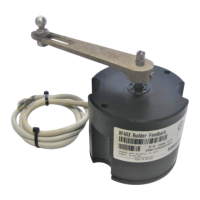
- FB40 Feedback Inspection: A checklist for inspecting various components of the feedback system, including chain tensioners and rudder angle limits.
- Stuffing Box (if KONGSBERG delivery): Description of the Walker seal, its compression element, and lubrication requirements.
- Function Test of Alarm System: Step-by-step guide to test various alarms (overload, phase failure, power failure, low oil level, hydraulic lock, clogged filter, high oil temp, aux alarm) to ensure proper functionality.
- Adjustment of Rudder Angle Indicator System: Procedure for calibrating the rudder angle indicator, including measuring resistance and adjusting the potentiometer.
- Adjustment of Rudder Angle Indicator Amplifier (if KONGSBERG delivery): Steps for zero adjustment and gain adjustment of the amplifier.
- Adjustment of Limit Switches in Feedback Unit: Instructions for adjusting the tripping cams of limit switches to interrupt the steering signal at max electrical rudder angle.
- Adjustment of FU-Controller (if KONGSBERG delivery): Procedure for aligning the rudder position to mid-ship and 30 degrees port/starboard.
- Replacement of Alarm System Card: Steps for replacing the alarm system card, including setting X8 and X9 nodes.
- Replacement of Pump Control Card: Procedure for replacing the pump control card, including verifying jumper positions and adjusting backlight level.
- Replacement of Amplifier Card: Instructions for replacing the amplifier card, with warnings about electrostatic discharges.
- Replacement of Selector Card: Steps for replacing the selector card, including setting jumper settings.
- Replacement of Start Relay: Procedure for replacing the start relay.
- Replacement of Solenoid Driver: Instructions for replacing the solenoid driver.
- Replacement of Limit Switches in Feedback Units: Steps for replacing limit switches, including soldering and adjustment.
- Replacement of Proximity Switch: Procedure for replacing the proximity switch, including adjusting its length.
Spare Parts:
The manual lists recommended on-board spare parts for mechanical/hydraulic components (gland seals kit, cover seal, flexible couplings, filters) and controls (proximity switches, phase failure relay, relay, relay socket, solenoid, solenoid driver, pump ECB). It also provides part numbers for seal kit valves, overhaul kits for valves, and general service items for the Power Pack (filter indicators, O-rings, filter elements). For Leistritz pump overhaul, specific part numbers for pump spare part kits and Loctite are provided, along with an exploded view of the pump cartridge. Instructions for dismounting and refitting the Leistritz pump are also included.
Kongsberg Maritime AS provides support and spares for Deck Machinery and Motion Control, with contact details for general inquiries and 24/7 global customer support. An app, KM-Support App, is also available for direct contact with support teams.

 Need help?
 General



 To Next Page