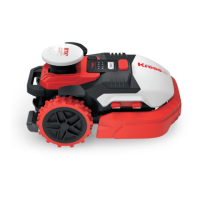
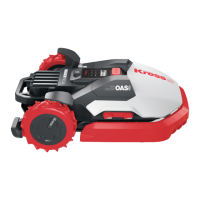
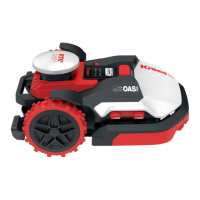
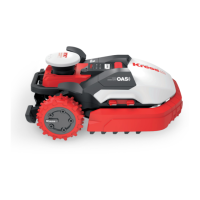
The device is a Kress Mission™ RTKn Robotic Lawnmower, available in models KR172E, KR172E.A, KR173E, and KR174E. It is designed for domestic lawn mowing, intended for frequent use to maintain a healthy and aesthetically pleasing lawn. The lawnmower can be programmed to operate at any time or frequency, depending on the lawn size. It is not designed for digging, sweeping, or snow cleaning.
Function Description:
The Kress Mission™ RTKn Robotic Lawnmower operates autonomously within a defined virtual boundary. It uses an RTK antenna to detect its proximity to this boundary and obstacles, adjusting its direction as needed. The cutting blades are razor-sharp on two edges and rotate in both directions for maximum cutting capacity. The redesigned blade profile helps prevent grass clippings from getting caught. The device includes a rain sensor, allowing it to adapt its operation to weather conditions. It features a display and keypad for user interaction, along with an ON/OFF key and a START key. An ultrasonic sensor is included in models KR172E.A, KR173E, and KR174E for enhanced navigation. The lawnmower is a Class III appliance and must be supplied with safety extra-low voltage. It is equipped with a detachable supply unit for recharging.
Important Technical Specifications:
- Rated Voltage: 20V Max. (Nominal voltage 18V)
- No Load Speed: 2700/min (KR172E, KR172E.A, KR173E) or 2600/min (KR174E)
- Cutting Area: 2000m² (KR172E), 3000m² (KR172E.A, KR173E), 5000m² (KR174E)
- Cutting Diameter: 20cm (KR172E, KR172E.A, KR173E) or 22cm (KR174E)
- Cutting Height: 30-60mm, with 7 positions
- Battery Type: Lithium-ion
- Battery Model: KA3024 (KR172E, KR172E.A, KR173E) or KA3006 (KR174E)
- Charging Time (approx.): 180 min (KR172E, KR172E.A), 90 min (KR173E), 72 min (KR174E)
- Charger Models: KA0200/KA0201 (KR172E, KR172E.A), KA3710/KA3711 (KR173E), KA3719/KA3819 (KR174E)
- Charger Rating:
- KR172E, KR172E.A: Input 100-240V~50/60Hz, 38W; Output 20V, 1.5A
- KR173E: Input 100-240V~50/60Hz, 90W; Output 20V, 3.0A
- KR174E: Input 100-240V~50/60Hz, 190W; Output 28V, 5.0A
- Machinery Weight: 12kg (KR172E), 12.2kg (KR172E.A, KR173E), 12.6kg (KR174E)
- Protection Degree: III
- App Connectivity: Yes
- Maximum Slope within Work Surface: 40%
- Noise Data (A-weighted sound pressure): 47.5 dB(A) for KR172E, KR172E.A, KR173E; 50.3 dB(A) for KR174E.
- Noise Data (A-weighted sound power): 55.5 dB(A) for KR172E, KR172E.A, KR173E; 58.3 dB(A) for KR174E.
- RF Output Power (Max): Ranges from 23dBm to 33dBm depending on the band (GSM900(B8), DCS1800(B3), WCDMA B1/B8, LTE-FDD B1/B3/B7/B8/B20/B28, LTE-TDD B38/B40).
- Operating/Storage Temperature: -40°C~85°C for antenna.
Usage Features:
The lawnmower is designed for safe and easy operation. Users must read the owner's manual carefully and be familiar with the controls. It is crucial to ensure the virtual boundary is correctly established and maintained. Before each work cycle, the machine verifies the boundary's existence. The RTK antenna helps the machine navigate and adjust direction when encountering obstacles or approaching the virtual boundary. The device should never be operated with defective guards or without safety devices. Hands and feet must be kept clear of rotating parts. The disabling device (STOP button) should be activated before clearing blockages, inspecting, cleaning, or working on the appliance, or after striking a foreign object. The lawnmower can be started by entering a four-digit PIN code. It can be charged manually by docking it into the charging base. For public areas, warning signs must be placed around the working area.
Maintenance Features:
Regular maintenance is essential for the longevity and performance of the Mission™ RTKn.
- Blade Replacement: Blades should typically be reversed monthly and replaced weekly, though frequency can be adjusted based on cutting quality. All blades and screws should be replaced simultaneously to maintain balance. Protective gloves must be worn. For dual-layer blades (if applicable), a specific procedure involving hex key and screwdriver is outlined. After replacement, ensure blades spin freely.
- Cleaning: The lawnmower should be cleaned regularly. Power must be off, and protective gloves worn. The machine body can be cleaned with a soft brush or moist rag, avoiding solvents or polishes. Hose water cleaning is supported, but high-pressure washers should NOT be used to prevent damage to electronic and mechanical parts. The underside, including the blade disc, chassis, front wheel, and driving wheels, should be cleaned thoroughly. Any stuck debris on the blade disc must be removed to prevent cracks. Contact pins on the charging base and charging strips on the lawnmower should be cleaned periodically to ensure proper charging.
- Battery Maintenance: The 20V Li-Ion battery should be fully charged and stored in a cool, dry place (-20°C~+60°C). The battery's lifespan depends on mowing season length, daily operating hours, and storage maintenance. For winter hibernation, the lawnmower should be thoroughly cleaned, fully charged, and powered off. It should be stored indoors, never upside down outdoors, to protect the underside from water. Before restarting after hibernation, charging strips and contact pins should be cleaned.
- Battery Replacement: A detailed procedure for replacing the battery is provided, which involves turning the mower upside down, removing the battery cover and screws, disconnecting connectors, and carefully lifting out the battery. New batteries should be of the same type.
- Troubleshooting: A comprehensive troubleshooting guide is included to address common issues such as the charging base LED not turning on, docking problems, power depletion, boundary overruns, positioning signal issues, and sensor abnormalities. If problems persist, contact the dealer.

 Need help?
 General

 To Next Page