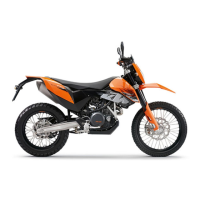
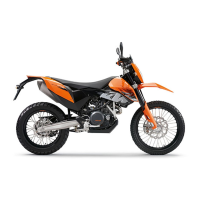
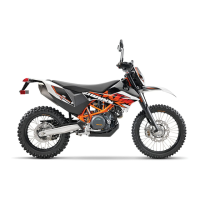
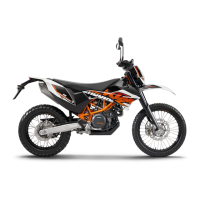
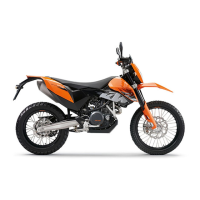
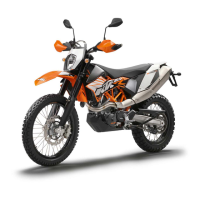
This document is the OWNER'S MANUAL 2008 for the KTM 690 ENDURO USA motorcycle, with article number 3211303en.
The KTM 690 ENDURO USA is a state-of-the-art sports motorcycle designed and constructed for normal demands of regular road and light off-road operation (dirt roads), but not for race courses. It is authorized for public road traffic in its homologous version.
Important Notes:
The manual emphasizes the importance of proper maintenance for perfect operation and prevention of wear. Using the motorcycle in extreme conditions may require more frequent servicing. Adherence to the running-in period, inspection, and maintenance intervals is crucial for a longer service life. Warranty claims are only valid if maintenance work is carried out by an authorized KTM workshop and confirmed in the service record. Only KTM-approved spare parts and accessories should be used.
The manual includes various warning labels and notes regarding safety:
- Danger of accidents: From insufficient traffic competence, missing/inadequate protective clothing, different tire tread patterns on front and rear wheels, non-approved tires/wheels, reduced road grip with new tires, brake system failure (e.g., foot brake pedal not released), unstable riding behavior due to excessive weight or incorrect baggage mounting, changed handling characteristics with excessive payload, delayed brake action on salted roads, and riding after a fall.
- Risk of injury: From missing/inadequate protective clothing, battery acid and gases, and passengers not sitting correctly.
- Danger of poisoning: From exhaust gases and fuel.
- Fire hazard: From hot components (engine, radiator, exhaust system) and flammable/explosive substances.
- Environmental hazard: From improper handling of fuel, oil, grease, filters, cleaning substances, brake fluid, and batteries.
- Material damage: From high engine speeds in cold engines, unfiltered intake air, high-pressure cleaning equipment, and excessive load on the side stand.
Location of Serial Numbers:
- Chassis number: Stamped on the right side of the steering head.
- Type label: Located on the upper right frame tube below the seat.
- Key number: Found on the KEYCODECARD, essential for ordering a spare key.
- Engine number: Stamped on the left side of the engine under the engine sprocket.
- Fork part number: Stamped on the inner side of the fork stub.
- Shock absorber part number: Visible from the right side.
Operating Elements:
- Clutch lever: Left side of the handlebar, hydraulically operated and self-adjusting.
- Hand brake lever: Right side of the handlebar, operates the front brake.
- Light switch: Left side of the handlebar, with positions for low beam and high beam.
- Headlight flasher switch: Left side of the handlebar, for actuating the high beam flasher.
- Flasher switch: Left side of the handlebar, for left and right turn signals, returns automatically to central position.
- Horn button: Left side of the handlebar.
- Emergency OFF switch: Left side of the handlebar, interrupts ignition circuit.
- Electric starter button: Right side of the handlebar.
- Ignition/steering lock: In front of the seat, with positions for OFF, ON, and LOCK.
- Combination instrument: Attached to the handlebar, featuring function buttons, tachometer, indicator lights, and a display.
- Display modes: Total distance (ODO), tripmaster 1 (TRIP 1), tripmaster 2 (TRIP 2), and TRIP F (fuel reserve).
- Speed display: In km/h or Mph, adjustable.
- Time display: Adjustable.
- Coolant temperature indicator: 12 bars, indicating engine temperature (cold, normal, hot).
- Filler cap: For fuel tank, with a tank air vent system.
- Handrails: For moving the motorcycle and for passenger support.
- Seat release: Using a strap.
- Passenger footrests: Foldable.
- Shift lever: Left side of the engine, with 6 gears and neutral between 1st and 2nd.
- Foot brake pedal: In front of the right footrest, operates the rear brake.
- Side stand: Coupled with the safety electric starter system.
General Tips and Hints on Putting into Operation:
- First use: Ensure pre-delivery inspection is done, read instructions, get to know elements, adjust clutch/brake pedals, practice slow riding, avoid over-stressing off-road, hold handlebar firmly, use only KTM-approved parts, and run in the engine.
- Running in the engine: Max engine speed 6,000 rpm for first 1,000 km, then 7,800 rpm. Avoid fully opening the throttle.
- Loading the vehicle: Do not exceed max permitted weight/axle loads, secure luggage properly, adapt speed to payload (max 130 km/h with baggage).
Riding Instructions:
- Checks before operation: Engine oil level, engine for oil loss, fuel level, bleed fork legs, chain tension, chain cleanliness, tire condition, tire air pressure, brake fluid levels, brake linings, brake system function, coolant level, operating element adjustment, electrical equipment function, baggage security, and rear mirror setting.
- Starting: Ensure sufficient ventilation, do not operate with discharged battery, warm up engine at low speeds, turn on emergency OFF switch, switch on ignition (fuel pump works for 2s, function test runs), shift to neutral (N light on), press electric starter button (max 5s, wait 5s before retry), do not open throttle when starting. Motorcycle can only start in neutral or with clutch lever pulled.
- Shifting, riding: Avoid abrupt load alterations/braking, do not downshift at high engine speed, do not change ignition key position during journey, make adjustments at standstill, passenger must sit correctly and hold on, observe traffic regulations, ride defensively, be aware of reduced road grip with cold/new tires, check vehicle after a fall, never ride without an air filter.
- Braking: Adapt to traffic/road conditions, clean wet/dirty brakes gently, check brake system if pressure point is spongy, take longer stopping distance with passenger/baggage, clean brake discs on salted roads, release throttle and operate both brakes simultaneously, use rear brake on slippery surfaces, complete braking before bends, use engine braking on long downhill stretches.
- Stopping, parking: Never leave engine running, secure vehicle against unauthorized use, switch off ignition, park on hard surface, swing side stand forward.
Maintenance Work on Chassis and Engine:
- Jacking up/removing motorcycle from work stand: Use underride guard, secure against falling.
- Fork/shock absorber: Adjust compression/rebound damping (settings provided for comfort, standard, sport, full payload).
- Bleeding fork legs: Lean motorcycle on side stand, remove bleeder screws briefly.
- Cleaning dust boots of fork legs: Jack up motorcycle, loosen fork protection, push dust boots down, clean and oil.
- Positioning fork protection: Mount and tighten screws.
- Checking/adjusting steering head bearing play: Jack up motorcycle, move handlebar to check play, adjust if necessary.
- Adjusting handlebar angle/position: Loosen screws, move handlebar to desired position, tighten.
- Checking/cleaning/adjusting chain: Check for dirt/wear/tension, clean regularly, adjust tension using adjusting screws.
- Checking brake discs: Check thickness against wear limits.
- Checking/adjusting free play of hand brake lever: Check free play, adjust with adjustment screw.
- Checking/adding brake fluid for front brake: Check level in reservoir, add DOT 4 / DOT 5.1 fluid if low.
- Checking/changing front brake linings: Check for minimum thickness, replace if worn.
- Checking/adjusting basic position of foot brake pedal: Check free play, adjust if necessary.
- Checking/topping up brake fluid of rear brake: Check level in reservoir, top up with DOT 4 / DOT 5.1 fluid if low.
- Checking/changing rear brake linings: Check for minimum thickness, replace if worn.
- Removing/fitting front/rear wheel: Jack up motorcycle, press brake caliper to retract pistons, remove/insert wheel spindle, remove/fit spacing sleeves.
- Checking rear hub rubber dampers: Check for damage/wear, measure play.
- Tire condition checking: Check for cuts/penetrations/damage, replace if necessary.
- Checking tire air pressure: Check when cold (off-road, road solo, passenger/fully loaded pressures provided).
- Checking spoke tension: Tap spokes with screwdriver, listen for high note.
- Removing/mounting the seat.
- Removing/installing/recharging the battery: Observe safety precautions for battery acid/gases, charge regularly if not in use.
- Changing main fuse/fuses of individual power consumers: Switch off power, remove defective fuse, fit new one.
- Adjusting engine characteristic: Use Map-Select switch (Soft, Advanced, Standard, Poor Fuel Quality settings).
- Removing/refitting headlight mask with headlight: Disconnect connectors, remove screws.
- Changing headlight bulb/parking light bulb/flasher bulb: Remove mask, access bulbs, replace.
- Checking/adjusting headlamp setting: Check light boundary on a wall, adjust range with screwdriver.
- Removing/installing air filter: Remove seat, remove filter box top, remove/mount filter.
- Cooling system: Water pump forces coolant, radiator cap regulates pressure, compensating tank for excess coolant.
- Checking antifreeze/coolant level: Check when engine is cold, ensure level is within range, correct antifreeze if needed.
- Draining/filling cooling system: Drain completely, refill with specified coolant.
- Adjusting basic position of clutch lever: Adjust with screw.
- Checking/correcting fluid level of hydraulic clutch: Check level, correct if needed.
- Checking/adjusting play in gas Bowden cable: Check play, adjust with lock nut and adjusting screw.
- Removing/installing engine guard.
- Checking engine oil level: Check when engine is at operating temperature, level must be between lower and upper edge of viewer.
- Changing engine oil and oil filter, cleaning oil screens: Drain oil, remove filter, clean screens, mount filter, fill with new oil.
- Topping up engine oil.
Troubleshooting:
Provides a table of faults, possible causes, and actions for various issues including engine not starting, engine turning but not starting, engine having too little power, engine overheating, FI warning lamp (MIL) lights/flashes, engine dying during journey, high oil consumption, headlight/parking light/flasher light/brake light/horn not functioning, battery discharged, combination instrument not showing anything, and speedometer not functioning.
Flashing Code:
A detailed table listing fault codes (e.g., 02, 06, 08, etc.), their descriptions (FI warning lamp flashes pattern), possible causes (e.g., malfunction in ignition pulse generator circuit, input signal from throttle valve sensor too low/high), and recommended actions (e.g., check ignition pulse generator, check throttle valve sensor).
Cleaning:
- Motorcycle cleaning: Avoid high-pressure cleaning, remove coarse dirt with water spray, use motorcycle cleaner, dry with compressed air.
- Post-cleaning: Ride to warm up engine and evaporate water, oil/grease moving parts, clean chain, treat bare metal parts with anti-corrosion materials, treat painted parts with polish, treat electrical contacts with contact spray, oil ignition/steering lock.
Conservation for Winter Operation:
- Clean motorcycle, treat engine/swingarm/bare parts with wax-based anti-corrosion substance, clean chain.
Storage:
- Empty fuel tank, clean motorcycle, change engine oil/filter, clean oil screens, check antifreeze/coolant, check tire pressure, remove/recharge battery, store in dry place without large temperature differences. KTM recommends jacking up the motorcycle.
- Putting into operation after storage: Remove from stand, recharge/install battery, set clock, fill fuel, perform pre-operation checks, test ride.
Technical Data:
- Engine: 1-cylinder 4-stroke, water-cooled, 654 cm³ displacement, 80 mm stroke, 102 mm bore, 11.8:1 compression, OHC control, 40 mm intake valve, 34 mm exhaust valve, 0.07-0.13 mm valve play (cold), 2 roller crankshaft bearings, needle conrod bearing, bronze piston pin bearing, forged light alloy pistons, 1 L-ring/1 tapered compression/1 oil scraper piston rings, pressure circulation lubrication with 2 rotor pumps, 36:79 primary transmission, APTC antihopping clutch, 6-speed claw-shifted gearbox (ratios provided), electronic fuel injection, contactless controlled fully electronic ignition, 12 V/224 W generator, NGK LKAR 8AI-9 spark plug (0.9 mm gap), water cooling, electric starter with automatic decompressor.
- Capacity - engine oil: 1.70 l (1.8 qt.) of SAE 10W/60 engine oil.
- Capacity - coolant: 1.20 l (1.27 qt.) of coolant.
- Engine Tightening Torques: Detailed list of screws and nuts with their sizes, tightening torques (Nm and lbf ft), and Loctite recommendations.
- Chassis: Lattice frame (chrome molybdenum steel tubing, powder-coated), WP 4860 MXMA fork, WP Suspension 4618 with Pro-Lever deflector shock absorber.
- Suspension travel: 250 mm front/rear.
- Brake system: Disc brake with dual-piston caliper (front), single-piston caliper (rear), floating.
- Brake disc diameter: 300 mm front, 240 mm rear.
- Wear limit of brake discs: 4.5 mm front, 3.5 mm rear.
- Tire air pressure: Road solo (1.8 bar front/rear), passenger/fully loaded (2.0 bar front, 2.2 bar rear), off-road single rider (1.5 bar front/rear).
- Rear wheel gearing: 15:45.
- Chain: 5/8 x 1/4” X-ring.
- Steering head angle: 63°.
- Wheelbase: 1,498±15 mm.
- Seat height unloaded: 910 mm.
- Ground clearance unloaded: 300 mm.
- Weight without fuel: 138.5 kg.
- Max permissible axle load: 150 kg front, 200 kg rear.
- Max permissible overall weight: 350 kg.
- Battery: YTZ10S, 12 V, 8.6 Ah, maintenance-free.
- Fuses: 30 A, 15 A, 10 A (specific part numbers provided).
- Lighting equipment: H4/P43t headlight (12 V, 60/55 W), W2,1x9,5d parking light (12 V, 5 W), LED instrument lights, BA15s flasher light (12 V, 10 W), BA15d brake/tail light (12 V, 21/5 W), W2,1x9,5d license plate lamp (12 V, 5 W).
- Front/Rear tire: Pirelli MT 21 RALLYCROSS (90/90-21 M/C 54R TT front, 130/90-18 M/C 69R TT rear).
- Capacity - fuel: 12 l (3.2 US gal) total, 2.5 l (2.6 qt.) reserve, uses Super unleaded (ROZ 95 / RON 95 / PON 91).
- Fork: Part number 14.18.7D.11, WP 4860 MXMA.
- Compression/Rebound damping: Settings for comfort, standard, sport, full payload (clicks provided).
- Spring length with preload spacer(s): 472 mm.
- Spring rate: 5.4 N/mm for 75-85 kg rider.
- Air chamber length: 110±20 mm.
- Fork length: 890 mm.
- Fork oil: SAE 5.
- Shock absorber: Part number 15.18.7D.11, WP Suspension 4618 with Pro-Lever deflector.
- Compression damping (high-speed/low-speed): Settings for comfort, standard, sport, full payload (turns/clicks provided).
- Rebound damping: Settings for comfort, standard, sport, full payload (clicks provided).
- Spring preload: 19 mm.
- Spring rate: 80 N/mm for 75-85 kg rider.
- Spring length: 220 mm.
- Gas pressure: 10 bar.
- Static sag: 25 mm.
- Riding sag: 80-90 mm.
- Fitted length: 395 mm.
- Chassis Tightening Torques: Detailed list of screws and nuts with their sizes, tightening torques (Nm and lbf ft), and Loctite recommendations.
Substances:
- Brake fluid DOT 4 / DOT 5.1: KTM recommends Castrol RESPONSE BRAKE FLUID SUPER DOT 4 and Motorex Brake Fluid DOT 5.1.
- Coolant: KTM recommends Motorex products, mixture ratio 50% anti-corrosion/antifreeze and 50% distilled water for -25 to -45 °C, or pre-mixed -40 °C.
- Engine oil (SAE 10W/60): Complies with JASO T903 MA and SAE (SAE 10W/60), KTM recommends Motorex Cross Power 4T.
- Fork oil (SAE 5): KTM recommends Motorex Racing Fork Oil.
- Hydraulic fluid (15): Complies with ISO VG (15), KTM recommends Motorex Hydraulic Fluid 75.
- Super unleaded (ROZ 95 / RON 95 / PON 91): Complies with DIN EN 228.
Auxiliary Substances:
- Chain cleaner: KTM recommends Motorex Chain Clean 611.
- Cleaning and polishing materials for metal, rubber and plastic: KTM recommends Motorex Protect & Shine 645.
- Contact spray: KTM recommends Motorex Accu Contact.
- High-luster polish for paint: KTM recommends Motorex Moto Polish.
- Long-life grease: KTM recommends Motorex Fett 2000.
- Motorcycle cleaner: KTM recommends Motorex Moto Clean 900.
- Offroad chain spray: KTM recommends Motorex Chain Lube 622.
- Universal oil spray: KTM recommends Motorex Joker 440 Universal.
Standards:
- JASO T903 MA: New specification for 4-stroke motorcycles, ensuring high performance at high engine speeds and suitability for gearboxes and clutches lubricated by engine oil.
- SAE: Viscosity classes for classifying oils, describing only one property of oil.

 Need help?
 General




 To Next Page