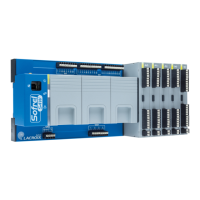
RADIO RDRTU-2 communication module
Technical specifications
(∗)
- Receiver sensitivity: - 118 dBm
- Antenna position:
- Place the antenna as high as possible, in a non-enclosed space (if possible outside of a building),
and in an area sufficiently distanced from any other antenna or metallic mass.
- RDRTU-2 module:
- Mounting bracket: allows the module to be offset at a high point near the antenna to
reception level; it can be either screwed onto the antenna mast or attached to a vertical surface.
- For the ‘RDRTU-2 – RS485’ link: Use a ‘2-pair’ cable with a shielded pair (D+,D-) and 1.5 mm² cross-
section, with reinforced, flexible and waterproof sheath.
- The maximum length of the cable for offsetting the module is 50 metres.
- The RDRTU-2 module must not be powered with any other source than the Remote Terminal Unit.
- Frequency and Power:
- 3 configurable frequency channels:
869.575 MHz
- 4 user-defined transmission powers:
)
: ‘27 dBm/500 mW’ power is reserved for use with a low-gain antenna.
- Antenna types:
We offer 3 types of high-gain antenna in order to optimise transmission depending on the application and the relief of the
terrain (a high-gain antenna enables better reception and lower transmission power):
High-gain antennas
+13 dBi/+11 dBd
+8 dBi/+6 dBd
+5 dBi/+3 dBd
)
: on some types of antennas, the gain is specified in dBd (dBd = dBi - 2).
Terms of use of license-free radio
EN 300 220-1 standard:
• The EN 300 220-1 standard defines a maximum ‘Duty Cycle’
(1)
fixed at 6 minutes per hour and per transmitting device.
• The user must therefore verify that the Inter-RTU Radio link configured on the RDRTU-2 modem
The hourly duty cycle of the RDRTU-2 modem frequency is:
proportional to the number of defined periodic blocks on all communicating devices of the
link, with a maximum transmission time of 2.5 sec per block,
proportional to the number of cycles per hour and is a function of the ‘Silence between
cycle’ and/or ‘silence between communicating devices’ configurations. In practice, we can
evaluate this silence time in seconds as:
'Silence between cycle’ = ‘silence between interlocutors’ = ‘Number of blocks x 25’
In some countries, usage of this frequency range may have restrictions; for more
information, please consult your local telecommunications regulatory body.
(1)
Definition of ‘Duty Cycle’:
Purpose of the duty cycle limit is to ensure that no application can occupy a frequency range for more than a certain percentage of time. The duty
cycle defines a maximum percentage of time (expressed as a percentage over any period of time that a modem is allowed to transmit). Duty
cycle limitation must be controlled by the terminal equipment connected to the modem. Contact LACROIX Sofrel’s Technical Department for your
duty cycle calculations.
(
)
: Only available in countries where 869MHz frequency is allowed, check with country’s regulations.


 To Next Page