
 Need help?
Do you have a question about the Lambda Vega 450 and is the answer not in the manual?
Explains how to use remote sense for voltage compensation and provides best practices.
Describes how to connect modules in parallel for load sharing using "daisy chaining".
Explains 1+1 redundant and N+1 parallel configurations, including hot swap.
Compares remote sensed and locally sensed current sharing systems.
Lists common causes of noise problems and practical steps to reduce or identify noise sources.
Explains MTBF calculation using MIL-HDBK-217F Ground benign and module combinations.
Lists failure rates per million hours (FPMH) for converters and modules at different temperatures.
Demonstrates how to calculate MTBF for a specific configuration by summing FPMH.
Emphasizes careful installation, cable/PCB layout to minimize noise and interaction.
Suggests using mains filters and metal enclosures with EMC gaskets.
Provides essential rules like using twisted pairs, starpoint earth, and de-coupling for good EMC.
Describes the primary converter (PFC, forward converter) and output modules (rectification, regulation).
Explains efficiency factors and two levels of overvoltage protection (tracking and fixed).
Describes how overvoltage/overcurrent conditions shut down the supply and how to re-establish operation.
Lists common series combinations with Vmin, Vmax, Imax, slots, and power ratings.
Lists available options for voltage/resistance programming, current limit, inhibit, and enable.
Explains voltage, resistance, and current programming inputs and their effects.
Lists available options for W5 module programming, current limit, inhibit, and enable.
Explains voltage, resistance, and current programming for the W5 module.
 General
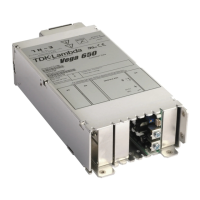
| Model | Vega 450 |
|---|---|
| Type | ATX |
| Output Power | 450W |
| Efficiency | 80 Plus Bronze |
| Fan Size | 120mm |
| Modular | No |
| PCIe Connectors | 1x 6+2-Pin |
| EPS Connector | 4+4-Pin |


 To Next Page