EasyManua.ls Logo

lancer 9000 - User Manual

lancer 9000
12 pages
Print Icon
To Next Page IconTo Next Page
Loading...
FOR QUALIFIED INSTALLER ONLY. This basic Installation Sheet is an initial release. If a complete Operations
Manual (for the unit being installed) is required or needed, please refer to the Lancer web site (lancerworldwide.com)
for immediate access, or for your convenience, scan this QR code with a mobile device (app required) for immediate
access Contact Lancer Customer Service for assistance as required.
ABOUT THIS MANUAL
This booklet is an integral and essential part of the product and
should be handed over to the operator after the installation and
preserved for any further consultation that may be necessary.
Please read carefully the guidelines and warnings contained
herein as they are intended to provide the user with essential
information for the continued safe use and maintenance of the
product. In addition, it provides GUIDANCE ONLY to the user on
the correct services and site location of the unit.
BEFORE GETTING STARTED
Each unit is tested under operating conditions and is thoroughly
inspected before shipment. At the time of shipment, the carrier
accepts responsibility for the unit. Upon receiving the unit,
carefully inspect the carton for visible damage. If damage exists,
have the carrier note the damage on the freight bill and le a
claim with carrier. Responsibility for damage to the dispenser lies
with the carrier.
IMPORTANT SAFETY INSTRUCTIONS
The installation and relocation, if necessary, of this product must be carried out by qualied personnel with
up-to-date safety and hygiene knowledge and practical experience, in accordance with current regulations.
Lancer PN: 28-3040
Revision: 00-0 - April 2020
The dispenser is for indoor use only. This unit is not a toy. Children should be supervised not to play with appliance. It should not
be used by children or inrm persons without supervision. This appliance is not intended for use by persons (including children)
with reduced physical, sensory or mental capabilities, or lack of experience and knowledge, unless they have been given
supervision or instruction concerning use of the appliance by a person responsible for their safety. Cleaning and user maintenance
shall not be performed by children without supervision. The min/max ambient operating temperature for the dispenser is 65°F to
105°F (18°C to 40°C). Do not operate unit below minimum ambient operation conditions. Should freezing occur, cease operation of
the unit and contact authorized service technician. Service, cleaning and sanitizing should be accomplished only by trained
personnel. Applicable safety precautions must be observed. Instruction warnings on the product being used must be followed.
! Intended Use
This system uses a ammable refrigerant under pressure. Do not tamper with it. Contact qualied service personal before disposal.
In order to minimize the risk of possible ignition due to incorrect parts or improper service, only factory authorized personnel should
perform service on the appliance and its component parts. Do not store explosive substances such as aerosol cans with a
ammable propellant in this appliance. Replace component parts with like components. Only use genuine Lancer parts or parts
certied by Lancer. Do not damage the refrigerant circuit.
H Refrigerant Warning
CED-600 R-290
LANCER INSTALLATION GUIDE
Warning; ammable material. Taking care to avoid causing a re by igniting ammable material.
H WARNING
®
9000
W O R L D W D E
®
Model 9000

Questions and Answers

Overview

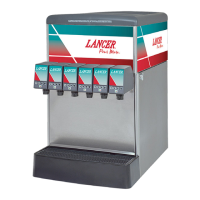
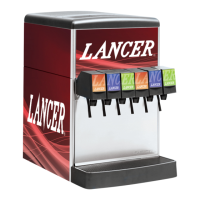
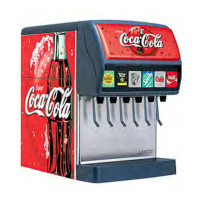
This document describes the Lancer CED-600 R-290 Model 9000 dispenser, a commercial beverage dispensing unit designed for indoor use.

Function Description

The Lancer CED-600 R-290 Model 9000 is a beverage dispenser that mixes and dispenses carbonated and non-carbonated drinks. It features an electronic ice bank control system to maintain optimal beverage temperature. The unit draws condenser air from the front and side vents and discharges it from the rear, requiring specific clearance for proper airflow. It is designed for either permanent counter installation or placement on a counter using provided legs. The dispenser utilizes a high-pressure water pump for carbonation and requires both plain water and CO₂ supply, along with syrup inlets for various beverage options. The system includes a carbonator tank that needs to be filled with distilled water and a small amount of baking soda to ensure proper electronic ice bank control function.

Important Technical Specifications

  • Electrical:
    • 115 VAC, 60 Hz, 8.0 Amps
    • 220-240 VAC, 50/60 Hz, 4.0 Amps
  • Dimensions:
    • Width: 16.86 inches (429 mm)
    • Depth: 25.56 inches (649 mm)
    • Height: 26.86 inches (657 mm)
  • Weight:
    • Shipping: 160 lbs (72.5 kg)
    • Empty: 146 lbs (66.2 kg)
    • Operating: 237 lbs (107.5 kg)
    • Ice Bath: 22 - 24 lbs (10.0 - 10.9 kg)
  • Plain Water Supply:
    • Minimum Flowing Pressure: 25 psi (0.172 MPa)
    • Maximum Static Pressure: 65 psi (0.448 MPa)
    • Water for Carb Inlet: 3/8 inch barb
  • Carbon Dioxide (CO₂) Supply:
    • Minimum Pressure: 70 psi (0.483 MPa)
    • Maximum Pressure: 80 psi (0.552 MPa)
    • CO₂ Inlet: 3/8 inch barb
  • Syrup Inlets: 1/4 inch barb
  • Sound Pressure Level: Below 70 dB
  • Maximum Altitude: 16,400 ft (5,000 m)
  • Ambient Operating Temperature: 65°F to 105°F (18°C to 40°C)
  • Water Bath Mixture: Distilled water with 1/8 oz (4 g) baking soda. Electric conductivity (E.C.) must be between 100 and 500 uS/cm for proper ice bank control function.
  • CO₂ Regulator Setting (High Pressure): 110 psi (0.758 MPa)
  • CO₂ Regulator Setting (Low Pressure): 75 psi (0.517 MPa)
  • Water Regulator Kit (PN 18-0253/02): Required if water source is above 50 psi (0.345 MPa), set regulator to a maximum of 50 psi (0.345 MPa).

Usage Features

  • Installation: Requires qualified personnel with up-to-date safety and hygiene knowledge. The unit must be level (0° tilt for optimum performance, maximum 5° tilt) for proper drainage. Adequate potable water supply and CO₂ supply are essential. Specific clearances (minimum 8 inches/203 mm above, 4 inches/101.6 mm behind) are needed for condenser airflow.
  • Electrical Connection: Must be plugged into a properly grounded electrical outlet with a separate circuit. Extension cords are not permitted. A 5-minute delay occurs before the compressor/fan starts, and a 3-minute protection timer is on the carbonator level sensor.
  • Water Bath Filling: Critical for performance. The water bath must be filled with a specific distilled water and baking soda mixture to achieve the correct electrical conductivity (100-500 uS/cm). RO or purified water should not be used.
  • CO₂ Supply: A dedicated CO₂ regulator is required for the unit and remote syrup pumps.
  • Dispenser Setup: Involves purging water to fill the carbonator tank, activating valves for gas-out, and then for a steady flow of carbonated water.
  • Volumetric Valve Adjustment: Allows for precise control of syrup/water ratio using a handheld programmer (PN 54-0031). This involves setting the desired ratio and drink type (carbonated or non-carbonated) for each valve.
  • Safety Warnings: Emphasizes not to energize the machine if damaged, proper electrical grounding, avoiding mechanical devices for defrosting, and ensuring ventilation openings are clear. It also warns about the dangers of CO₂ gas leaks and the flammability of the refrigerant.

Maintenance Features

  • Cleaning and Sanitizing:
    • General: To be performed by trained personnel using sanitary gloves. Avoid strong bleaches, detergents, metal scrapers, hot water above 140°F (60°C), and spilling sanitizing solution on circuit boards.
    • Cleaning Solution: Mild, non-abrasive detergent (e.g., dish soap) mixed with clean, potable water at 90°F to 110°F (32°C to 43°C) (1 oz cleaner to 2 gallons water).
    • Sanitizing Solution: Prepared according to manufacturer's recommendations, providing 100 PPM chlorine (e.g., Sodium Hypochlorite or bleach).
    • As Needed: Keep exterior surfaces, drip tray, and cup rest clean with a damp cloth.
    • Daily: Remove and rinse nozzles and diffusers (no soap/detergent), wash cup rest in soapy water, wipe drip tray and exterior surfaces with a clean, warm cloth (no abrasive soaps/detergents). Replace cup rest, diffusers, and nozzles.
    • Weekly: Taste products for off-tastes. Check and replenish water level in the water bath.
    • Monthly: Unplug unit, remove bonnet, clean dirt from gas cooler with a soft brush, replace bonnet, and plug in.
    • Every Six Months: Clean and sanitize the unit using the procedures outlined in the manual.
    • Yearly: Clean water bath interior (including evaporator coils and refrigeration components) and the entire exterior of the unit.
  • Syrup Line Cleaning and Sanitizing: Involves disconnecting lines from Bag-In-Box (BIB) containers, flushing with warm water, cleaning with cleaning solution, flushing with warm water, sanitizing with sanitizing solution, and finally flushing with end-use product until no aftertaste remains.
  • Nozzle Cleaning and Sanitizing: Involves disconnecting power, removing nozzles and diffusers, rinsing with warm water, washing with cleaning solution, immersing in sanitizing solution for 15 minutes, air drying (no rinsing with water), and reattaching.
  • Troubleshooting Guide: Provides a comprehensive list of common problems, their causes, and remedies, covering issues such as water leakage, insufficient water/syrup flow, erratic ratio, no product dispensed, valve not shutting off, excessive foaming, continuous water overflow, and warm drinks.
  • Dispenser Disposal: Emphasizes recycling the unit through an authorized recycler and complying with local regulations for refrigerant and insulation disposal to prevent environmental harm.

lancer 9000 Specifications

General IconGeneral
Brandlancer
Model9000
CategoryCommercial Food Equipment
LanguageEnglish

Related product manuals