D
D
C
C
S
S
8
8
1
1
0
0
S
S
D
D
i
i
g
g
i
i
t
t
a
a
l
l
D
D
C
C
S
S
e
e
r
r
v
v
o
o
D
D
r
r
i
i
v
v
e
e
r
r
M
M
a
a
n
n
u
u
a
a
l
l
R
R
e
e
v
v
1
1
.
.
0
0
Tel: (86)755-26434369 13 Website: www.leadshine.com
Tuning the Servo
A servo system is error-driven. The “Gain” of the system determines how hard the
servo tries to reduce the error. A high-gain system can produce large correcting
torques when the error is very small. A high gain is required if the output is required
to follow the input faithfully with minimal error.
A servo motor and its load both have inertia, which the servo amplifier must
accelerate and decelerate while attempting to follow a change at the input. The
presence of the inertia will tend to result in over-correction, with the system
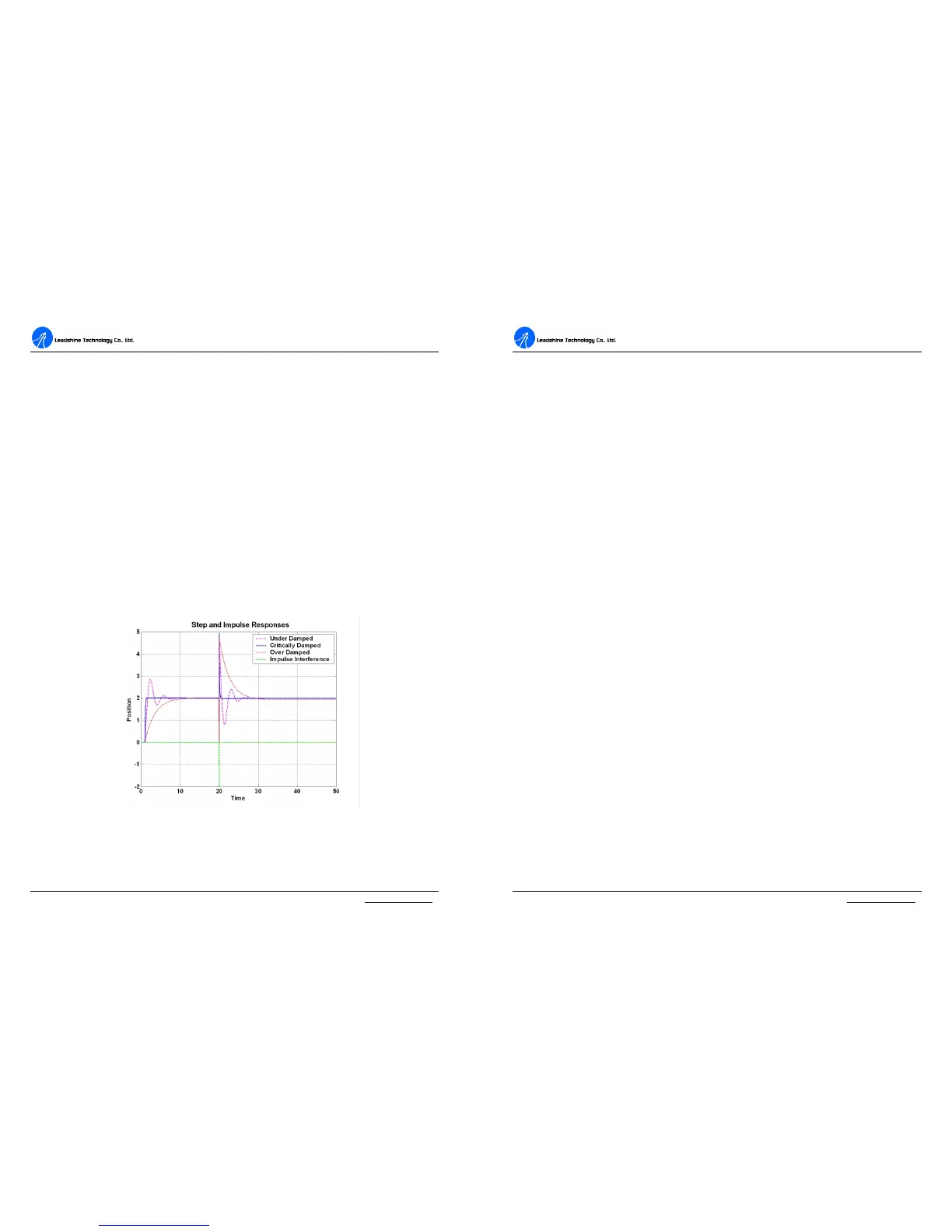
oscillating beyond either side of its target. It’s called UNDER DAMPED status. See
Figure 13. This oscillation must be damped, but too much damping will cause the
response to be sluggish, namely cause the system to get into an OVER DAMPED
state. When we tune a servo, we are trying to achieve the fastest response with little
or no overshoot, namely get a CRITICALLY DAMPED response.
Figure 13: Step and impulse responses
As mentioned in previous contents, the DCS810S is a digital servo driver and its
input command is PUL/DIR signal. In other words, step response just exists in each
D
D
C
C
S
S
8
8
1
1
0
0
S
S
D
D
i
i
g
g
i
i
t
t
a
a
l
l
D
D
C
C
S
S
e
e
r
r
v
v
o
o
D
D
r
r
i
i
v
v
e
e
r
r
M
M
a
a
n
n
u
u
a
a
l
l
R
R
e
e
v
v
1
1
.
.
0
0
Tel: (86)755-26434369 14 Website: www.leadshine.com
step command signal. For each step command signal is a very small movement, so
OVER SHOOT and SETTLING TIME between each step are very small, causing
you hardly can see a step response such as Figure 13, even if the SET POINT is a
very large quantity and the acceleration is very high.
However, if you try to evaluate performances of the digital servo by investigating its
position tracking-error or position following error, you may find it’s much easier
than investigating its step response. The easiest way to get a tracking-error or
position following error response is to induce an impulse load on the motor. See
Figure 13 at “time 20”.
Leadshine offer a Windows based setup software ProTuner to its customers for
evaluating servo performances. Small servo tuning unit STU (optional) is available
too, and it’s for field tuning without PC.
Tuning servo systems formed by the DCS810S drivers can be summarized as the
following rules:
1. If servo system is UNSTABLE, then the first thing of tuning is to stabilize
the system. You can increase Derivative Gain of Position Loop (Kd) or
decrease Proportional Gain of Position Loop (Kp) or Integral Gain of
Position Loop (Ki).
2. If servo system is UNDER DAMPED, then increase Kd or decrease Kp or
Ki.
3. If servo system is CRITICALLY DAMPED, then stop tuning and
download the parameter settings to the driver’s EEPROM.
4. If servo system is OVER DAMPED, then decrease Kd or increase Kp or
Ki.
Please see “User’s Manual for Tuning the DCS810S with ProTuner” for more
detail about Servo Tuning.


 To Next Page