4.1.4 Sensor in Oil (no Water)
This step provides OIL indication when the sensor is in a very thick layer of
oil. If Second Alarm setting is desired (i.e. AIR / HIGH OIL indication when
oil level is more then a certain value), skip directly to Paragraph 3.1.5.
• Verify that the sump or tube/tank is empty.
• Add oil until the Sensor floats properly.
OIL light should turn on.
If OIL light stays off, turn R2 counter-clockwise until OIL light turns on.
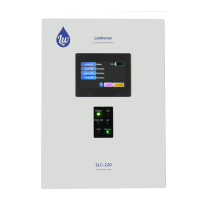
(For some demo units only: R2 is the calibration screw next to AIR / HIGH
OIL light on the front panel).
4.1.5 Second Alarm Point Change
This step provides AIR / HIGH OIL indication when oil layer is thicker than
the predetermined value. If Second Alarm is not required, skip this
paragraph.
• When the Sensor is floating on water, slowly add oil until the desired layer
thickness for second alarm is reached.
• If OIL light is on, turn R2 clockwise until OIL light turns off and AIR / HIGH OIL
turns on.
Otherwise, if OIL light is off, turn R2 counter-clockwise until OIL turns on and
then clockwise just until AIR / HIGH OIL turns on.
(For some demo units only: R2 is the calibration screw next to AIR / HIGH OIL
light on the front panel).
4.1.6 System Check
• Sensor in the air: AIR / HIGH OIL light on.
• Sensor in water: WATER light on.
• Sensor in water with an oil layer of 2mm (or a different thickness to which the
Sensor was calibrated): OIL light on



 To Next Page