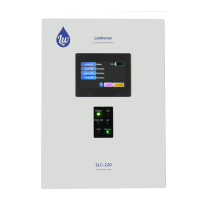
5.1.2 Air Detection
Lift the Sensor Assembly up to the air.
AIR / HIGH OIL light should turn on.
5.1.3 Water/Oil Interface
• Put the Sensor Back in Water (without oil).
• Make sure that water level in the vessel is appropriate and the sensor floats
freely.
• Add an oil layer of the thickness that is to be detected (1 mm for example).
OIL light should turn on.
• Adjust detection sensitivity by turning R5 counter-clockwise till WATER light
turns on and then slightly clockwise till OIL light is on.
This procedure (5.1.3) can be also implemented on site in order to change
sensitivity of oil detection, as follows:
• To decrease sensitivity (i.e. start detection from a thicker oil layer), or to
“out-calibrate” an oil layer of certain thickness which is not needed to be
detected, use R5 and rotate it counter-clockwise.
• To increase sensitivity (i.e. detect a thinner oil layer), R5 should be rotated
clockwise.
Detection of oil layer thinner than 1mm is maintained only in conditions similar
to those in which the calibration process was performed. Changes such as
water table variation, flow velocity, etc., may affect detection sensitivity.
5.1.4 Second Alarm Point
• Add an oil layer of the thickness that is to be detected as Second Alarm (10
mm for example).
• If OIL light is on:
Slightly turn R2 clockwise till AIR / HIGH OIL turns on and OIL turns off.
(For some demo units only: R2 is the calibration screw located next to AIR /
HIGH OIL light).
If AIR / HIGH OIL light is on:
Turn R2 counter-clockwise till OIL light turns on and then slightly clockwise till
AIR / HIGH OIL light turns on.



 To Next Page