WWW.leaptonpv.com
6
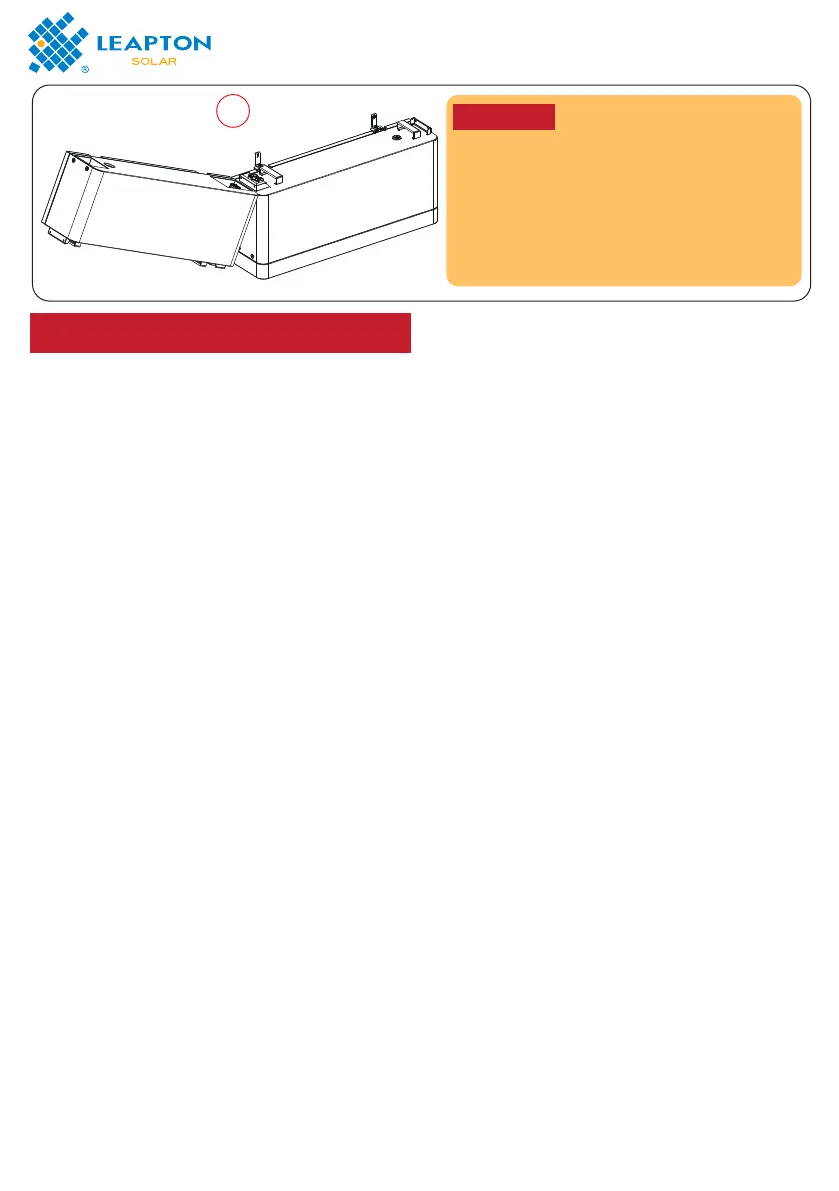
If a battery pack is dropped or violently
impacted during installation, internal
damage may occur. Do not use such
battery packs; otherwise, safety risks
such as cell leakage and electric shock
may arise.
DANGER
Installation Environment Requirements
• The installation and use environment must meet relevant international, national, and local
standards for lithium batteries, and are in accordance with the local laws and regulations.
• Ensure that the battery is not accessible to children and away from daily working or living areas,
including but not limited to the following areas: studio, bedroom, lounge, living room, music room,
kitchen, study, game room, home theater, sunroom, toilet, bathroom, laundry, and attic.
• When installing the battery in a garage, keep it away from the drive way. It is recommended that
the battery be mounted on the wall higher than the bumper to prevent collision.
• When installing the battery in a basement, keep good ventilation. Do not place flammable or
explosive materials around the battery. It is recommended that the battery be mounted on the wall
to avoid contact with water.
• Install the battery in a dry and well-ventilated environment. Secure the battery on a solid and flat
surface.
• Install the battery in a sheltered place or install an awning over it to avoid direct sunlight or rain.
• Install the battery in a clean environment that is free from sources of strong infrared radiation,
organic solvents, and corrosive gases.
• For areas prone to natural disasters such as floods, debris flows, earthquakes, and typhoons/
hurricanes, take corresponding precautions for installation.
• Keep the battery away from fire sources. Do not place any flammable or explosive materials
around the battery.
• Keep the battery away from water sources such as taps, sewer pipes, and sprinklers to prevent
water seepage.
• Do not install the battery in a position where it is easy to touch as the temperature of the chassis
and heat sink is high when the battery is running.
• To prevent fire due to high temperature, ensure that the vents and the cooling system are not
blocked when the battery is running.
• Do not expose the battery to flammable or explosive gas or smoke. Do not perform any operation
on the battery in such environments.
• Do not install the battery on a moving object, such as ship, train, or car.
• In backup power scenarios, do not use the battery for the following situations: a. Medical
devices substantially important to human life. b. Control equipment such as trains and elevators,
which may cause personal injury. c. Computer systems of social and public importance.
d. Locations near medical devices. e. Other devices similar to those described above.
• Do not install the battery outdoors in salt-affected areas because it may corrode. A salt-affected
area refers to the region within 500 meters from the coast or prone to sea breeze. The regions
prone to sea breeze vary with weather conditions (such as typhoons and monsoons) or terrains
(such as dams and hills).
�


 To Next Page
 Loading...