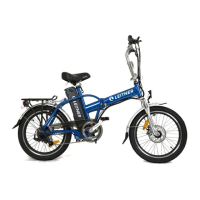
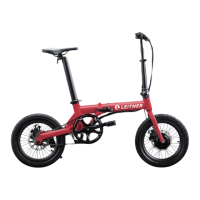
Mechanical and electrical work performed on your ebike.
Safety depends on correct assembly and maintenance. The
use of a torque wrench is recommended to tighten bolts
correctly. Special tools and skills are necessary to
comprehensively service this bike. In the interest of safety
we recommend that you visit a skilled local electric bike
mechanic to assemble, tune and regularly service the bike.
WARNING! Modifying or tampering with your bike can
provide a safety risk.
• Non‐original components which are not approved or
incorrect assembly can cause accidents and injury. Do not
make any modifications including but not limited to
installing incompatible forks, drilling, sanding, filing or
removing parts.
• Third party components and accessories can provide a
safety risk. Examples are bicycle trailers, bicycle carriers
and child seats. Installation and use at the customer’s
risk.
• Original components can be purchased through your
retailer. Consult your retailer for safety and compatibility
advice. For example, installing a seat post which is too
long may put stress on the frame leading to damage.
• The electric parts do not need maintenance. Do not open
electric parts. Disassembly of thebikebeyondthestatein
which it has been delivered in the retail box voids
warranty.
• If your bike has been tampered with, it is advised to
replace non‐original components with genuine
components and have the bike safety‐checked by a
skilled bike mechanic to ensure safe operation.
• Replacement of inner tubes with a suitable inner tube of
a reputable brand is not considered tampering.
Riding a bike in different conditions
WARNING! Using a bike in conditions beyond its limits and
beyond the skills of the rider could lead to damage to
bicycle, fork, frame, parts and injury. Do not use your bike
on rough trails, trails with obstacles, areas where tyres are
momentarily off the ground, jumps, technical areas, speeds
over 25 km/h and for aggressive riding. Do not ride down
curbs.
• Riding an ebike can be fun for commuting, exercise or
recreation if you ride your bike in a manner that is within
your ability and within the limits of the bike. Ride
carefully and mindful of your environment to avoid
dangerous situations. Bikes are limited by use, surface,
maintenance and design.
• Leitner ebikes are designed for use on paved surfaces
with shallow gradients where the tyres are always on the
ground.
• Permissible total pay load: Weight limit of rider
(including luggage) 120kg (264 pounds). Maximum total
weight (rider + luggage + bike) approximately 145kg.
Empty weight of bike including battery approximately
25kg. Do not ride on hills steeper than 15 percent
incline.
WARNING! Smooth gravel roads and loose surfaces increase
risk of losing control. Your riding style needs to be adjusted.
Apply brakes gently, go around turns slowly and be careful
not to use motor during turns and do not accelerate quickly.
Guidetosafeoperation
• Bikes do not protect you in accidents. You may
damage the bike, fall and it may cause serious injury
or death.
WARNING! Riding a bike after an impact beyond its
limits, e.g. accident may cause the bike to break at lower
than standard loads. It is recommended to have the bike
inspected by an ebike mechanic before riding it again.
Ridinginstructions
• Use your brakes carefully: if your bike has two brake
levers it is recommended to press both brake levers at
the same time. Check which brake lever engages which
brake. In Australia, normally the right lever engages
the front brake, the left lever the rear brake. In the
USA, normally the right lever engages the rear brake.
Over‐using the front brake lever may cause the rear
wheel to lift resulting in loss of control.
• Always keep a safe distance from other vehicles or
objects. Get to know your brakes by practicing in a flat,
safe location with concrete surface at low speeds.
Adjust brakes if they are too powerful or too weak.
• Do not use the electric assistance to begin with. If you
are comfortable riding the bike without electric
assistance, read all instructions about using electric
assistance, then ride bike using low assistance levels.
• Always be prepared to press the brake levers in case
you accelerate unexpectedly. Do not switch on your
bike on unless you are ready to ride it to prevent
accidental acceleration. Also refer to section “Changing
gears correctly” in this manual.
• Go around turns carefully, do not pedal around turns,
keep your pedal arms horizontal to avoid pedals
touching the ground.
WARNING! Incorrect use of brakes, gears and electric
controls may cause loss of control and injury.
• When you ride, include a pump, a spare inner tube,
puncture repair kit, and tools so you can repair your
bicycle if it has a flat tyre or other mechanical problem.
It is not recommended to ride at night. If you do ride at
night, include a spare light source for emergencies.
WARNING! Prevent toe‐overlap. Be aware of situations
where your feet which are on the pedal touch the front
wheel. In normal riding situations the front wheel is not
turned sufficiently to allow contact of your toes with the
wheel, however this may occur when going around tight
turns at low speeds. Do not pedal when going around
turns. Toe overlap is affected by the size of your feet, the
pedals, crank arms, mudguards and tyres.
• Carrying cargo will change the way your bike handles,
including braking distance, steering, acceleration,
balancing, hill climbing ability. Cargo should not
protrude too far from your bike and a low centre of
gravity is recommended.
• When riding in coastal areas, wipe bike after every ride
as salt water and humidity are very corrosive. Apply
anti‐rust treatment to spokes and other unpainted
parts. Do not use anti‐rust sprays. It may contaminate
unwanted parts such as brake pads. Damage from
corrosion is not covered under warranty.
2
©LeitnerPtyLtd2020



 To Next Page