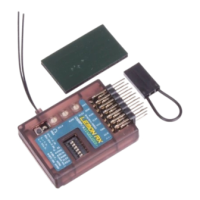
* Used for Stabilization ON/OFF on 6 channel transmitters; otherwise used as a normal servo output.
6. Verify control directions, adjust centring and servo throws
1. Power ON. Use the Stabilizer ON/OFF switch to turn stabilization OFF (green Status light OFF). Be sure
you know which way is OFF in case you need to use it in a hurry!
2. Adjust transmitter reversing so that all servos work in the correct direction in response to the sticks. Note
that where elevon, V-tail or flaperon mixing is involved it may be necessary to interchange the two servo
connectors and/or reverse controls to get the correct action.
3. With trims in neutral, adjust servo arms and linkages to align your control surfaces. Use only a minimum
of subtrim on the transmitter for fine tuning. Servo arms should be at right angles to push rods to ensure
equal movement in both directions.
4. With travel (limits) and control rates at 100%, check that control surface throws are at the recommended
maximums for the model and adjust linkages if necessary. Note that adjusting throws in the transmitter
will not affect stabilization responses, so throws need to be set mechanically to give the stabilizer an
appropriate amount of control; the exact amount is not critical, as gain will later be used to adjust
stabilization, but it should be reasonably close.
7. Test stabilization response and directions
Turn the three on-board gain adjustment pots fully clockwise to maximize action.
Set the Stabilizer ON/OFF
switch to ON (green Status light ON). Sharply move the plane in each of the three flight axes and verify that the
control surfaces move momentarily to oppose the disturbance. See diagram below.
HINT: If you find it hard to see the response direction, put your finger on the hinge line of the control surface. It
is easier to feel a short pulse than see it.



 To Next Page