
 Need help?
Do you have a question about the Lennox 14HPX and is the answer not in the manual?
Guidelines to prevent damage from electrostatic discharge during installation and service.
Detailed technical data, ratings, and electrical information for the 14HPX series units.
List of optional components available for the 14HPX series units.
Details on the control box, including terminal strip, contactors, and capacitors.
Explanation of the demand defrost control, sensors, pressure switches, and lockout features.
Description of operational modes, calibration, test procedures, and fault codes for the defrost control.
Information on scroll compressor, fan motor, reversing valve, and related safety switches.
Details on the filter drier, moisture checks, and the crankcase heater system for compressor protection.
Diagrams of cooling and heating cycles, showing refrigerant flow and gauge connections.
Information on refrigerant piping, line sets, service valves, and Schrader port access.
Procedures for pumping down, leak testing, and evacuating the refrigeration system.
Instructions for setting up, calculating, and adding refrigerant charge to the system.
Scheduled maintenance tasks for outdoor unit, indoor coil, and indoor unit components.
Schematic illustrating the electrical connections and components of the 14HPX unit.
Step-by-step description of unit operation during cooling, heating, and defrost modes.
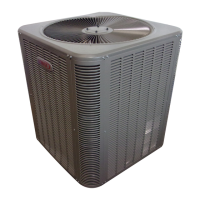
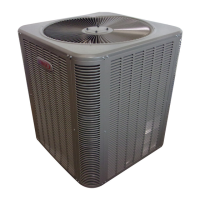
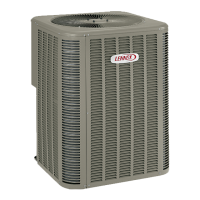
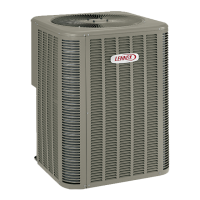
The 14HPX is a residential split-system heat pump designed for use with expansion valves (TXV) and HFC-410A refrigerant, utilizing scroll compressors. It is available in 1-1/2, 2, 2-1/2, 3, 3-1/2, 4, and 5-ton capacities. For proper operation and warranty coverage, all major components, including the indoor blower and coil, must be matched according to Lennox recommendations.
The 14HPX operates as a heat pump, providing both cooling and heating functions for residential environments. Its core components include a scroll compressor, condenser fan, TXV valve, drier, reversing valve, and a high-pressure switch. The unit's operation is managed by a defrost control system (CMC1) that monitors ambient and coil temperatures, as well as compressor run time, to determine when a defrost cycle is needed.
The scroll compressor is a key component, known for its simple, efficient design with few moving parts. It compresses gas by the orbiting motion of one scroll against a stationary one, drawing gas into crescent-shaped pockets, compressing it, and then discharging it. This design makes the compressor tolerant to liquid return, as the orbiting scroll can separate from the stationary one if liquid enters, working it toward the center for discharge. However, it's crucial not to use the scroll compressor for evacuating or "pumping-down" the system, as deep vacuum operation can cause internal arcing and damage, voiding the warranty.
The defrost system is a "demand defrost" control, meaning it measures differential temperatures to detect performance degradation due to ice buildup on the outdoor coil. The control self-calibrates at the start of each defrost cycle and after each cycle. It monitors ambient temperature, outdoor coil temperature, and total run time. The coil temperature probe, designed with a spring clip, must be correctly mounted on the outside coil tubing for accurate defrost operation. The demand defrost board precisely measures system performance as frost accumulates, leading to longer run times between defrost cycles.
The defrost control also incorporates pressure switches: a high-pressure switch (HI-PS) that cycles off the compressor if liquid line pressure rises too high, and an optional low-pressure switch (LO-PS) that shuts off the compressor if suction pressure drops too low. The control has a "5-strike lockout" feature, where if a pressure switch opens and closes five times during an active Y1 (Input) line, the control enters a lockout condition. This lockout can be reset by cycling 24-volt power to the control board or by shorting the TEST pins for 1 to 2 seconds.
The 14HPX units do not include a 24V transformer; all 24 VAC controls are powered by the indoor unit. Field thermostat wiring connects to a 24V terminal strip on the defrost control board. The compressor is energized by a single-pole contactor (K1) through the CMC1 board when the indoor thermostat demands Y1 (24V). A dual capacitor (C12) is used for both the fan motor and the compressor, with different MFD ratings for each.
The defrost control offers field-selectable termination temperatures (50, 70, 90, and 100°F), with a factory setting of 50°F. If no shunt is installed, the default is 90°F. A "Delay Mode" function, activated by a jumper on the DELAY pins, cycles the compressor off for 30 seconds when entering and exiting defrost mode, reducing occasional sounds.
The system can be put into a "Test Mode" by shorting the "Test" pins for 2 to 5 seconds while Y1 is energized and 24V power is applied. This mode reduces control timings, ignores the low-pressure switch, and clears any active lockout conditions.
Regular maintenance is crucial for the 14HPX. At the beginning of each cooling and heating season, the system should be checked. For the outdoor unit, this includes cleaning and inspecting the outdoor coil, visually inspecting all connecting lines, joints, and coils for oil leaks, checking wiring for loose connections, verifying correct voltage, checking amp draw on the outdoor fan motor, and inspecting/cleaning drain holes in the coil compartment base. The outdoor fan motor is pre-lubricated and sealed, requiring no further lubrication.
For the indoor coil, maintenance involves cleaning the coil, checking connecting lines, joints, and coils for oil leaks, and cleaning the condensate line. For the indoor unit, filters should be cleaned or changed, and blower motors, being pre-lubricated and sealed, do not require further lubrication. Blower speed should be adjusted for cooling by measuring the pressure drop over the coil and referring to the indoor unit service manual. Belt drive blowers should be checked for wear and proper tension. All wiring should be checked for loose connections, and correct voltage and amp draw on the blower motor should be verified.
If insufficient heating or cooling occurs, the unit should be gauged, and the refrigerant charge checked. The system uses HFC-410A refrigerant, which operates at higher pressures than HCFC-22. Only expansion valves approved for HFC-410A should be used, and the unit is not approved for coils with metering orifices or capillary tubes. The factory charge is based on a matching indoor coil and outdoor coil with a 15-foot line set; adjustments are needed for varying line set lengths and indoor unit matchups.
When servicing, it's critical to use Allen wrenches of sufficient hardness (50Rc minimum) to prevent rounding or breaking off the wrench or stripping the valve stem recess. Service valve stems are factory torqued and should be handled carefully. The system should never be "pumped down" to 0 psig or lower using the compressor, as this can cause internal fusite arcing and compressor damage. When evacuating the system, a vacuum pump with a vacuum gauge should be used, and a temperature vacuum gauge, mercury vacuum (U-tube), or thermocouple gauge is recommended for accuracy. The compressor should never be used to evacuate the system.
If the refrigerant system is exposed to open air, the dryness of the system must be verified due to POE oils absorbing moisture. An oil sample should be taken, and if it doesn't test in the dry color range, the filter drier must be replaced with one approved for HFC-410A and POE application. A liquid line filter drier should also be replaced if the pressure drop across it exceeds 4 psig.
 General
| Compressor | Single-stage |
|---|---|
| Refrigerant | R-410A |
| Energy Star Certified | Yes |
| Cooling Capacity (BTU/h) | 18, 000 - 60, 000 |
| Operating Temperature Range (Cooling) | Up to 125°F |
| Sound Rating | 76 dB |
| Efficiency Rating | Up to 14 SEER |
| HSPF | 8.2 |



 To Next Page
