EasyManua.ls Logo

Lennox VRF VVCA Series - User Manual

Lennox VRF VVCA Series
25 pages
Print Icon
To Next Page IconTo Next Page
Loading...
1
©2017 Lennox Industries Inc. Dallas, Texas, USA
INSTALLATION
INSTRUCTIONS
THIS MANUAL MUST BE LEFT WITH THE OWNER
FOR FUTURE REFERENCE
Shipping and Packing List
General
Check the components for shipping damage. If you
nd any damage, immediately contact the last carrier.
Package 1 of 1 contains the following:
1 - Assembled indoor unit
2 - Condensate plugs
2 - Rubber grommets
1 - Water level switch cable
1 - 5/8 to 1/2 adapter (VVCA018)
1 - 3/8 to 1/4 adapter (VVCA018)
1 - Water level switch cable
1 - Installation manual
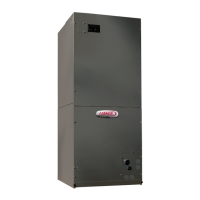
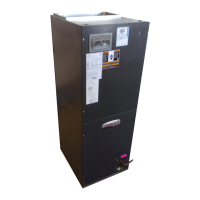
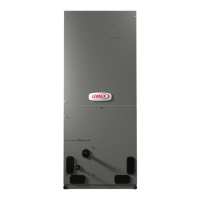
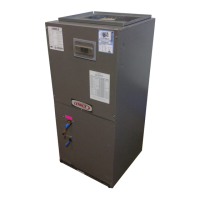
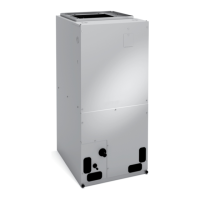
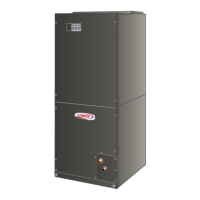
VVCA Vertical Air Handler
The VVCA air handler is designed for indoor installation
only. As shipped, the unit is ready for installation in upow
and horizontal-right air discharge applications. Field-
congurable for horizontal left-air discharge.
The unit has accessible electrical controls, refrigerant
piping connections and an internally mounted expansion
valve kit. This unit is also equipped with variable speed
blower motor.
Refer to the Product Specication bulletin (EHB) for the
proper use of these indoor units with specic heat pumps,
heat recovery units, mode switching devices, branch
pipes, line sets and controls.
These instructions are intended as a general guide and do
not supersede local codes in any way. Consult authorities
having jurisdiction before installation.
The air handler is shipped from the factory completely
assembled. This unit is provided with anges for
connecting the supply plenum.
VRF
VRF SYSTEMS -- Air Handler
507539-05
11/2018
WARNING
Improper installation, adjustment, alteration, ser vice or
maintenance can cause property damage, personal
injury or loss of life.
Installation and service must be performed by a li censed
professional HVAC installer, service agency or the gas
supplier.
Failure to follow safety warnings and these instruc tions
exactly could result in property damage, dan gerous
operation, serious injury, or death.
Any additions, changes, or conversions required in order
for the appliance to satisfactorily meet the ap plication
needs must be made by a licensed profes sional HVAC
installer (or equivalent) using factory-specied parts.
Do not use this system if any part has been under water.
A ood-damaged appliance is extremely dan gerous.
Immediately call a licensed professional HVAC service
technician (or equivalent) to inspect the system and to
replace all controls and electrical parts that have been
wet, or to replace the system, if deemed necessary.
IMPORTANT
The Clean Air Act of 1990 bans the intentional venting
of refrigerant (CFCs, HCFCs and HFCs) as of July 1,
1992. Approved methods of recovery, recycling or
reclaiming must be followed. Fines and/or incarceration
may be levied for noncompliance. These units must be
installed as a part of a matched system as specied in
the Product Specications (EHB) bulletin.
CAUTION
As with any mechanical equipment, contact with sharp
sheet metal edges can result in personal injury. Take
care while handling this equipment and wear gloves and
protective clothing.


Questions and Answers

Overview

The VVCA Vertical Air Handler is an indoor unit designed for Variable Refrigerant Flow (VRF) systems, functioning as an air handler to manage and distribute conditioned air within a space. It is specifically designed for indoor installation and, as shipped, is configured for upflow and horizontal-right air discharge applications. The unit can be field-configured for horizontal left-air discharge, offering flexibility in installation.

Key usage features of the VVCA air handler include accessible electrical controls, refrigerant piping connections, and an internally mounted expansion valve kit. It is also equipped with a variable speed blower motor, allowing for precise control over airflow and enhancing energy efficiency. The unit is designed to be integrated with specific heat pumps, heat recovery units, mode switching devices, branch pipes, line sets, and controls, as detailed in the Product Specification bulletin (EHB). This ensures proper system matching and optimal performance.

The installation process emphasizes safety and proper setup. The unit must be supported on a suitable base or a field-supplied support frame for upflow applications, and securely attached to the floor or support frame. For horizontal installations, the entire length of the cabinet must be supported, typically using angle iron or Unistrut channel with threaded rods and nylon-lock nuts. Proper sloping of the unit is crucial to ensure complete drainage of the condensate pan. The air handler is provided with flanges for connecting the supply plenum, and the supply and return duct systems must be adequately sized to meet the system's air requirements and static pressure capabilities. Flexible joints (canvas) are recommended at duct connections to prevent vibration transmission.

Refrigerant piping connections are a critical aspect of the installation. The unit uses two copper lines for refrigerant, which must be individually insulated. Brazing of refrigerant lines must be performed by a qualified technician, following established procedures, including purging with low-pressure nitrogen to prevent oxidation and moisture ingress. It is essential to use specific brazing rods/sticks suitable for air conditioning pipework. All refrigerant piping must be supported within 12 inches (305 mm) of any mechanical fitting to prevent strain.

Condensate piping connections are also vital for proper operation. The air handler has 3/4" NPT condensate drain connections. A 3-inch trap must be installed in the main drain line as close to the unit as practical, ensuring the top of the trap is below the connection to the drain pan for complete drainage. For horizontal runs, an anti-siphon air vent (standpipe) is required ahead of the horizontal run. A field-fabricated secondary drain pan with a drain pipe to the outside of the building is required for installations over finished living spaces or areas susceptible to water damage. All drain lines must be properly routed and insulated to prevent leaks and condensation.

Electrical connections require careful attention. The power supply must be isolated before accessing unit electrical terminals. All wiring must conform to local and national codes (NEC/CEC). The unit nameplate provides minimum circuit ampacity and maximum overcurrent protection size. A 18 GA., 3-conductor, shielded control wire (polarity sensitive) is specified for communication, with all shields connected to the GROUND terminal to ensure proper system communication. The unit must be properly grounded and protected by a circuit breaker.

Maintenance features include the ability to remove and clean the air filter. The air filter is field-provided and installed, and its proper selection and placement are critical to airflow and system performance. The manual provides guidelines for filter sizing, recommending a minimum surface area of 200 sq. in. per ton for the return air filter grille. The unit is equipped with a receiver that has a digital display providing error codes, which can be used for troubleshooting. These codes help identify issues such as communication errors, sensor malfunctions, or fan motor errors. The manual also outlines a spot check performance tracking table to view diagnostic information, aiding in monitoring the unit's operation and identifying potential problems.

The VVCA air handler is designed for long-term reliability and performance, with an emphasis on proper installation and regular maintenance to ensure efficient operation and prevent issues. The detailed instructions and warnings provided in the manual are crucial for safe and effective use of the device.

Lennox VRF VVCA Series Specifications

General IconGeneral
RefrigerantR410A
Dimensions (H x W x D)Varies by model
WeightVaries by model
TypeAir Handlers
Static Pressure Range (in. wg)Up to 0.8

Related product manuals