System bus (CAN) with Servo PLC & Drive PLC
System blocks
6.1 CAN1_IO (9300 Servo PLC)
6-3
L
PLC-Systembus EN 1.1
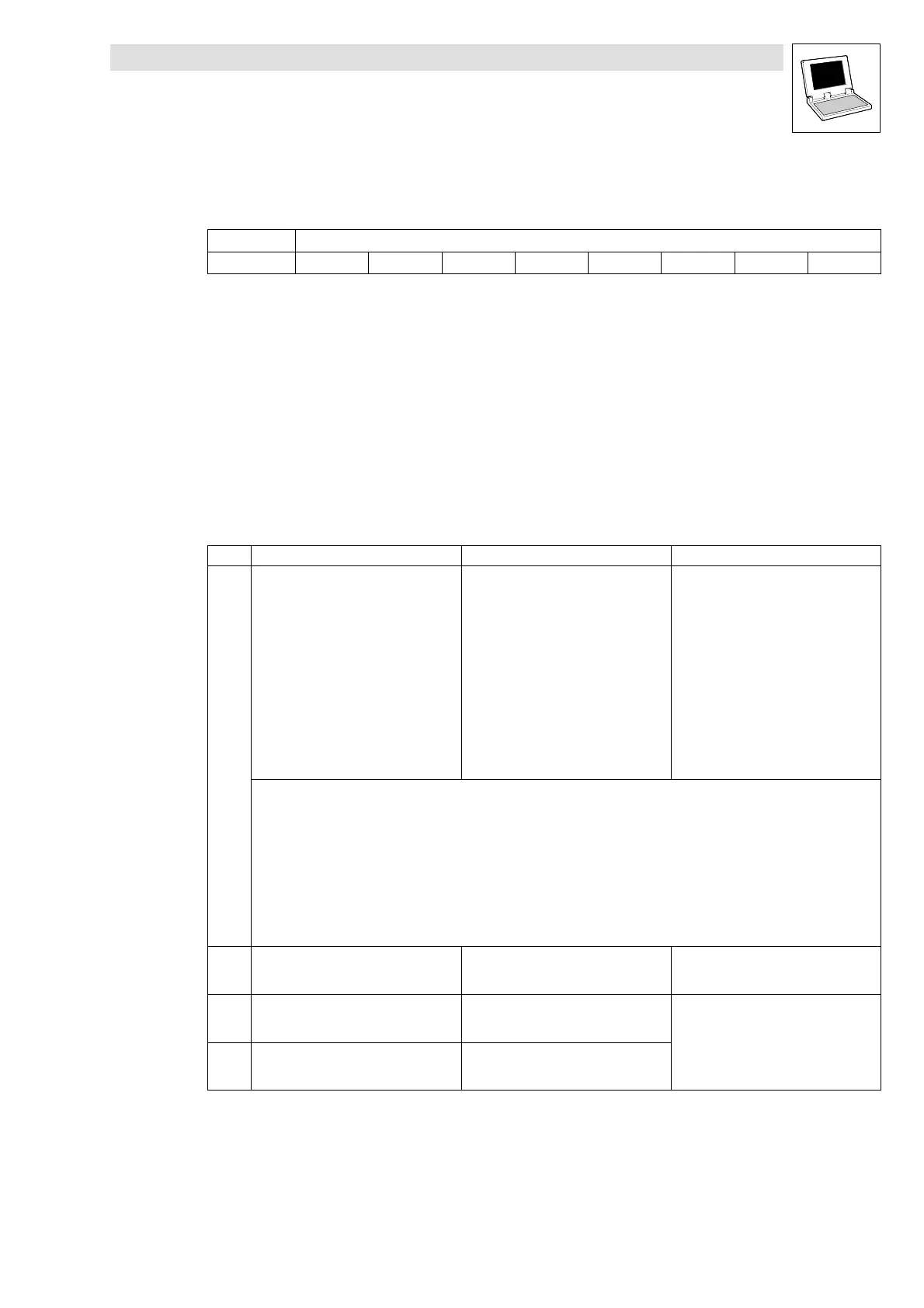
Process data telegram
The process data telegram consists of an
identifier
and 8 bytes of user data.
11-bit 8-byte user data
Identifier Byte 1 Byte 2 Byte 3 Byte 4 Byte 5 Byte 6 Byte 7 Byte 8
Identifier
Information about the identifier can be found in chapter 2.3.1.
(^ 2-2)
User data
The received 8 bytes of user data are assigned to several variables of a different data type at the same
time and can therefore - as required - be evaluated as
• binary information (1-bit)
• control word quasi-analog value (16-bit)
• phase-angle information (32-bit)
in the PLC program:
Byte Variable (1-bit) Variable (16 -bit) Variable (32 -bit)
1, 2
CAN1_bInB 0 _b
CAN1_bInB 1 _b
CAN1_bInB 2 _b
CAN1_bCtrlQ uickstop_b
CAN1_bInB 4 _b
...
CAN1_bInB 7 _b
CAN1_bCtrlDisable_b
CAN1_bCtrlCInhibit_b
CAN1_bCtrlTripSet_b
CAN1_bCtrlTripReset_b
CAN1_bInB 12 _b
...
CAN1_bInB 15 _b
CAN1_wDctrlCtrl
Note:
The internal control word of the drive controller is not permanently connected with byte 1/2!
• The signals for the functions Quick Stop (QSP), DISABLE, CINH, TRIP SET and TRIP RESET can be written to the DCTRL SB by
connecting the variable CAN1_wDctrlCtrl with the variable DCTRL_wCAN1Ctrl of the DCTRL SB.
• These signals can also be read and processed via the following variables:
– CAN1_bCtrlQuickstop_b
– CAN1_bCtrlDisable_b
– CAN1_bCtrlCInhibit_b
– CAN1_bCtrlTripSet_b
– CAN1_bCtrlTripReset_b
• The remaining 11 bits (CAN1_bInB.._b) can be used to control further functions/function blocks.
3, 4
CAN1_nIn W1_a
5, 6 CAN1_bInB 0 _b
...
CAN1_bInB 15 _b
CAN1_nIn W2_a
7, 8 CAN1_bInB 16 _b
...
CAN1_bInB 31 _b
CAN1_nIn W3_a
C
N1_dnInD1
p



 To Next Page