Friedrich Leutert GmbH & Co. KG 13
Engine Indicators Type 50 and Type 30 - Operating Instructions
4 Operating Procedure
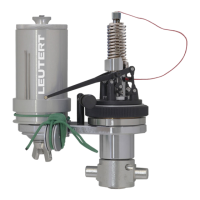
Remove the upper part from the bottom part by turning the ring nut.
Lubricate the operative surfaces of the bottom part, piston rod and
piston rod guide with top-quality, non-viscous cylinder oil.
CAUTION
Take care not to damage the recording mechanism while
removing the upper part. Slightest damage may lead to
substantial recording errors.
The links must never be disassembled and should always be
sufficiently lubricated with cylinder oil.
Do not bend the piston rod while removing the upper part as
the piston may seize.
Reconnect the upper part to the bottom part.
CAUTION: Make sure that the seat of spring support and the
corresponding seat of the bottom part are absolutely clean
before inserting the upper part.
When inserting the upper part, do not tighten the ring nut fully at
first. Use the knurled handle to move the recording levers until the
pencil touches the drum, then tighten the ring nut in this position
firmly by hand (do not use tools).
If the recording pencil is pressed on the drum too hard, faulty
diagrams will result. If the ring nut is slackened, the recording lever
can be turned and arrested in any desired position.
Make sure that the indicator is designed for the pressure of the
engine to be measured.
WARNING: Check the maximum pressure of the indicator
spring. If the spring is designed for lower pressures the
recording mechanism of the Indicator will be damaged.
Wrap a sheet of indicator paper around the drum. The indicator is
now ready to record the first cylinder.
WARNING
Put on suitable gloves as the instrument will get very hot
during operation.
The usage of safety glasses is required when operating the indi-
cator as hot gas and particles may be ejected from the engine.


 To Next Page