Starting up the device - Basic configuration
Leuze electronic GmbH + Co. KG CML 720i 72
Select Digital IOs > IO Logic > Positive PNP.
Select Digital IOs > IO Pin 2 > IO Function > Trigger input.
A teach input is configured according to the same principle.
Select Digital IOs > IO Logic > Positive PNP.
Select Digital IOs > IO Pin 2 > IO Function > Teach Input.
Configuration of pin 5 as PNP height area
The following example shows the configuration of pin 5 as PNP height area.
Select Digital IOs > IO Logic > Positive PNP.
Select Digital IOs > IO pin 5 > Teach height > Execute.
8.5.2 Inversion of the switching behavior (light/dark switching)
Light/dark switching is configured with this configuration.
The following example shows how the switching output is switched from light switching (normal) to dark
switching (inverted).
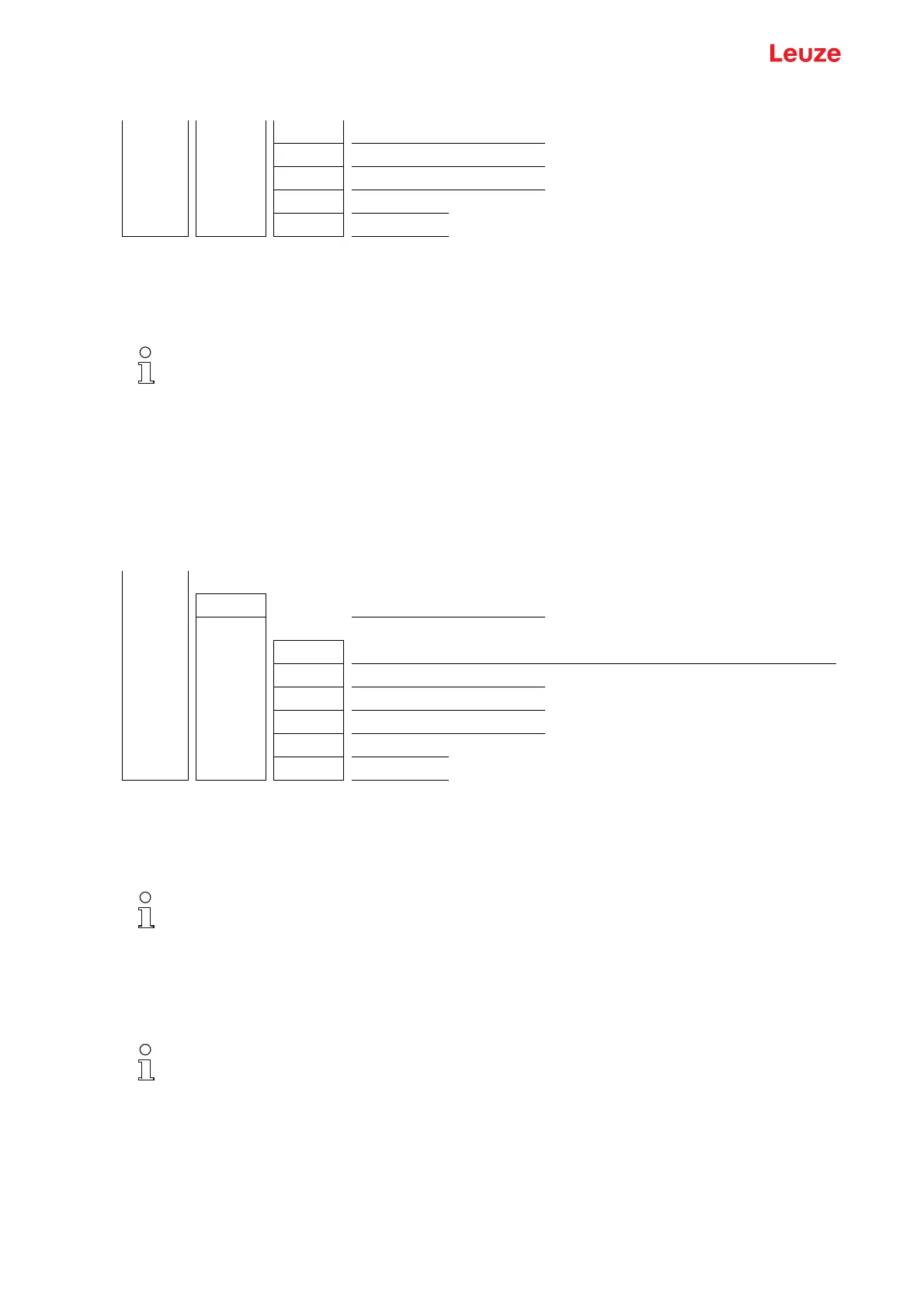
The structure of the configuration in the receiver control panel menu is as follows:
Inversion Normal Inverted
Teach height Execute Exit
Area logic AND OR
Start beam (enter value)
End beam (enter value)
Trigger input and output are only active if cascading (triggered operation) was activated via the
configuration interface or process interface.
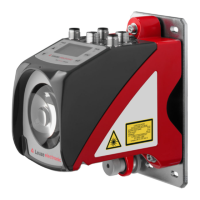
Level 0 Level 1 Level 2 Description
Digital IOs
IO Logic Positive PNP Negative NPN
IO Pin 5
IO function Trigger In Teach In Area Out Warn Out Trigger Out
Inversion Normal Inverted
Teach height Execute Exit
Area logic AND OR
Start beam (enter value)
End beam (enter value)
The pin is automatically configured as an area output.
IO Function > Area Out must also be selected.
Level 0 Level 1 Level 2 Description
For all digital process interfaces, the configuration can also be performed via the respective field-
bus interface (see chapter 10 et seq.) or via the
Sensor Studio
configuration software (see
chapter 16).


 To Next Page