Section 2
2-2 Power On
Alarms
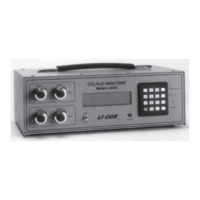
The LI-820 is equipped with high and low alarms, which can be configured as open drain
(open collector) or 0-5V output (TTL levels) using jumpers on the main PC board (Figure 2-
1). Figure 2-2 shows the position of the jumpers for each of the two alarm conditions.
TTL stands for Transistor-transistor logic, which commonly refers to a signal level where the
“on” voltage is near +5 volts. This is the default alarm jumper position in the LI-820,
whereby whenever a high or low alarm is triggered, the LI-820 outputs a +5V signal.
The LI-820 alarms can also be configured as open drain (open collector), which is a circuit
technique that allows multiple devices to communicate bi-directionally on a single wire.
Open drain/open collector devices sink (flow) current in their low voltage active (logic 0)
state, or are high impedance (no current flows) in their high voltage non-active (logic 1) state.
These devices usually operate with an external pull-up resistor that holds the signal line high
until a device on the wire sinks enough current to pull the line low. Multiple devices can be
attached to the signal wire. If all devices attached to the wire are in their non-active state, the
pull-up will hold the wire at a high voltage. If one or more devices are in the active state, the
signal wire voltage will be low.


 To Next Page