Section 4
Theory of Operation 4-5
temperature, an airflow pattern is created with sufficient eddy currents to cause thermal
equilibration.
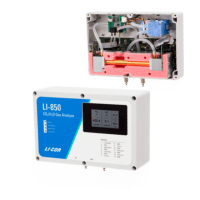
The optical bench is mounted in a foam enclosure to accomplish two purposes. The first is to
assist in maintaining the controlled thermal environment required for the optical bench as
described above. The second function of the foam enclosure is to protect the optical bench
from mechanical shock and vibration that might damage the mechanically sensitive
components. The foam enclosure is supported by a optical bench “tray” which is in turn
attached to the main circuit board (PCB). The optical bench is mechanically de-coupled from
the case by creating the s-bend in the Bev-a-line tubing from the external fittings to the optical
bench gas inlet and outlet connectors. The electronic interface to the source and detectors is
achieved through printed circuit boards mounted directly to the source and detector housings,
respectively. The main PCB connects to the source and detector PCBs via a ribbon cable.
This achieves the mechanical isolation desired for the optical bench.
Equation Summary
Measuring CO
2
Absorptance
CO
2
absorptance
c
is measured by the LI-820 by comparing the output of two detectors; one
(W) filtered to a CO
2
absorption band, and the other (W
0
) filtered to a non-absorption band.
α
c
o
W
W
ZS= −
⎛
⎝
⎜
⎞
⎠
⎟
1
4-1


 To Next Page