
 Need help?
Do you have a question about the Liberty Pumps LSG Series and is the answer not in the manual?
Guidance for storing the pump before installation to maintain its condition and protect it.
Details on manual and automatic control panels for LSG/LSGX-Series pumps.
Requirements for overload protection in 3-phase LSG/LSGX-Series grinder pumps.
Explanation of thermal overload protection for 1-phase pump models.
Safety warnings and requirements regarding power and control cords.
Explanation of float switch operation sequences for automatic and manual pumps.
Guidelines for positioning float switches for pump control and alarms.
Steps for preparing the basin for pump installation, including cleaning and inspection.
Instructions for completing pump and control wiring connections.
Procedure to verify correct motor rotation for 3-phase pumps before installation.
Information on installing and operating guide rail systems for pump mounting.
Instructions for placing the pump into the basin and ensuring correct mounting.
Guidelines for making discharge connections, including check valves and piping.
Requirement to vent the basin in accordance with applicable plumbing codes.
Steps to verify plumbing and valve readiness before starting the pump system.
Guidelines for checking the pump for corrosion and wear, and lubrication requirements.
Information on repair policies and assistance for unresolved issues.
Details the terms and conditions of the limited warranty for Liberty Pumps products.
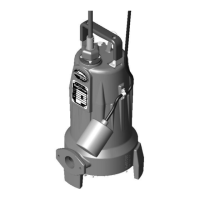
This document outlines the installation, operation, and maintenance procedures for Liberty Pumps' Omnivore 2 HP Grinder Pumps, specifically the LSG and LSGX-Series models. These pumps are designed for handling septic tank effluent, sewage, and drain (storm) water in residential and commercial applications. The LSG200-Series are single-stage pumps, while the LSGX200-Series are two-stage high-head pumps, both featuring robust grinding capabilities.
The Omnivore 2 HP Grinder Pumps are submersible centrifugal pumps engineered for continuous underwater operation. Their primary function is to grind solids and fibrous matter found in wastewater into small particles, allowing them to be safely pumped through small diameter piping. This grinding action is performed by hardened cutters designed for efficient flow characteristics and clog-free operation. The pump's induction motor is insulated against heat and moisture, ensuring durability in demanding environments. Protection against water entry is provided by a dual-seal system: a Viton lip seal at the lower end and a mechanical seal with two silicon carbide faces at the upper end. This design ensures the pump's longevity and reliable performance in challenging wastewater applications.
The pump system typically includes a control panel and float switches to automate its operation. For manual models, float switches are connected to the control panel, while automatic models feature a "piggyback" float switch attached directly to the pump. These float switches monitor the liquid level in the wet well (basin) and initiate or stop pump cycles accordingly. In 3-phase models, overload protection is integrated into the control panel, requiring proper sizing and adjustment based on the pump's full load input power to prevent overheating and nuisance tripping. Single-phase models are protected from locked rotor and running overloads by an integrally mounted thermal overload (thermostat) that automatically resets once the pump has cooled.
The Omnivore grinder pumps are designed for ease of installation and automated operation, provided all safety guidelines and instructions are followed. Before initial use, it is crucial to perform a "Cutter and Impeller Free Movement Check" to ensure the cutter spins freely with minimal resistance, which also helps lubricate the shaft seals. For 3-phase pumps, a "3-Phase Pump Rotation Verification" is mandatory to ensure correct impeller rotation (counterclockwise from the bottom view) before lowering the pump into the basin. Incorrect rotation can lead to significant performance loss and increased current draw.
The pump's operation is controlled by float switches that dictate the ON and OFF cycles based on liquid levels. For simplex (manual) systems, separate PUMP OFF, PUMP ON, and HIGH LEVEL ALARM floats are used, with specific level settings to optimize pump starts and prevent overflows. Duplex systems utilize PUMP OFF, LEAD PUMP ON, LAG PUMP ON, and HIGH LEVEL ALARM floats, allowing for alternating pump cycles and engaging a second pump during high demand or in case of a primary pump malfunction. The ON/OFF float switch differential should be set to avoid excessive starts per hour.
The pump requires a properly sized and grounded branch circuit, with electrical connections made by qualified personnel in accordance with the National Electrical Code® and local ordinances. Power and control cords are not to be spliced, and a junction box may be used if necessary. The pump's grounding conductor (green lead) must be properly connected. For automatic models, the piggyback switch is plugged into a 6-20R receptacle, which is wired to a 30 Amp breaker, and the pump is then plugged into the piggyback receptacle. For direct wiring into a junction box, the plug is removed, and connections are made by qualified personnel.
A check valve is required in the discharge line to prevent backflow, and a gate valve should follow it to facilitate periodic cleaning or pump removal. The discharge line should be as short as possible with minimal turns to minimize friction head loss, and its size should not be reduced below the pump outlet size. Proper basin venting is also required in accordance with plumbing codes to alleviate poisonous gas buildup and reduce the risk of explosion or fire.
Regular maintenance is crucial for ensuring the long-term reliability and performance of the Omnivore grinder pumps. The pump should be checked quarterly for corrosion and wear, with more frequent checks recommended for severe operating environments. As the motor is oil-filled, no lubrication or other routine maintenance is typically required for the motor itself. However, if replacement lubrication is needed, ISO VG 10 turbine oil should be used, filling approximately 0.8 gallons to just cover the upper bearing.
Before any handling or adjustments to the pump, pump system, or control panel, it is imperative to disconnect the pump(s) from all power sources to prevent electric shock. When working on pumps or piping exposed to wastewater, adequate Personal Protective Equipment (PPE) must be worn due to the potential for illness or disease transmission. Entry into a pump basin after it has been used is discouraged due to the presence of poisonous gases.
For uninstalled pumps that have been idle for more than three months, the cutters and impellers should be manually rotated once a month to lubricate the seals. Similarly, for installed pumps idle for over a month, impellers and cutters should be manually operated via the breaker panel once a month. For automatic models, this involves turning off the breaker, unplugging the piggyback switch, plugging the pump directly into the receptacle, turning the breaker on for 30 seconds, and then turning it off before plugging the piggyback switch back in.
Troubleshooting guidance is provided to address common issues such as the pump not starting, operating noisily, or repeated tripping. This includes checks for damaged cords, selector switch positions, blown fuses, tripped breakers, improper voltage, obstructed impellers or volutes, loose wiring, thermal overloads, water inside the motor, unintentional grounds, motor winding failures, and control circuit malfunctions. For 3-phase pumps, verifying correct rotation is a key troubleshooting step. Issues with float switch settings, liquid levels, airlocks, capacitor failures, and motor contactors are also covered. Any repair work during the warranty period must be approved by Liberty Pumps to avoid voiding the warranty. Disassembly by unauthorized personnel automatically voids the warranty.
 General
| Material | Cast Iron |
|---|---|
| Motor Housing Material | Cast Iron |
| Impeller Material | Cast Iron |
| Motor Type | Oil-filled |
| Horsepower | 2 HP |
| Voltage | 115V |
| Switch Type | Automatic |
| Phase | Single |
| Cord Length | 20 ft |
| Solids Handling | 2 inch |




 To Next Page