Need help?
Do you have a question about the Lifesaver jerrycan and is the answer not in the manual?
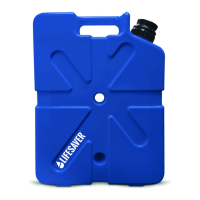
Identifies key parts of the LIFESAVER® jerrycan, including the carry handle, tap, and filtration membrane.
Details on minimum/maximum operating and storage temperatures for the jerrycan.
Covers flow rate, cartridge service rating, MWCO, and retention percentages for contaminants.
Lists regulatory compliance, membrane approvals, dry weight, and storage capacity.
Information on activated carbon priming and glycerine's role in membrane maintenance.
Detailed steps for priming the cartridge, initial drinking, and refilling the jerrycan.
Details on the ANYWAY® technology for angled use and guidelines for transporting the jerrycan.
Essential steps before trips, including cartridge checks, pump maintenance, and safety warnings.
Step-by-step guide for the FILL•PUMP•DRINK™ process for daily water filtration.
Advice on choosing the cleanest water sources to maximize filter life and performance.
Specifies what the jerrycan can and cannot filter, and the shelf life of the cartridge.
Critical warnings regarding shock, misuse, incompatible liquids, and cleaning agents.
Instructions for performing a front-side wash to reduce particulate build-up on membranes while in the field.
Detailed steps for cleaning the cartridge at home using a basin of water.
Step-by-step guide for safely removing the old and installing a new LIFESAVER® jerrycan UF cartridge.
Crucial safety precautions to minimize cross-contamination risk when changing cartridges in the field.
Instructions for installing or replacing the activated carbon filter tap for chemical removal.
Guidance on when to use the activated carbon filter tap, typically for suspected chemical contamination.
Instructions for lubricating the pump's o-ring with silicone grease to ensure smooth operation.
Explanation of the FAILSAFE™ technology that automatically shuts off water flow when the cartridge expires.
How to perform an integrity check to ensure membranes are not damaged.
Detailed steps and indicators for checking membrane integrity, including air expulsion.
Procedures for storing the jerrycan long-term, including front-side washing and avoiding drying.
Advice on preventing salt crystallization on membranes, especially in hard water areas.
Urgent caution regarding keeping membranes wet after first use to prevent pore closure.
Information on where to buy replacement cartridges and consumables.
Guidance on the proper disposal of used cartridges, specifying recyclability.
Provides the physical dimensions of the LIFESAVER® jerrycan in millimeters.
Answers questions about filtering urine and sea water, clarifying limitations regarding salt removal.
Details on the availability and use of activated carbon filters with specific jerrycan models.
Troubleshooting steps for when no water is coming out, suggesting cartridge expiry or need for front-side wash.
Information on sourcing replacement parts and addressing stiff pumping action due to lack of lubrication.
Details of the 2-year international warranty, including coverage and requirements for claims.
States that information is based on experience and provided as a guideline, not a guarantee.
Lists registered trademarks, patents, and copyright information for LIFESAVER® systems.
 General
| Capacity | 18.5 liters |
|---|---|
| Filtration Method | Ultra Filtration |
| Pore Size | 0.015 microns |
| Filtration Capacity | 20, 000 liters |
| Removes | Bacteria, Viruses, Cysts |
| Material | BPA-free plastic |

 To Next Page