Unpacking, Inspecting and Installing
248083408-1 Rev 1 3-11
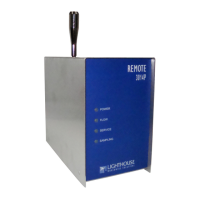
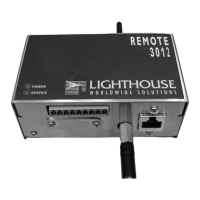
The Lighthouse Worldwide Solutions REMOTE P instruments
incorporate MODBUS TCP/IP communication over Ethernet.
Connecting a REMOTE P particle counter directly to an Ethernet
network should only be done with the permission and guidance of the
network administrator.
The primary advantage of using the REMOTE P on an Ethernet
network is that a separate network does not have to be installed just for
the instruments. Using the Ethernet Port allows the instruments to co-
exist with computers, printers and servers on a LAN that is already in
place, thereby reducing installation costs.
This document will explain how to program the Network Adapter
through its TCP/IP or its RS232 interface. It will also list typical
equipment required and provide some troubleshooting information.
The end of the document includes examples of T568A and T568B
wiring diagrams for straight-through and cross-over cables.
Definitions of
Terms Used
This list is provided for the convenience of the user or technician.
• ARP - Address Resolution Protocol, a program that can change
the ARP Cache of a host by adding or removing IP addresses.
Each IP address is associated to a MAC address.
• ARP Cache - List of IP addresses and their associated MAC
addresses for hosts whose addresses cannot be resolved normally.
• DHCP - Dynamic Host Configuration Protocol, a program
running on a server that issues IP addresses to computers or
devices (Hosts) on its LAN.
• Gateway - a network device that controls traffic between two or
more networks.
• Hardware address - a unique identifying code programmed by the
factory into a network device, such as a network PCB, comprised
of six two-digit groups of letters A-F and numbers 0-9.
• Host - a computer or device that allows access to itself via a LAN.
• IP (Internet Protocol) Address - a unique logical address used to
identify a host on a TCP/IP network.
• LAN - Local Area Network, a group of computers or hosts
connected together in a relatively small geographical area, such
as a building or floor of a building.
• MAC address - the same as hardware address.
• Netmask - a logical hexadecimal number that prevents accessing
hosts outside of its range. A bit value of zero allows access and a
non-zero blocks access.



 To Next Page