EasyManua.ls Logo

Lightware UMX-TPS-TX120 - User Manual

Lightware UMX-TPS-TX120
183 pages
Print Icon
To Next Page IconTo Next Page
Loading...
UMX-TPS-TX120, -TX130, -TX140, -TX140K, -TX140-Plus
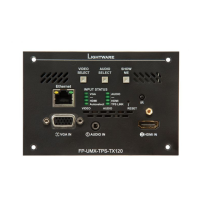
FP-UMX-TPS-TX120, -TX130
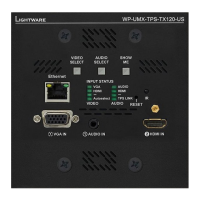
WP-UMX-TPS-TX120-US Black, White
WP-UMX-TPS-TX130-US Black, White
WP-UMX-TPS-TX130-Plus-US Black, White
HDBaseT
TM
Multimedia Extender
User’s Manual
v3.0 18-05-2021

Table of Contents

Other manuals for Lightware UMX-TPS-TX120

Questions and Answers

  • L
    ljacksonAug 18, 2025
    How to fix no picture on Lightware Extender video output?
    • B
      bellmorganAug 19, 2025
      If you're not getting any picture on the video output of your Lightware Extender, there are several potential causes: * **Power Issues:** Ensure all devices, including the extenders themselves, are properly powered. Try unplugging and reconnecting them. * **Cable Problems:** Make sure all cables, including video and TPS cables, are securely connected. * **TPS Mode:** Verify that the TPS mode and the selected modes of the extenders are correctly configured. * **Muted Ports:** Check if the input or output port is muted. * **Display Compatibility:** Ensure the display is capable of receiving the video format. Try emulating the display’s EDID on the input port. * **HDCP:** Enable HDCP on both the input and output ports.
  • R
    riverajeffreyAug 21, 2025
    Why does Lightware Extender HDMI output have no audio?
    • T
      tracycooperAug 21, 2025
      If the HDMI output signal from your Lightware Extender contains no audio, there are a couple of things to check: * **HDMI Mode:** Verify the output port properties and ensure the signal type is set to HDMI or Auto, not DVI. * **EDID Emulation:** Check the EDID settings and select an HDMI EDID to emulate instead of a DVI EDID.
  • B
    Brandon TaylorAug 23, 2025
    What to do if Lightware Extender displays the wrong picture?
    • D
      danielpageAug 23, 2025
      If the picture displayed on the video output of your Lightware Extender isn't what you expect, here's what to investigate: * **Test Pattern Settings:** Check the input ports properties to ensure the video input is not set to a static test pattern (no sync screen). * **Crosspoint Settings:** Verify that the video source isn't set to Testpattern input (I6). * **Source Video Settings:** Confirm that the video output isn't set to a test pattern because there's no picture on the video source. Check video settings of the source.
  • M
    Mr. Paul Curtis DDSAug 26, 2025
    How to troubleshoot no audio on Lightware Extender output?
    • M
      Marissa WalkerAug 26, 2025
      If you're not getting any audio on the output of your Lightware Extender, consider the following: * **Source Audio:** Check the audio settings of the source to ensure the volume isn't too low or muted. * **Input Port:** Verify the audio input port properties to make sure it's not muted. * **Output Port:** Check the output port properties to confirm it's not muted.
  • M
    Miguel VelasquezAug 27, 2025
    Why can't I establish a LAN connection with my Lightware Extender?
    • L
      lindsey25Aug 27, 2025
      If you're unable to establish a LAN connection with your Lightware Extender, try the following: * **IP Address:** If using a static IP, ensure the IP address is correct. Consider using a dynamic IP address by enabling the DHCP option. * **Factory Reset:** Restore the factory default settings (with fix IP). * **IP Conflict:** Check for IP address conflicts with other devices on the network.
  • B
    brianwebbAug 30, 2025
    How to fix a Lightware Extender when connected serial device does not respond?
    • J
      jennifer17Aug 30, 2025
      If a connected serial device isn't responding when connected to your Lightware Extender, check these things: * **Cable Connections:** Ensure the connectors fit well and check the wiring of the plugs. * **RS-232 Settings:** Verify that the port settings of the transmitter and the connected serial device(s) match. * **RS-232 Mode:** Confirm that the RS-232 mode settings (control, command injection, or disconnected) are correct.
  • A
    Amanda NunezSep 1, 2025
    How to stop continuous error messages on Lightware Extender?
    • N
      Nicole AndersonSep 1, 2025
      If you are continuously receiving error messages with your Lightware Extender, check the port protocol settings (LW2 / LW3) and use the proper protocol commands. It may be that a different protocol is set.
  • S
    Shannon FrederickSep 4, 2025
    Why doesn't changing EDID on Lightware Extender change resolution?
    • T
      Tonya GilmoreSep 4, 2025
      If you've changed the EDID on an input port of your Lightware device to get a different resolution and nothing happens, you need to restart your source to make it read out the EDID again.
  • E
    Edwin RobertsSep 8, 2025
    What to do if there is no audio output from Lightware UMX-TPS-TX120?
    • M
      Michelle MurphySep 8, 2025
      If there's no audio present on the output of your Lightware Transmitter, consider the following: * **Crosspoint Settings:** Verify the audio layer crosspoint settings to ensure the correct audio port is switched to the output. * **Source Volume:** Check the audio settings of the source device to ensure the volume is not low or muted. * **Output Port Mute:** Review the output port properties to confirm it is not muted. * **Analog Audio Volume:** If using analog audio, check the Analog audio input port settings and ensure the volume is not set too low.
  • M
    Michael GrahamSep 12, 2025
    Why does my Lightware Transmitter HDMI output have no audio?
    • J
      Justin LeeSep 12, 2025
      If your Lightware Transmitter's HDMI output signal contains no audio, check the following: * **HDMI Mode:** Verify the properties of the output port and ensure it is set to HDMI or Auto, not DVI. * **EDID Emulation:** Check the EDID settings and select an HDMI EDID to emulate, rather than a DVI EDID.

Summary

Important Safety Instructions

Class II Apparatus Construction and Ventilation

Guidance on operating, disconnecting, and ventilating the apparatus safely, emphasizing user-serviceable parts and avoiding hazards.

1. Introduction

1.1. Description of UMX-TPS-TX100 Series

Overview of the transmitter's design for extending digital/analog signals, HDCP support, EDID management, and remote powering.

1.3. Features List

Lists key features like 4K/3D support, Autoselect, IT-security, Batch Commands, CEC, Dark Mode, and more.

1.4. Model Comparison

Compares available models based on video ports, audio ports, and interface ports, highlighting feature differences.

2. Product Overview

Front Panel Buttons and Special Functions

Describes the function of front panel buttons like Video/Audio Select, Show Me, Reset, and special functions like DHCP.

3. Installation

Electrical Connections

Details the electrical connections including 12V DC, 48V DC, VGA, HDMI, DisplayPort, and DVI-I connectors.

4. Device Concept

Video and Audio Interface Features

Details video input modes, source selection, and the Autoselect feature with priority settings.

IT Security, Batch Commands, and TCP Recognizer

Covers basic IT security measures, batch command execution, and TCP message recognition.

Event Manager and GPIO Interface

Explains the Event Manager for automated actions and GPIO for controlling devices.

USB Interface (KVM) and CEC Feature

Details USB KVM extension capabilities and Consumer Electronics Control (CEC) for remote control.

5. Software Control - Lightware Device Controller

Install and Update Lightware Device Controller

Provides instructions for installing and updating the LDC software on Windows, macOS, and Linux.

Connecting to Devices via Device Discovery

Guides on using the Device Discovery window to find and connect to devices over Ethernet, Serial, or USB.

Crosspoint Menu Overview

Describes the Crosspoint menu interface, port tiles, and state indicators for managing signal routing.

Port Properties Windows

Details settings and status information for Analog Video, Digital Video, TPS Video Output, and Audio ports.

Event Manager Configuration

Explains how to arrange events, set conditions, actions, delays, and use the Event Manager Tool Kit.

The Built-In Miniweb

Details the miniweb feature for remote device control via a web browser or LDC.

Advanced View Window

Explains the Advanced View Window for LW3 protocol commands, including terminal and command line usage.

6. LW2 Programmers Reference

LW2 Protocol Description and Terminal Usage

Explains the LW2 protocol structure, commands, and instructions for using terminal applications.

General LW2 Commands

Lists and describes general LW2 commands for viewing product type, label, firmware, connection, and compile time.

AV Port Settings Commands

Details LW2 commands for switching inputs, muting/unmuting outputs, locking/unlocking ports, and viewing states.

LW2 Commands Quick Summary

A concise summary of all available LW2 commands for system, AV ports, network, RS-232, and GPIO configurations.

7. LW3 Programmers’ Reference

System Commands for Device Management

Covers commands for querying product name, serial number, firmware, resetting, and restoring defaults.

Video and Audio Port Settings Commands

Details LW3 commands for querying port status, crosspoint settings, autoselect, and input priorities.

Event Manager Basics and Tool Kit

Guides on arranging events, setting conditions, actions, delays, and using event manager tools.

Variable-Management Commands

Covers LW3 commands for assigning, adding/subtracting, and cycling variable values.

LW3 Commands - Quick Summary

Provides a comprehensive summary of LW3 commands for system, video, audio, event manager, and network settings.

8. Firmware Update

8.7. Troubleshooting Firmware Update Issues

Provides guidance on what to do if the firmware update is not successful, including error codes and logs.

9. Troubleshooting

Lightware UMX-TPS-TX120 Specifications

General IconGeneral
CategoryTransmitter
PoEYes
ResolutionUp to 4K@60Hz
Transmission DistanceUp to 100m
Power SupplyPoE
HDCP SupportHDCP 2.2
ControlRS-232, Ethernet
Audio Connectors1 x 3.5mm
USB SupportYes
Operating Temperature0°C - +40°C
Storage Temperature-20°C - +70°C

Related product manuals