13
LINCE ITALIA S.p.A.
Fig. 24
2.4.6 Antimascheramento
Il rilevatore 1907-BOBBY-AM-T-E e 1908-BOBBY-AM-T è dotato
di antimascheramento a infrarossi attivi per la protezione dei
sensori piroelettrici, che genera un segnale di manomissione
entro 3 minuti.
L’uscita dedicata a questa funzione è il morsetto denominato
MASK (v. g. 13).
In una installazione tipica questo morsetto può essere collegato ad
una linea attiva 24h o ad un ingresso di centrale opportunamente
programmato per l’invio di messaggi di anomalia. Quando il
rilevatore rileva un tentativo di mascheramento i quattro LED
lampeggiano simultaneamente no a quando permane la
condizione di mascheramento. Per abilitare il funzionamento
corretto della rilevazione di mascheramento (Anti-masking),
è necessario consentire al rilevatore di studiare ed analizzare
automaticamente le condizioni ambientali dell’area che deve
proteggere. Questa procedura è obbligatoria per assicurare il
corretto funzionamento del canale antimascheramento.
La procedura da seguire è la seguente:
1) Effettuare i collegamenti alla morsettiera del rilevatore.
2) Dopo aver dato alimentazione, chiudere il coperchio ed effet-
tuare tutte le prove di portata necessarie per il funzionamento
desiderato.
3) Riaprire il coperchio e impostare la sensibilità desiderata tra-
mite il dip switch 5.
4) Chiudere immediatamente il coperchio (entro 10 secondi al
massimo).
5) Tenersi fuori dall’area di copertura del rilevatore per circa 4
minuti afnché, durante questo periodo, non venga rilevata
nessuna presenza e vericare che non vi siano oggetti nel
raggio di 1 m.
2.4.6 Anti-masking
The detector 1907-BOBBY-AM-T-E e 1908-BOBBY-AM-T is
equipped with an active IR anti-masking function to protect the
pyroelectric sensors. It emits a tampering signal within 3 minu-
tes.
The output of this function is the MASK terminal block (see g.
13).
In a standard conguration, this terminal block can be connected
to a 24h active line or to a control unit input appropriately pro-
grammed to send fault messages. When the detector identies
a masking attempt, the four LEDs ash simultaneously until the
masking condition is resolved. To enable the correct operation of
the masking detection system (Anti-masking), allow the detector
to study and analyse the environmental conditions of the area
to be protected. This procedure is mandatory to guarantee the
correct operation of the anti-masking channel.
Follow the procedure below:
1) Make the connections to the detector terminal box.
2) Once powered, close the lid and run all the ow tests requi-
red.
3) Open the lid and set the desired sensitivity by dip switch 5.
4) Close the lid immediately (maximum within 10 seconds).
5) Keep out of reach of detector for about 4 minutes in order that
not detected any presence and pay attention that there are no
objects within 1 m.
3. AREA DI COPERTURA 2. COVERAGE AREA
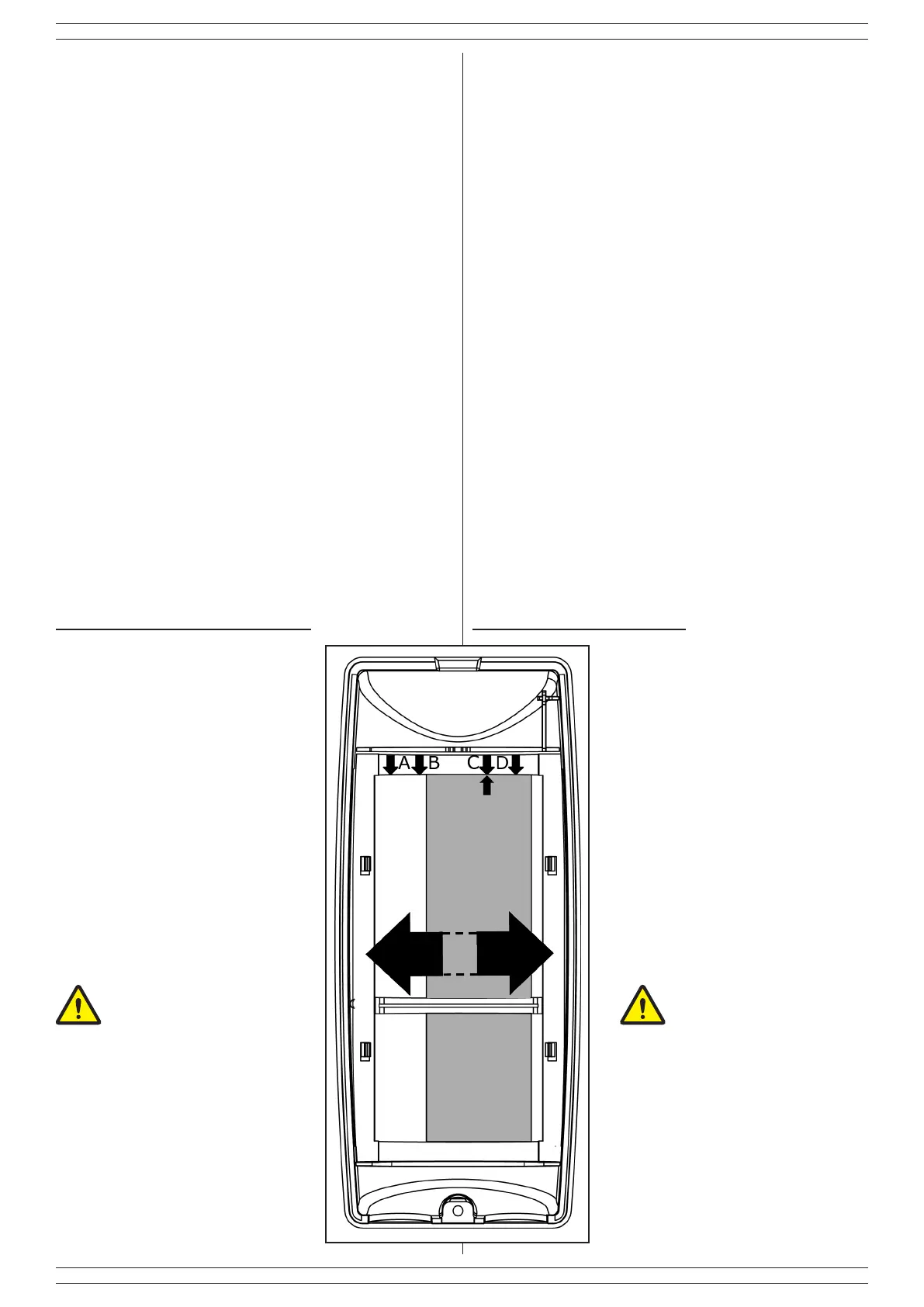
L’area di copertura del rilevatore
è costituita principalmente da due
fasci con un’apertura di 5° ognuno e
perpendicolari tra di loro.
All’interno del coperchio con lente è
presente un foglio in materiale plastico
utile per mascherare uno dei due
fasci, qualora sia necessario, e che è
possibile far scorrere sulla lente stessa
in diverse posizioni contraddistinte con
le lettere A, B,C,D.
Nell’immagine accanto viene riportata
la maschera in grigio che è possibile
far scivolare sulla lente e posizionare
in corrispondenza delle quattro lettere
facendo coincidere la freccia riportata
accanto ad ognuna di esse e quella
presente sulla maschera stessa.
The coverage area of the detector is
mainly constituted by two beams with an
aperture of 5 ° each and perpendicular
to each other.
Inside the lid with lens there is a
plastic sheet useful for masking one of
the two beams, if it is necessary, and
it is possible to slide on the lens itself
in different positions marked with the
letters A, B, C, D.
The picture on the left shows the mask
in gray; the mask can slide on the lens
and be placed in correspondence of the
four letters by aligning the arrow shown
near to each of them, and the arrow
present on the mask itself.
La maschera è trasparente e va fatta
scorrere orizzontalmente premendo
sulla parte superiore e inferiore con-
temporaneamente. In prossimità del-
le tre zone sensibili della lente (zone
in rilievo) potrebbe essere necessario
esercitare una maggiore pressione.
The mask is transparent and must be
slid horizontally by pressing on the
top and bottom simultaneously.
Close to the three sensitive area of
the lens (embossed areas) you may
need to apply more pressure.


 To Next Page