EasyManua.ls Logo

Lincoln Electric POWER WAVE S350CE - User Manual

Lincoln Electric POWER WAVE S350CE
44 pages
Print Icon
To Next Page IconTo Next Page
Loading...
Operator’s Manual
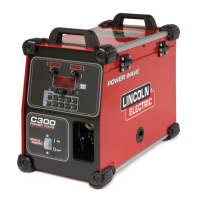
POWER WAVE
®
S350CE
Register your machine:
www.lincolnelectric.com/register
Authorized Service and Distributor Locator:
www.lincolnelectric.com/locator
IM10029-C | Issue D ate Apr-18
© Lincoln Global, Inc. All Rights Reserved.
For use with machines having Code Numbers:
11625, 11783*, 12795*
Need Help? Call 1.888.935.3877
to talk to a Service Representative
Hours of Operation:
8:00 AM to 6:00 PM (ET) Mon. thru Fri.
After hours?
Use “Ask the Experts” at lincolnelectric.com
A Lincoln Service Representative will contact you
no later than the following business day.
For Service outside the USA:
Email: globalservice@lincolnelectric.com
Save for future reference
Date Purchased
Code: (ex: 10859)
Serial: (ex: U1060512345)
*

Questions and Answers

  • E
    Eric DonovanAug 17, 2025
    What to do if my Lincoln Electric Welding System will not power up?
    • B
      Blake GonzalezAug 17, 2025
      If your Lincoln Electric Welding System won't power up and there are no lights, first ensure that the input supply disconnect is turned ON and check the input fuses. Also, make sure that the Power Switch (SW1) on the power source is in the 'ON' position. Another possible reason is that the input voltage is either too low or too high. Verify that the input voltage is correct by checking the rating plate located on the rear of the machine.
  • L
    lorimataAug 19, 2025
    Why Lincoln Electric Welding System won’t weld, can’t get any output?
    • L
      loweebonyAug 19, 2025
      If your Lincoln Electric Welding System won’t weld or produce any output, and this is accompanied by an error code, it could be due to a few reasons. First, ensure that the input voltage is correct according to the rating plate on the rear of the machine. Another cause could be a thermal error. Also, the secondary current limit might have been exceeded, possibly indicating a short in the output circuit. If the condition persists, contact an authorized Lincoln Electric Field Service facility.
  • M
    Melissa PetersonAug 22, 2025
    What to do if Lincoln Electric POWER WAVE S350CE output shuts down during a weld?
    • J
      Jessica SanchezAug 22, 2025
      If your Lincoln Electric Welding System's output shuts down during a weld, it might be because the secondary current limit has been exceeded, causing the machine to protect itself. To resolve this, adjust your procedure or reduce the load to lower the current draw. Another potential cause is a system fault, which will interrupt welding and cause a status light to blink.
  • R
    robertasharpAug 25, 2025
    Why my Lincoln Electric POWER WAVE S350CE won’t produce full output?
    • C
      Cheryl SmithAug 26, 2025
      If your Lincoln Electric Welding System isn't producing full output, the input voltage may be too low, limiting the power source's capability. Ensure the input voltage is correct by checking the rating plate on the rear of the machine. Also, the machine might need calibration of its secondary current and voltage.
  • A
    Ashley MillerAug 27, 2025
    What causes the Thermal LED to be ON on a Lincoln Electric POWER WAVE S350CE?
    • D
      david62Aug 27, 2025
      If the Thermal LED is ON on your Lincoln Electric Welding System, it could be due to improper fan operation. Check if the fan is running correctly: it should run at low speed when the machine is idle and at high speed when the output is triggered. Also, inspect for any material blocking the intake or exhaust louvers, or excessive dirt clogging the cooling channels. Another possible cause is an open thermostat circuit. Check for broken wires, open connections, or faulty thermostats in the thermostat circuit.
  • M
    Meagan MillerAug 30, 2025
    Why is the arc excessively long and erratic on my Lincoln Electric Welding System?
    • J
      jamesphillipsAug 30, 2025
      An excessively long and erratic arc on your Lincoln Electric Welding System could be due to a wire feed problem. Check for feeding issues and ensure the proper gear ratio has been selected. Another cause could be a loss of, or improper shielding gas; verify the gas flow and type are correct. Lastly, the machine may require calibration of its secondary current and voltage.
  • D
    Dustin PerrySep 2, 2025
    Why do the input fuses keep blowing on my Lincoln Electric POWER WAVE S350CE?
    • Z
      zbrownSep 2, 2025
      If the input fuses of your Lincoln Electric Welding System keep blowing, it could be due to several reasons. First, ensure that the fuses are properly sized according to the installation section of the manual. Another potential cause is an improper weld procedure that demands output levels exceeding the machine's rating; in this case, reduce the output current, duty cycle, or both. If, upon removing the covers, you notice major physical or electrical damage, contact your local authorized Lincoln Electric Field Service facility for assistance.
  • D
    Deanna GarciaSep 5, 2025
    How to fix wire burn back to tip at the end of the weld on Lincoln Electric Welding System?
    • L
      linda28Sep 5, 2025
      If the wire burns back to the tip at the end of the weld with your Lincoln Electric Welding System, it could be related to the burnback time setting. Try reducing the burnback time and/or work point.
  • F
    frank44Sep 8, 2025
    Why cannot connect Lincoln Electric POWER WAVE S350CE?
    • J
      John WalkerSep 8, 2025
      If your Lincoln Electric Welding System cannot connect, verify that you are using the correct patch cable or crossover cable. Ensure the cables are fully inserted into the bulkhead connector. The LED under the PC board ethernet connector should light up when the machine is connected to another network device. Also, use the appropriate PC utility to verify the correct IP address information has been entered and that no duplicate IP addresses exist on the network. Finally, verify that the network device connected to the Power Wave is either a 10-baseT device or a 10/100-baseT device.
  • C
    Charles ChaseSep 10, 2025
    What to do if “Real Time Clock” no longer functioning on Lincoln Electric Welding System?
    • J
      Jacob ThompsonSep 12, 2025
      If the “Real Time Clock” is no longer functioning on your Lincoln Electric Welding System, the cause is likely a Control PC Board Battery issue. Replace the battery with type BS2032.

Summary

General Safety Guidelines

Examine Carton and Equipment for Damage

Instructions for inspecting equipment upon receipt for shipping damage.

User Safety Responsibility

Emphasizes user responsibility for safe operation and installation.

Essential Personal Protective Equipment

Details essential personal protective equipment for welding safety.

Safety Warnings and Precautions

California Proposition 65 Warnings

Specific warnings related to California Proposition 65 for diesel exhaust and welding fumes.

Engine Powered Equipment Safety

Safety instructions for operating and maintaining engine-powered equipment.

Electric and Magnetic Field Hazards

Information on potential hazards from electric and magnetic fields during welding.

Welding Hazard Control

Electric Shock Prevention

Critical safety measures to prevent electric shock during welding operations.

Arc Ray Protection

Guidelines for protecting eyes and skin from harmful arc rays.

Fume and Gas Dangers

Warnings and precautions regarding hazardous fumes and gases produced during welding.

Fire and Explosion Prevention

Welding Sparks and Fire Hazards

Precautions to prevent fires and explosions caused by welding sparks.

Compressed Gas Cylinder Safety

Safety guidelines for handling and using compressed gas cylinders.

Electrically Powered Equipment Safety

Safety instructions for electrically powered welding equipment.

Electromagnetic Compatibility (EMC)

Conformance and Standards

Details compliance with European directives and harmonized standards for EMC.

Introduction to Emissions

Explains sources and transmission of electromagnetic emissions from electrical equipment.

Installation and Use Considerations

User responsibilities for installing and using equipment to manage interference.

EMC Emission Reduction Methods

Mains Supply and Shielding

Recommendations for connecting to the mains supply and shielding cables to reduce emissions.

Welding Equipment Maintenance

Routine maintenance procedures for welding equipment to ensure proper function.

Cable Management for EMC

Guidelines for positioning welding cables to minimize electromagnetic interference.

Technical Specifications

Power Source Input Voltage and Current

Details input power requirements, amperes, idle power, and power factor.

Rated Output Parameters

Specifies output ranges for GMAW, SMAW, and GTAW-DC processes.

Input Wire and Fuse Size Recommendations

Provides guidance on recommended input wire sizes and fuse/breaker ratings.

Welding Process and Physical Specifications

Welding Process Output Ranges

Lists output ranges (amperes, OCV) for different welding processes.

Physical Dimensions and Weight

Provides physical measurements and weight of the welding machine.

Temperature and Insulation Ratings

Specifies operating, storage temperatures, and insulation class.

Installation Safety Precautions

General Electrical Shock Warnings

Critical safety warnings for qualified personnel regarding electrical hazards.

Location and Environmental Considerations

Guidance on selecting a suitable operating location and environmental factors.

Lifting, Stacking, and Tilting Guidelines

Procedures and warnings for safely moving and positioning the equipment.

Input Connection and Power Cord

Input Connection Procedures

Instructions for connecting input power leads by qualified electricians.

Input Fuse and Wire Considerations

Guidance on selecting appropriate input fuses, wire sizes, and breakers.

Power Cord Replacement

Steps and safety precautions for replacing the power cord.

Welding Connection Diagrams

GTAW (TIG) Welding Connections

Diagram illustrating connections for TIG welding setup.

SMAW (STICK) Welding Connections

Diagram illustrating connections for Stick welding setup.

GMAW (MIG) Welding Connections

Diagram illustrating connections for MIG welding setup.

Work Cable Sizing and Guidelines

Recommended Cable Sizes for Arc Welding

Table and guidelines for selecting appropriate work and electrode cable sizes.

Cable Connection and Routing

Best practices for connecting and routing welding cables for optimal performance.

Cable Inductance and Voltage Sensing

Effects of Cable Inductance on Welding

Explains how cable inductance affects welding performance and how to minimize it.

Remote Sense Lead Specifications

Details requirements and guidelines for remote voltage sense leads.

Voltage Sensing Details

Electrode Voltage Sensing

Information on how electrode voltage sensing is automatically configured.

Work Voltage Sensing Requirements

Recommendations for using remote work voltage sense leads for optimal performance.

Multiple Arc Voltage Sensing

Considerations for Multiple Arc Systems

Special care needed when multiple arcs operate simultaneously.

Sense Lead Usage in Multiple Arcs

Guidelines for positioning sense leads in multi-arc configurations.

Control Cable Connections

General Control Cable Guidelines

Best practices for using and routing control cables, including length limits.

ArcLink Wirefeeder Connections

Specific instructions for connecting ArcLink compatible wire feeders.

Ethernet Network Connections

Guidelines for connecting to Ethernet networks, including cable types.

Operation Safety and Basics

Operation Safety Precautions

Essential safety warnings before operating the welding machine.

Graphic Symbols Explained

Explains the meaning of graphic symbols used on the machine and in the manual.

Power-Up Sequence and Duty Cycle

Describes the machine's power-up sequence and the definition of duty cycle.

Product Description and Capabilities

Product Summary

Overview of the POWER WAVE® S350CE's features and capabilities.

Recommended Processes and Equipment

Information on compatible welding processes and recommended equipment.

Process and Equipment Limitations

Details limitations on processes, wire types, and compatible feeders.

Machine Design Features

Standard Design Features

Lists key features and technologies incorporated into the machine's design.

Case Front Controls Overview

Identifies and explains the controls located on the front panel of the machine.

Case Back Controls

Controls for Code 11625 (Case Back)

Details the controls located on the back panel for specific machine codes.

Controls for Code 11783 (Case Back)

Details the controls located on the back panel for specific machine codes.

Welding Procedures and Controls

Making a Weld - Basic Procedures

Guides the user through the process of making a weld and selecting parameters.

Welding Mode Definitions

Explains synergic and non-synergic welding modes.

Basic Welding Control Adjustments

Describes adjustments for Weld Mode, WFS, Amps, Volts, Trim, and UltimArc.

Specific Welding Process Operations

SMAW (Stick) Welding Operation

Details how to set up and operate for Stick welding.

GTAW (TIG) Welding Operation

Details how to set up and operate for TIG welding.

Constant Voltage Welding Modes

Explains synergic CV, non-synergic CV, and Pinch control.

Advanced Pulse Welding Features

Pulse Welding Waveform Control

Explains how pulse welding parameters affect arc properties and control.

UltimArc Control Functionality

Details how UltimArc™™ Control adjusts arc shape and characteristics.

Accessories and Options

Kits, Options, and Accessories Overview

Lists available kits, options, and accessories for the welding system.

Field Installed Options - General

Describes general field-installable options like DeviceNet and Gas Regulator kits.

Cable Packages and Connectors

Details available cable packages, plugs, and receptacles for welding connections.

Specific Accessory Kits

Stick Welding Accessory Kits

Lists accessory kits specifically for Stick welding applications.

TIG Welding Options and Torches

Describes TIG torches, Amptrols, and arc start switches.

MIG Welding Cables and Equipment

Lists MIG welding cables and compatible Lincoln equipment.

Maintenance Procedures

Maintenance Safety Precautions

Crucial safety warnings before performing any maintenance on the equipment.

Routine Maintenance Tasks

Basic cleaning and maintenance tasks to ensure longevity.

Periodic Maintenance and Calibration

Recommended checks and calibration for optimal performance.

Troubleshooting Guide Introduction

How to Use the Troubleshooting Guide

Step-by-step instructions on how to effectively use the troubleshooting guide.

Service and Repair Warnings

Warnings about performing repairs and the importance of qualified personnel.

Status LED Error Codes

Understanding System Status Lights

Explanation of the status lights and their meaning in diagnosing problems.

LED and Beeper Error Interpretation

Details how to interpret error codes indicated by status lights and audible beeps.

Main Control Board Error Codes

Main Control Board Error Code List

Lists specific error codes and their indications for the main control board.

Input Control Board Error Codes

Input Control Board Error Code List

Lists specific error codes and their indications for the input control board.

Troubleshooting Basic Machine Problems

Fuse and Power-Up Issues

Addresses problems with input fuses blowing and the machine not powering up.

Welding Output Problems

Troubleshoots issues related to the machine not welding or getting output.

Troubleshooting Performance Issues

Thermal Faults and Clock Issues

Addresses thermal LED indications and "Real Time Clock" malfunctions.

Weld and Arc Quality Degradation

Discusses common causes for general degradation in weld performance.

Welding Quality Troubleshooting

Wire Burnback and Shutdown Issues

Troubleshoots wire burning back and machine output shutting down during welds.

Arc Instability and Output Problems

Addresses issues causing excessively long, erratic arcs and low output.

Connectivity Troubleshooting

Ethernet Connection Failures

Guides on resolving issues with establishing and maintaining Ethernet connectivity.

Cable Location and Connection Drops

Addresses problems with connection drops due to cable placement.

Electrical Diagrams

Power Wave S350 CE Schematic

Provides the main electrical schematic for the welding machine.

Physical Dimensions

Equipment Dimension Print

Illustrates the physical dimensions and layout of the welding machine.

Customer Assistance Policy

Company Assistance and Limitations

Outlines the scope and limitations of customer assistance and advice provided.

Lincoln Electric POWER WAVE S350CE Specifications

General IconGeneral
BrandLincoln Electric
ModelPOWER WAVE S350CE
CategoryWelding System
LanguageEnglish

Related product manuals