Mow a
Circuit Breaker Works
With the exception of No. 1015 transformer supplied
with several starter train sets, all Lionel transformers are
equipped with built-in thermostatic circuit breakers. Circuit
breakers of this type depend on the heating effect of elec-
tric current. Whenever the current drawn from a trans-
former exceeds a certain limit, it overheats a thermostatic
bi-metal strip or disc within tlIe circuit breaker and snaps
it open, cutting off the output of the transformer. In a few
seconds the circuit breaker cools down and closes automati-
cally. It will keep on opening and closing in this way as long
as the transformer is overloaded-as by a short circuit or
another excesRive load.
The purpose of the circuit breaker is to protect the
transformer and it operates only if the transformer is
overloaded. In large layouts it is possible for the track to
be "shorted" without causing the circuit breaker of a large
and powerful transformer to operate. However, no injury
can occur to the transformer in this event, because it is
not being overloaded even though the voltage in the shorted
portion of the track may drop down below the operating
point of the train.
No. 91 Circuit Breaker
Lionel No. 91 Circuit Breaker differs from the regular
built-in breakers in being electro-magnetic instead of ther-
mostatic. No. 91 Circuit Breaker does not depend on the
heating effect of electric current but opens instantaneously
the moment the current passing through it exceeds the
ILLUMINA TED
RESET BUTTON
limit for which it is adjusted. It is adjustable to open on any
current from 1 to 6 amperes, and has an illuminated manual
reset button which lights up whenever the circuit breaker
snaps open.
No. 91 Circuit Breaker has two main applications. The
first is to protect transformers which are not equipped with
their own built-in circuit breakers, such as No. 1015 Trans-
former, supplied with several "027" starter train outfits.
The other application, must useful in larger or multi-train
layouts, is to protect each train circuit separately. If you
depend on the built-in transformer circliit breaker a short
circuit or a derailment in any portion of the railroad will
stop all traffic everywhere. However, if each train is pro-
tected individually its derailment will shut off power from
its own branch alone, without interfering with the power
supply to other sections. In this way the trouble can be
quickly localized and corrected.
HOW TO BUILD A MODEL RAILROAD
One of the most fascinating things about owning a minia-
ture train is the planning and building of a model layout
that has all the features of an actual railroad system. With
Lionel's wide selection of tracks and accessories it is easy
to duplicate any of the operations of th" big roads. Like
all hobbies, model railroading develops slowly. You can start
with a layout that fits your income, and add to it gradually.
This booklet has a few ideas to get you started. You can
get a great many more from the various model railroad
hobby magazines available at your hobby or news dealer.
Plan Your Layout Carefully
First step is to get out your pencil and put down a few
ideas that will guide you in your planning. Where will your
~
,. ". '. ,;.".w
Overall size: 82" x S2".
Track needed: 8 sections
straiqht. 10 sections curved.
pair of switches.
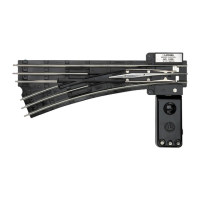
Ove roll size: 82" x 41".
Track needed: 14 sections
straiqht. 11 curved. 3 switches
1 remote control section.
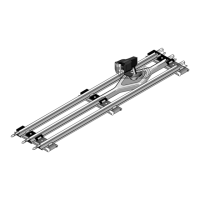
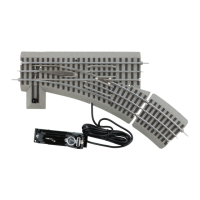
Overall size: 82" x 41".
Track needed: 15 sections
slraiqht. 14 sections curved.
one 90 deqree crossinq. one
remote control section. 2 rlqh\o
hand. 3 left·hand switches.
Overall s1:l.: 82" x 41".
Track needed: 14 sltCtions
straiqht. 10 sections curved.
4 swltche •• 2 remote control
.ectiona.
c:c::: :)





 To Next Page