Lionel "Smoke" Locomotives
Most Lionel steam-type loco-
motives are equipped with a
smoke generator which produces
odorless, realistic "smoke". Drop
a smoke pellet into the locomo-
tive stack and turn on the track
power. In a few seconds the
heater. in the smoke generator
melts the pellet and smoke rises
from the stack. The locomotive
will puff only when the wheels
are turning.
Important
Lionel locomotives are equipped with two types of smoke-produc-
ing mechanisms.
If the locomotive requires Pellets. use only Lionel No. SP. Any
other material may damage the heating element in the smoke
generator. Use only one pellet at a time making-sure that each is
used up before dropping in another. Too many pellets will clog the
generator and result in less smoke.
Other Lionel locomotives require No. 909 Smoke Fluid furnished
in squeeze bottles. Place four to eight drops in the smoke generator.
Make sure that smoke fluid in the locomotive is used up before put-
ting more into the generator. An excess amount will overflow and
spill from the locomotive.
Only Lionel No. 909 Smoke Fluid should be used. Other smoke
producing compounds may result in damage to the smoke generator.
Both Lionel No. SP Smoke Pellets and No. 909 Smoke
Fluid have been rigorously tested and are free from any
toxic. effects. They are absolutely. harmless even if acci-
dentally swallowed by a small child.
How to Take Care of Smoke Locomotives
After the locomotive has been used for a while it may
produce less smoke than it did at first. This may be caused
by smoke material clogging up the stack, or the small air
opening inside the generator. Clean out the stack, increase
the track power slightly and let the locomotive stand in
neutral for a few minutes. This treatment will melt the
smoke material. Then lift the locomotive slightly to allow
the wheels to turn rapidly. After a few minutes the loco-
motive will puff as well as ever.
Coupling and Uncoupling
All standard Lionel cars and tenders are equipped with
remote control operating knuckle couplers. Open couplers
are closed mechanically, simply by pushing two mating
couplers together until their knuckles close and latch. This
operation can be done along any straight portion of track
provided that at least one of the mating couplers is open.
Most modern Lionel cars and locomotives have "magnetic"
couplers with a TRIGGER PLATE or BUTTON which is
attracted by the central electromagnet of the control track.
To open a "magnetic" coupler move the car so that the truck
you wish opened is over the uncoupling electromagnet. Then
push the "Uncouple" button.
"Magnetic" Button-operated Couplers can be operated
mechanically by means of the No. 1008 I'Cam-Tr01" un-
coupling unit and also by any Remote Control Uncoupling
Track Section.
Remote Control Uncoupling Track Sections are available
for all types of Lionel track. These are: No. 6019 for "027"
track, No. UCS for "0" gauge and No. 37 for Super "0".
AUTOMATIC OPERATING CARS
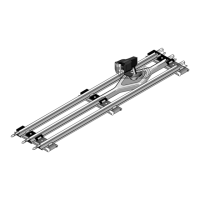
Because of the closely-spaced track ties of "Super-O"
track, the special contact blades of such equipment as the
No. 3656 Cattle Platform, No. 497 Coaling Station and the
"low bridge" signal blades of No. 3376 Giraffe Car can-
not be fitted into the regular "Super-O" track and must be
mounted on No. 38 Accessory Adapter Sections, which are
sold in pairs each one-half length of a regular "Super-O"
straight section.
Cars Using Contact Slide Shoes
The mechanism of most operating cars is powered by an
electrical coil, which is connected with one or two sliding
shoes located on the bottom of the car trucks. These sliding
shoes make contact with the track in a variety of ways:
through control rails of UCS or No. 6019 Remote Control
Track Sections, through OTC contactors which are clamped
to .ordinary track, through special contact blades built
into the bases of various trackside accessories or through
remote control blades of "Super-O" track. Cars which
are made to operate on Remote Control Track can also be
made to work on a pair of properly spaced and connected
OTC contactors. To operate cars of this type, position them
so that the slide shoe or shoes ride up on the control rails
or blades. Then push the appropriate controller button.
Nate:
Nos. 6009 and 6029 uncoupling track sections sup-
plied with some lower-priced Lionel train outfits do not
have control rails and cannot be used to operate cars of
this type. Listed below are some of the most-recently manu-
factured operating cars using contact slide shoes.
CAR
I
OPERATED BY
1
or
No. 3359 Dump Car 2 OTC Contactors "Super
No. 3562 Barrel Car 1 OTC Contactor 0"
No. 3356 Horse Car 1 OTC Contactor Blades
No. 3656 Cattle Car *Cattle Platform Blades
No. 3424 Brakeman Car *Low Bridge Signal Blades
No. 3662 Milk Car
No. 3482 Milk Car
lues",
No. 6019 R=""
No. 3461 Lumber Car
Control Track, 2 OTC
No. 3361 Lumber Car
Contactors, or 2 "Super-O"
No. 3469 Coal Dump Car
Operating Blades
No. 38 Sections are 5%" long
and must be used in pairs to
balance the layout.
OTC
Contactor
OTC contactor is clamped to the track like a lockon and
the height of its control rails adjusted to match the height
of
"0"
or "027" track. When the OTC contactor is clamped
to the track, its No. 2 clip makes automatic contact with
the center rail and No.1 clip is connected internally to both
control rails. The illustration below shows how the OTC
control rails may be connected to track power, to fixed
voltage or to "ground."
TRACK POWER
OTC
FIXED VOLT AGE
OTC
GROUND
OTC LOCKON
NO. 90
CONTROLLER





 To Next Page