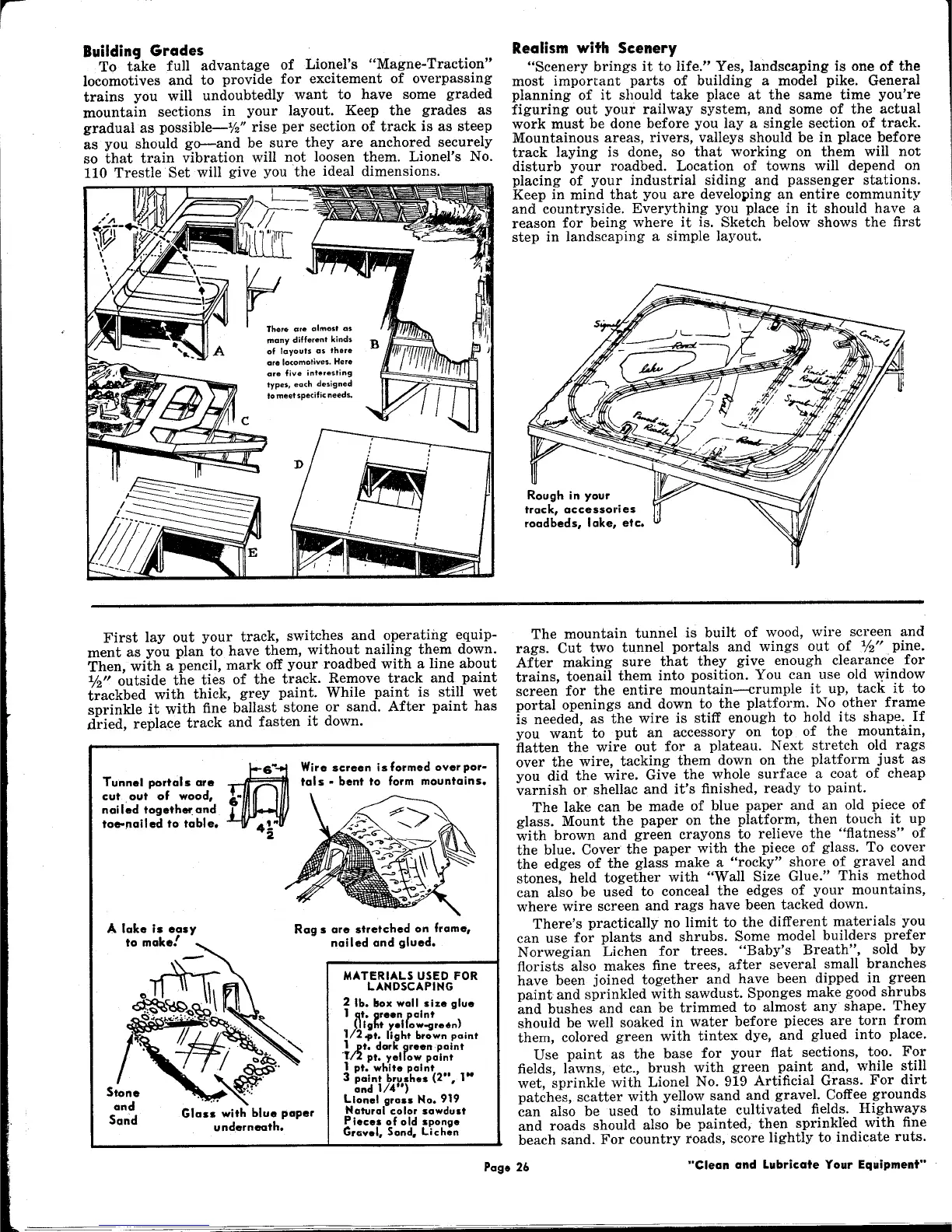
Building Grades
To take full advantage of Lionel's "Magne-Traction"
locomotives and to provide for excitement of overpassing
trains you will undoubtedly want to have some graded
mountain sections in your layout. Keep the grades as
gradual as possible-%" rise per section of track is as steep
as you should go--and be sure they are anchored securely
so that train vibration will not loosen them. Lionel's No.
110 Trestle Set will give you the ideal dimensions.
Realism with Scenery
"Scenery brings it to life." Yes, landscaping is one of the
most important parts of building a model pike. General
planning of it should take place at the same time you're
figuring out your railway system, and some of the actual
work must be done before you lay a single section of track.
Mountainous areas, rivers, valleys should be in place before
track laying is done, so that working on them will not
disturb your roadbed. Location of towns will depend on
placing of your industrial siding and passenger stations.
Keep in mind that you are developing an entire community
and countryside. Everything you place in it should have a
reason for being where it is. Sketch below shows the first
step in landscaping a simple layout.
First layout your track, switches and operating equip-
ment as you plan to have them, without nailing them down.
Then, with a pencil, mark off your roadbed with a line about
%"
outside the ties of the track. Remove track and paint
trackbed with thick, grey paint. While paint is still wet
sprinkle it with fine ballast stone or sand. After paint has
dried, replace track and fasten it down.
Tunnel portols are
cut, out of wood,
noiled together and
toe-/1ailed to table.
If(j
H
6"
4~"
2
Wire screen is formed over por"
tals" bent to form mountains.
A lake is easy
to make!
Rag s are stretched on frame,
nailed and glued.
MATERIALS USED FOR
LANDSCAPING
2 lb. "ox wall siz ••glu ••
1 !it. gr••••n paint
(light
y••
llow-gre6n)
1/2 •••
t.
light brown paint
1 .pt. dark gr••••npaint
'T/2
pt.
y••
llow paint
1 pt. whit •• paint
3 paint brushes
(2". 1"
and
1/4")
Llon ••
1
gross No. 919
Natural color sawdust
PI••c••• of old .pong ••
Grav ••
l. Sand. Lich ••n
~
I
c5tiS5"
Stone . ,~.
d .. ~'"
S::d Glass with blue paper
underneath.
The mountain tunnel is built of wood, wire screen and
rags. Cut two tunnel portals and wings out of
Y2"
pine.
After making sure that they give enough clearance for
trains, toenail them into position. You can use old 'Yindow
screen for the entire mountain--crumple it up, tack it to
portal openings and down to the platform. No other frame
is needed, as the wire is stiff enough to hold its shape. If
you want to put an accessory on top of the mountain,
flatten the wire out for a plateau. Next stretch old rags
over the wire, tacking them down on the platform just as
you did the wire. Give the whole surface a coat of cheap
varnish or shellac and it's finished, ready to paint.
The lake can be made of blue paper and an old piece of
glass. Mount the paper on the platform, then touch it up
with brown and green crayons to relieve the "flatness" of
the blue. Cover the paper with the piece of glass. To cover
the edges of the glass make a "rocky" shore of gravel and
stones, held together with "Wall Size Glue." This method
can also be used to conceal the edges of your mountains,
where wire screen and rags have been tacked down.
There's practically no limit to the different materials you
can use for plants and shrubs. Some model builders prefer
Norwegian Lichen for trees. "Baby's Breath", sold by
florists also makes fine trees, after several small branches
have been joined together and have been dipped in green
paint and sprinkled with sawdust. Sponges make good shrubs
and bushes and can be trimmed to almost any shape. They
should be well soaked in water before pieces are torn from
them, colored green with tintex dye, and glued into place.
Use paint as the base for your flat sections, too. For
fields, lawns, etc., brush with green paint and, while still
wet, sprinkle with Lionel No. 919 Artificial Grass. For dirt
patches, scatter with yellow sand and gravel. Coffee grounds
can also be used to simulate cultivated fields. Highways
and roads should also be painted, then sprinkled with fine
beach sand. For country roads, score lightly to indicate ruts.






 To Next Page