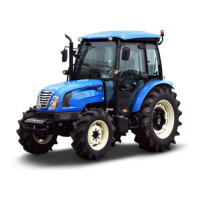
Why is the headlight dark on my LS tractor?
- ZznorrisSep 12, 2025
If the headlight of your LS tractor is dark, it could be due to: * Battery capacity is low: charge or replace the battery. * Bad wiring and contact: check and repair the wiring.

Why is the headlight dark on my LS tractor?
If the headlight of your LS tractor is dark, it could be due to: * Battery capacity is low: charge or replace the battery. * Bad wiring and contact: check and repair the wiring.
What causes oil leakage in my LS tractor?
If you notice oil leakage on your LS tractor, it could be due to: * Connecting part loosened: tighten it. * Oil seal damaged: replace it. * Pipe cracked: replace it.
Why is it hard to operate the steering wheel on my LS tractor?
If the steering wheel of your LS tractor is hard to operate, it could be due to: * Steering unit spline and column spline is not aligned: check mounted condition of steering unit and column. * Spool and sleeve damaged by foreign material: replace. * Excessive tightening torque of end cap bolt: apply regular torque. * Low speed: adjust RPM or repair. * Wearing or failure: repair or replace. * Valve spool clogged: repair or replace. * Setting pressure too low: reset or adjust.
Why doesn't the cylinder work smoothly as steering wheel movement on my LS tractor?
If the cylinder of your LS tractor does not work smoothly as steering wheel movement, it may be caused by: * Air in steering line if not used for a long time: Bleed air. * Air in suction pipe: Repair. * Piston seal damaged: Replace.
Why does the steering wheel turn to the opposite direction on my LS tractor?
If the steering wheel of your LS tractor turns to the opposite direction, it may be caused by: * bad assembly of steering gear: Repair. * bad assembly of steering hose: Repair.
Why won't the start motor turn on my LS tractor?
If the start motor of your LS tractor doesn't turn when you turn the key, it could be due to several reasons: * The start safety switch may not be contacted: fully depress the clutch pedal. * The PTO switch may not be in the “OFF” position: place the PTO switch in the “OFF” position. * The battery may be discharged: charge or replace it. * A terminal may be loosened: tighten it. * The key switch may have failed: repair or replace it. * The start motor may have failed: repair or replace it.
Why is the clutch slipping on my LS tractor?
If your LS tractor's clutch is slipped, it could be due to: * Wrong clutch pedal play: adjust it. * Friction lining worn or broken: replace it.
What to do if the lift arm does not lower on my LS tractor?
If the lift arm of your LS tractor does not lower, check the following: * Down speed control valve locked: turn the knob counter-clockwise. * Control valve failure: repair or replace the valve. * Cylinder damaged: replace the cylinder. * Lift shaft turning part damaged: repair or replace it.
Why is the hydraulic steering system not working on my LS tractor?
If your LS tractor's hydraulic steering system does not work, it could be due to: * Pump worn or part damaged: repair or replace. * Steering unit damaged or worn: repair or replace. * Oil leakage by steering cylinder piston seal damaged or worn: repair. * Oil leakage by pipe damage: repair or replace.
What causes the clutch to not cut-off in my LS tractor?
If the clutch of your LS tractor does not cut-off, it could be due to: * Lining damaged: repair or replace the lining. * Wrong clutch pedal play: adjust the pedal play.
| Engine Type | Diesel |
|---|---|
| Drive | 4WD |
| Brakes | Wet Disc |
| Hydraulic System | Open Center |
| 3-Point Hitch | Category I |
| PTO Type | Independent |
| PTO Speed | 540 rpm |
| Steering | Power steering |
Provides essential information about the tractor's operation, manual scope, and safety alerts.
Crucial safety advice for tractor operation, including pre-use checks, clothing, and hazard warnings.
Information on safety decals, their meaning, and placement for operator safety.
Location and importance of instructional signs for safe tractor operation.
Identifies key components for Roll-Bar and Cabin types.
Safe procedures for entering and exiting the tractor, covering both cabin and roll-bar models.
Details on safety features like Hood, Fender, PTO covers, and ROPS for operator protection.
Overview of the instrument panel and all front-mounted controls for tractor operation.
Detailed description of controls located on the right-hand side and cabin pillar.
Explanation of controls situated on the left-hand side of the tractor.
Information on the electro-hydraulic forward and reverse system for convenient operation.
Safety precautions and details regarding the tractor's hydraulic system.
Essential checks and break-in procedures for a new tractor.
Step-by-step instructions for safely starting and stopping the tractor engine.
Guidance on driving procedures, speed changes, and stopping.
Safety rules and procedures for driving the tractor on public roads.
Instructions for 3-point linkage, PTO operation, and implement handling.
Information on appropriate driving speeds based on transmission and tires.
Importance of regular maintenance, genuine parts, and service intervals.
Standard service intervals for tractor components and checks.
Specifications for engine oil viscosity, lubricants, and system capacities.
Specific checks and maintenance required after the first 50 hours of operation.
Understanding and responding to instrument panel warning lights.
Daily pre-start checks for engine oil, fuel, indicators, lights, and horn.
Maintenance tasks required every 50 hours of operation.
Maintenance tasks required every 100 hours of operation.
Maintenance tasks required every 300 hours of operation.
Maintenance tasks required every 500 hours of operation.
Maintenance tasks for changing front axle and transmission oil.
Maintenance tasks required every 1000 hours or 1 year.
Maintenance tasks required every 1500 hours or 2 years.
Maintenance tasks required every 3000 hours.
Procedures for fuel system, fuses, battery, and alternator maintenance.
Diagnosing and resolving common tractor system faults.
Identification of components within the AC and heating system.
Instructions for operating AC and heater controls.
Scheduled maintenance for the AC system every six months.
Scheduled annual maintenance for the AC system.
Common AC system issues and their potential causes and solutions.
Diagram illustrating the air conditioning system components and flow.
Detailed dimensions for the tractor's roll-bar configuration.
Detailed dimensions for the tractor's cabin configuration.
Technical specifications for engine, fuel, lubrication, transmission, and PTO systems.
Specifications for engine oil viscosity, lubricants, and system capacities.