Operation Manual
touchTymp MI 24
and
MI 34
Version
The aim of Acoustic Reflexes is to test the condition of the Musculus stapedius.
o One or more louder tones will be heard during the test. No participation is
expected from the patient.
The aim of Reflex Decay is test the integrity of the CN VIII.
o One tone is presented above the acoustic reflex threshold measurement for
a minimum period of 10 seconds.
The aim of ETF is to test the condition of the Eustachian tube.
o ETF Intact: three tympanograms are completed while the patient performs
a manueaver between each tympanogram.
o ETF Perforated: pressure level is obtained in the ear canal and the patient
swallows to measure change of pressure.
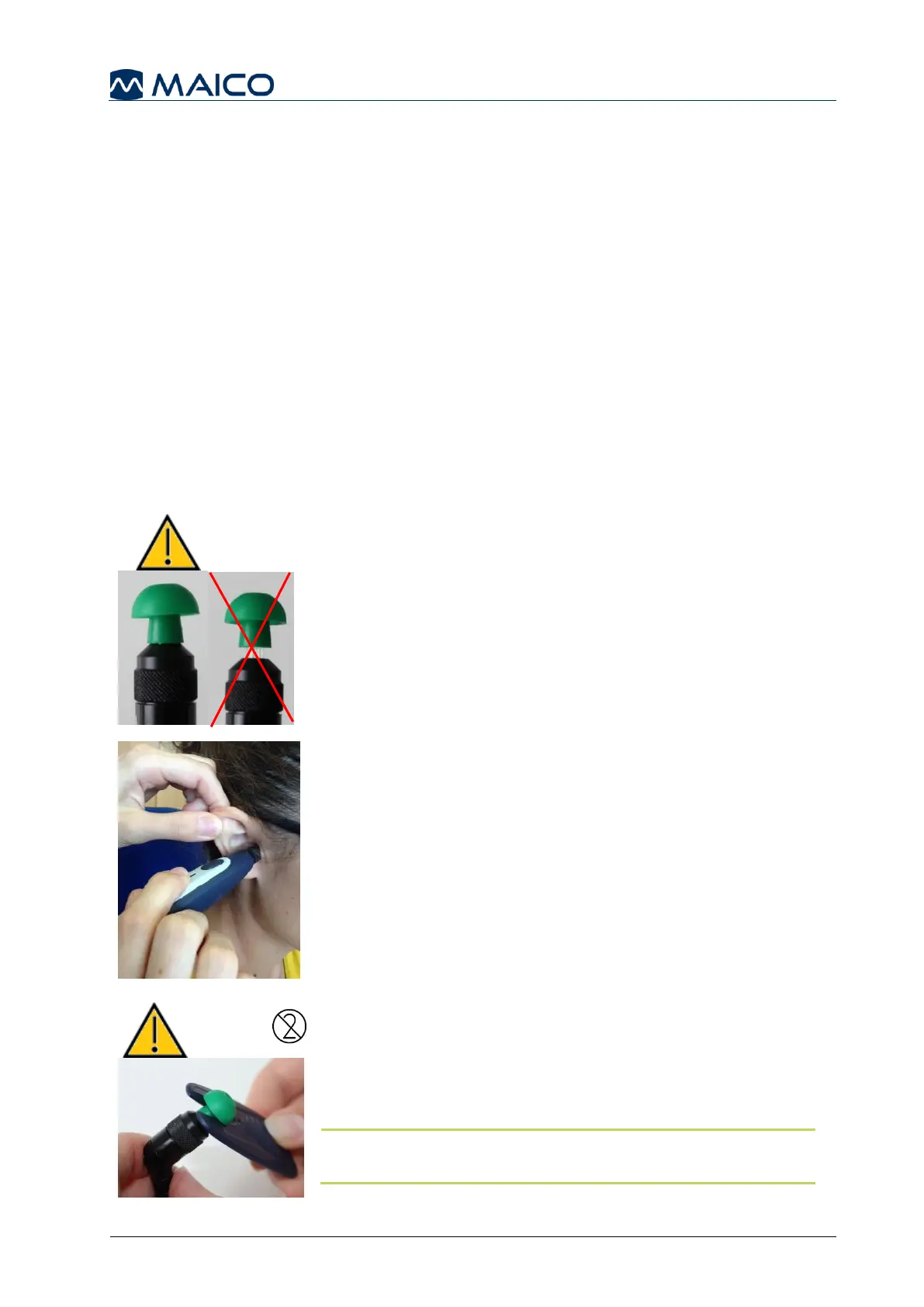
5.4.3.4 Handling the Eartips
Choose the proper size of eartips based on your inspection of the size of the patient’s ear canals.
Do not insert the probe without having an eartip attached to
prevent damage to the patient’s ear canals.
Put the eartip tightly on the probe tip making sure it is pushed
all the way down (Figure 37).
Insert the probe with eartip attached into the patient’s ear.
For children and adults, pull gently up and back on the outer
ear (i.e. Pinna) during insertion to straighten the ear canal.
Hold the adapter and aim and twist (gently) the eartip into the
ear canal. The fit of the eartip should be secure; not
superficial (Figure 38). Release the earlobe. When testing
infants, gently pull the Pinna down and back to straighten the
ear canal.
Each eartip should only be used once. For more detailed
information see section 3.4.
In order to remove the eartip, grasp the eartip at the base
using the eartip removal tool and pull it smoothly straight off
the probe tube (Figure 39).
NOTE: If the probe tip becomes dirty or clogged, it must
be cleaned (see section 3.3.4) or replaced.


 To Next Page