Need help?
Do you have a question about the Makita HP1620 and is the answer not in the manual?
Drilling capacities for concrete, steel, and wood.
No load speed, blows per minute, overall length, net weight, and safety class.
Manual symbols, intended use, power requirements, and EU compliance.
Safety for work area, electrical connections, cords, and wet conditions.
Personal protective measures, tool operation, and care advice.
Specific precautions for using impact drills, ear protection, and footing.
Proper grip, hand placement, material handling, and dust precautions.
How to operate the trigger switch, lock button, and tool lamp.
How to change the rotation direction of the drill bit.
Guidance on attaching and positioning the auxiliary side handle.
Steps for inserting and removing drill bits using chuck key or sleeve.
How to use the depth gauge for drilling uniform depth holes.
Technique for drilling into concrete with hammering action.
Using the optional bulb to clear dust from drilled holes.
Methods for drilling in wood, metal, and using lubricants.
Advice on tool inspection, repairs, and servicing by authorized centers.
List of recommended accessories and attachments for the tool.
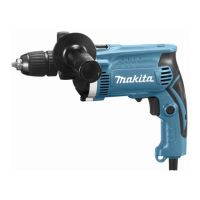
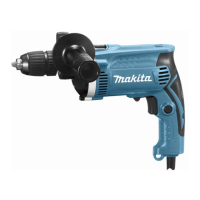
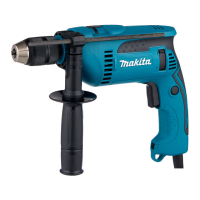
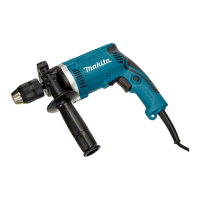
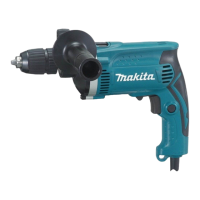
The Makita Hammer Drill, models HP1620, HP1620F, HP1621, and HP1621F, is a versatile power tool designed for both impact drilling in brick, concrete, and stone, and drilling without impact in wood, metal, ceramic, and plastic. It features a robust design with double insulation for enhanced safety.
The hammer drill is equipped with a switch trigger for operation, allowing for variable speed control based on the pressure applied. For continuous operation, the switch trigger can be pulled and then locked in place with the lock button. To stop the tool from a locked position, the trigger must be pulled fully and then released.
Models HP1620F and HP1621F include a lamp that illuminates when the trigger is pulled, providing better visibility of the workpiece. Users are cautioned not to look directly into the light source or clean the lens with gasoline or thinner, as this may cause damage or reduce illumination. A dry cloth should be used for cleaning the lamp lens.
A reversing switch is integrated to change the direction of rotation, offering both clockwise (A side) and counterclockwise (B side) rotation. It is crucial to ensure the tool has come to a complete stop before changing the direction of rotation to prevent damage. The switch trigger will not depress if the reversing switch is not fully set to either the A or B position.
The tool also features an action mode change lever, allowing users to select between "rotation with hammering" (hammer symbol) for impact drilling and "rotation only" (drill bit symbol) for standard drilling. It is important to slide the lever completely to the desired mode to avoid damaging the tool.
The hammer drill offers impressive capacities across various materials:
Its performance metrics include:
The tool is classified under Safety Class /II, indicating double insulation. It operates on a single-phase AC supply, with voltage matching the nameplate.
For European countries, the typical A-weighted noise levels are a sound pressure level of 97 dB (A) and a sound power level of 108 dB (A), with an uncertainty of 3 dB. Ear protection is recommended during operation. The typical weighted root mean square acceleration value is 15 m/s². These values comply with EN60745.
Side Grip (Auxiliary Handle): The side grip is essential for operating safety and should always be used. It can be installed on the tool barrel and tightened by turning clockwise. The grip can be swung 360° to secure it at any desired position, though it cannot swing 360° when the depth gauge is installed.
Drill Bit Installation/Removal:
Depth Gauge: A depth gauge is provided for drilling holes of uniform depth. It is inserted into the hole in the side grip and adjusted to the desired depth before tightening the side grip. Note that the depth gauge cannot be used if it strikes against the tool body.
Hammer Drilling Operation: For drilling in concrete, granite, or tile, the action mode change lever should be set to the "rotation with hammering" position. A tungsten-carbide tipped bit is recommended. Users should position the bit, pull the trigger, and apply light pressure for best results, keeping the tool steady. Excessive pressure when the hole clogs should be avoided; instead, the tool should be run at idle, and the bit partially removed to clear chips. A blow-out bulb (optional accessory) can be used to clean dust from holes after drilling.
Drilling Operation (Rotation Only): For drilling in wood, metal, or plastic, the action mode change lever should be set to the "rotation only" position.
Safety Precautions during Operation:
To ensure product safety and reliability, all repairs, carbon brush inspection and replacement, and any other maintenance or adjustments should be performed by Makita Authorized Service Centers, using only genuine Makita replacement parts.
Before performing any inspection or maintenance, always ensure the tool is switched off and unplugged from the power source.
Accessories: Makita recommends using specific accessories and attachments with this tool to prevent injury. These include:
Users needing assistance or more details on accessories should contact their local Makita service center.

 To Next Page

 General