Need help?
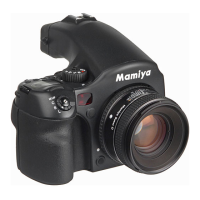
Do you have a question about the Mamiya 645 and is the answer not in the manual?
The Mamiya 645 120 MACRO A F4 M Lens is a specialized optical instrument designed for the Mamiya 645 camera system, offering exceptional capabilities for both close-up and general-purpose photography. Its primary function is to capture images with high precision and sharpness, particularly at close focusing distances, thanks to its advanced built-in floating system. This system automatically adjusts internal lens elements to correct for aberrations that typically occur during close-focusing, ensuring that edge sharpness is maintained across the frame. This makes the lens highly versatile, performing admirably whether you are shooting subjects at infinity or engaging in intricate macro work.
One of the most notable usage features of this lens is its unique built-in extension helicoid barrel. This innovative design allows the lens to achieve life-size reproductions (1:1 magnification) without the need for any additional accessories such as extension tubes or bellows. This integrated capability simplifies the workflow for macro photographers, reducing the amount of gear needed and making the lens a self-contained solution for extreme close-up photography. The ability to focus from infinity to 1:1 magnification in a single lens body underscores its versatility and makes it a valuable tool for a wide range of photographic applications, from detailed product shots to nature macro photography.
Attaching the lens to the camera body is a straightforward process. First, the front lens cap is removed by rotating it counterclockwise. Then, the lens's attachment dot is aligned with the alignment mark on the camera mount. The lens is inserted into the camera body and rotated clockwise until the exposure meter coupler securely links with the aperture pin of the camera body, ensuring proper communication between the lens and the camera for accurate exposure readings. Detaching the lens involves pressing the lens release button on the camera body in the direction of the arrow and then rotating the lens counterclockwise.
For precise control over magnification, the lens features a MAG Scale, which is aligned with a red index mark in the center of the depth-of-field scale. This scale allows photographers to determine the exact magnification ratio of their subject. The MAG Number is a reciprocal of the image size; for instance, a MAG Number of 20 indicates that the subject is being photographed at 1/20th of its actual size, while a MAG Number of 1 signifies life-size reproduction. This detailed feedback is crucial for macro photography, where exact reproduction ratios are often critical for scientific or artistic purposes.
The lens also incorporates a depth-of-field scale and a depth-of-field table to assist photographers in understanding and controlling the sharpness range within their images. By moving the A/M lever to 'M' (Manual), the diaphragm closes to the working aperture, allowing the depth-of-field to be visually assessed through the lens. Alternatively, the depth-of-field scale on the lens barrel provides a quick reference, showing the effective depth-of-field between two matching aperture values. For even greater precision, the depth-of-field table offers detailed ranges based on aperture and distance, which is particularly useful for critical focus applications.
Exposure compensation is another important consideration, especially in close-up photography. Due to the significant lens extension required for macro shots, the amount of light reaching the film is reduced, necessitating an increase in exposure. The manual provides a close-up table that details the distance to the object, the shooting range, and the required exposure correction in steps. This table is invaluable when using an external light meter to ensure correct exposures. However, if an AE prism finder is used, no manual exposure correction is typically necessary, as the camera system will automatically adjust for the light loss.
The lens barrel design is thoughtfully crafted to shield the front lens element from extraneous light, often negating the need for a separate lens hood. However, for situations where additional light control is desired, the Mamiya screw-in hood M67-No. 4 can be used. This attention to detail in design contributes to the overall image quality by minimizing flare and ghosting.
Regarding maintenance features, proper care is essential to ensure the longevity and optimal performance of the Mamiya 645 120 MACRO A F4 M Lens. It is crucial to always handle the lens carefully, avoiding drops or strong impacts, as these can damage the delicate internal mechanisms and optical elements. The lens is explicitly stated as NOT water resistant, so it should be wiped with a soft, dry cloth if it gets wet. If exposed to salt air, a soft, damp cloth should be used to clean it.
Storage conditions are also important. The lens should never be left in areas exposed to naphthalene, formalin, or other chemical gases, as these substances can cause irreparable damage. For general cleaning, a soft, dry cloth is recommended. Solvents should never be used to clean the lens, as they can cause discoloration of the lens finish. If the lens surface becomes dirty or smudged with fingerprints, a piece of soft, clean gauze should be used for gentle wiping. In cases where the lens surface is difficult to clean, or if mold is discovered, it is advised to contact a Mamiya service provider rather than attempting to disassemble or repair the lens oneself. The manual emphasizes that users should never try to modify the lens or take it apart. Adhering to these maintenance guidelines will help preserve the lens's optical integrity and mechanical functionality for years to come, allowing photographers to continue capturing high-quality images with this versatile macro lens.
 General
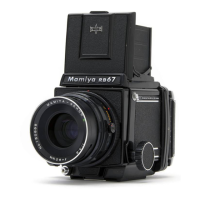
| Type | Medium format SLR camera |
|---|---|
| Lens Mount | Mamiya 645 mount |
| Focusing Screen | Interchangeable |
| Film Format | 120 film, 220 film (with optional film back) |
| Image Size | 56 x 41.5 mm |
| Shutter | Focal-plane shutter |
| Shutter Speed | 8 s to 1/1000 s + Bulb |
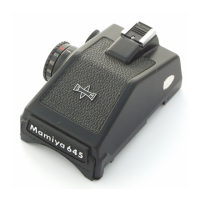
| Viewfinder | Interchangeable |
| Exposure Metering | TTL metering (with AE prism finder) |
| Flash Sync | 1/60 s |


 To Next Page