3-13
TILT SENSOR
For this operation, open out the arms.
- Place the access platform in a leaning position greater than that authorised.
> Result to be obtained: the movements of telescope extension and arm lifting must be locked.
The leaning indicator is lit in the basket, and the buzzer is active intermittently in the basket.
OVERLOAD SENSOR
For this operation, fold the arms into the transport position.
- Place a weight greater than that indicated in the basket.
> Result: the movements of telescope extension and arm lifting must be locked. The overload
indicator is lit in the basket and the buzzer is continuously active in the basket.
A3 IC ENGINE OIL LEVEL
CHECK
Set the lifting platform on a horizontal surface with the engine switched off and let the oil drain
back into the sump.
- Open the left-hand cover
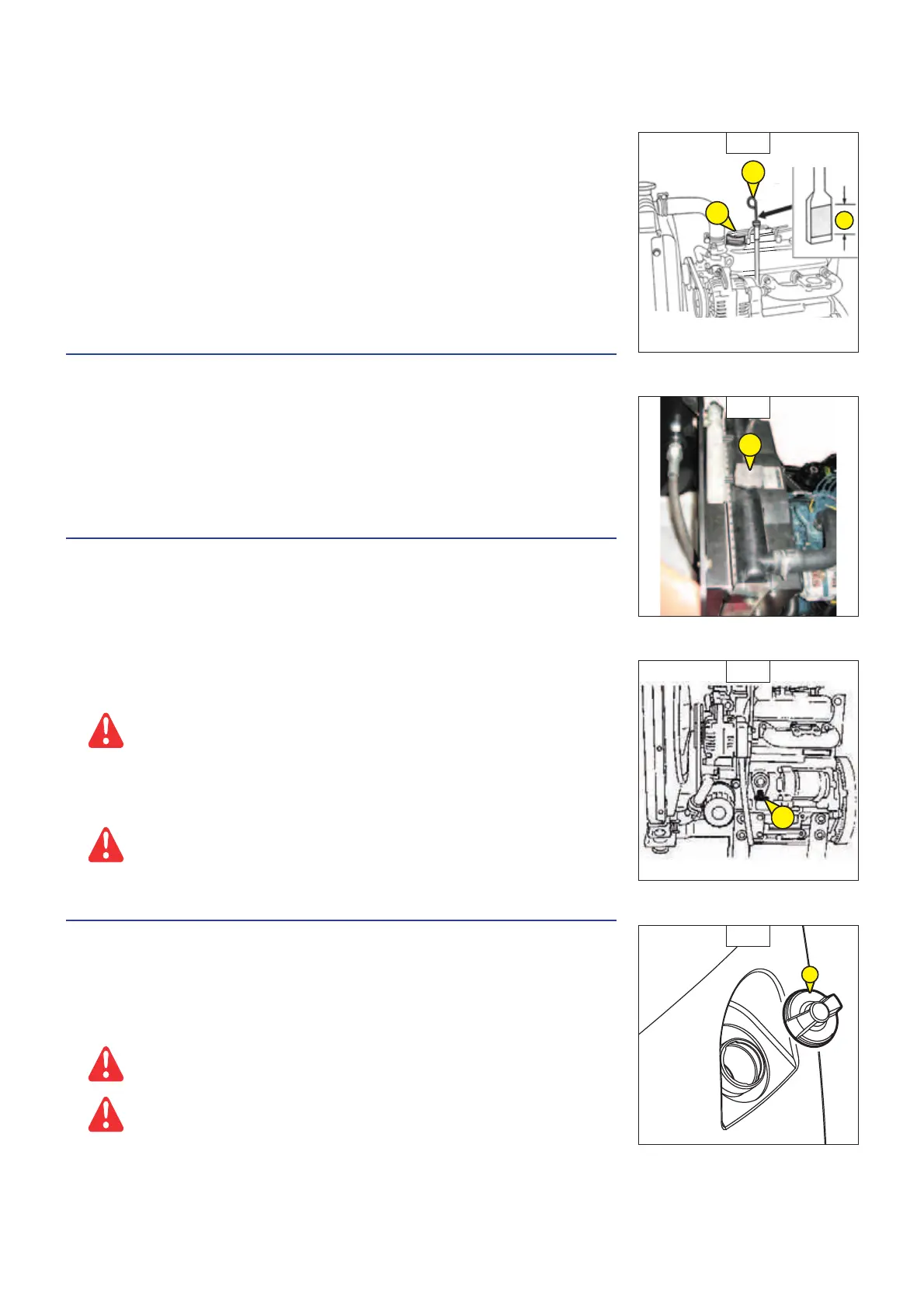
- Remove the dipstick 1 (Fig. A3).
- Wipe the dipstick and check that the oil level is between the two upper notches. Ref. A (Fig. A3).
- If necessary, add oil (see the LUBRICANTS section) via the filling hole 2 (Fig.A3).
A4 COOLANT LEVEL
CHECK
Set the platform on a horizontal surface with the engine off and wait for the engine to cool
down.
- Open the left-hand cover.
- Remove the radiator cap 1 (Fig. A4/1)
- Check that the coolant level is up to the supply opening.
- Check the drain tap 2 (Fig. A4/2) located on the side of the engine casing.
If the radiator cap must be removed, follow the above precautions and then retighten it securely.
Use pure fresh water and an antifreeze solution to refill the emergency reservoir.
If a water leak occurs, contact your dealer
Ensure that muddy water or sea water does not get into the radiator.
Do not refill the emergency reservoir with coolant above the ‘FULL’ marking.
Take care to tighten the cap firmly. If the cap is loose or badly closed, water can escape and the
engine can overheat.
Do not remove the radiator cap when the engine is hot. Then, gently loosen the cap up to the stop
to release any excessive pressure before removing the cap completely. If the engine overheats,
steam may spurt from the radiator or the emergency reservoir, possibly causing severe burns.
A5 FUEL LEVEL
CHECK
Keep the fuel tank as full as possible to reduce any condensation due to atmospheric conditions
as much as possible.
- Remove the cap 1 (Fig. A5)
- Top up the tank via the filling hole with clean Diesel, filtered through a strainer or a clean, lint-
free cloth.
Do not smoke or bring a naked flame near to the tank during filling or when
the tank is open. Never fill the tank with the engine running
.
The fuel tank is vented by the filling cap. When changing the cap, always use
an original cap with the vent hole.
A4/1
A5
1
A3
1
A
2
A4/2
2
1
647414 EN (27/05/2015)




 To Next Page