EasyManua.ls Logo

Marantz 4270 - Page 7

Marantz 4270
49 pages
Print Icon
To Next Page IconTo Next Page
To Previous Page IconTo Previous Page
Loading...
ed
of
L301
to
L304
and
C311
to
C320
for
elimination
of
undesirable
residual
switching
signal
and
through
a
de-emphasis
network
consisting
of
R325,
R326,
C321
and
C322,
into
the
npn-pnp
direct
coupled
audio
amplifier,
where
the
signals
are
amplified
to
a
required
level
for
the
output
from
J311
and
J313.
From
these
jacks,
the
audio
signals
are
led
to
the
TAPE
OUTPUT
jacks
through
the
function
switch.
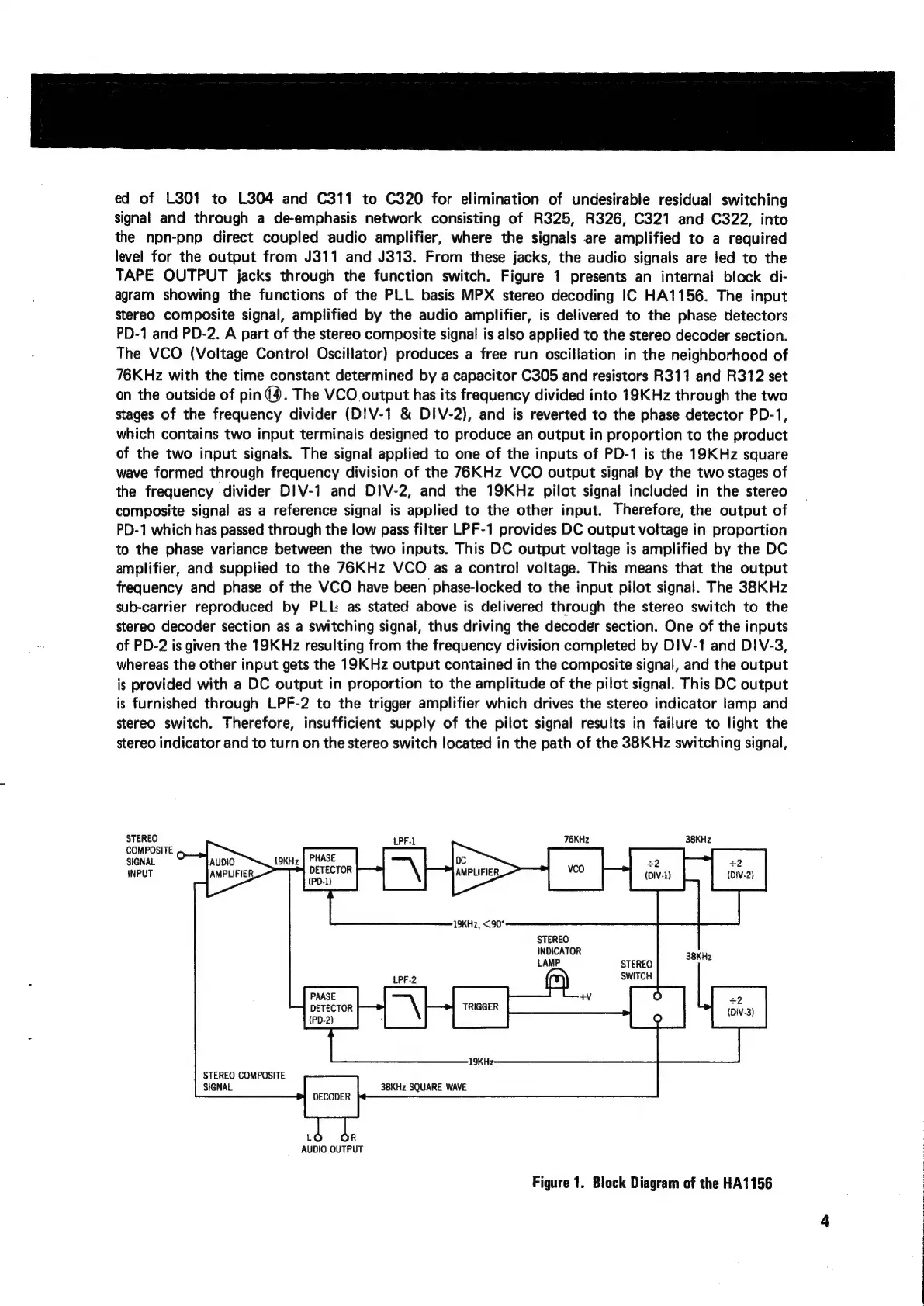
Figure
1
presents
an
interna!
block
di-
agram
showing
the
functions
of
the
PLL
basis
MPX
stereo
decoding
IC
HA1156.
The
input
stereo
composite
signal,
amplified
by
the
audio
amplifier,
is
delivered
to
the
phase
detectors
PD-1
and
PD-2.
A
part
of
the
stereo
composite
signal
is
also
applied
to
the
stereo
decoder
section.
The
VCO
(Voltage
Control
Oscillator)
produces
a
free
run
oscillation
in
the
neighborhood
of
76KHz
with
the
time
constant
determined
by
a
capacitor
C305
and
resistors
R311
and
R312
set
on
the
outside
of
pin
(4.
The
VCO
output
has
its
frequency
divided
into
19KHz
through
the
two
stages
of
the
frequency
divider
(D!V-1
&
DIV-2),
and
is
reverted
to
the
phase
detector
PD-1,
which
contains
two
input
terminals
designed
to
produce
an
output
in
proportion
to
the
product
of
the
two
input
signals.
The
signal
applied
to
one
of
the
inputs
of
PD-1
is
the
19KHz
square
wave
formed
through
frequency
division
of
the
76KHz
VCO
output
signal
by
the
two
stages
of
the
frequency
divider
DIV-1
and
DIV-2,
and
the
19KHz
pilot
signal
included
in
the
stereo
composite
signal
as
a
reference
signal
is
applied
to
the
other
input.
Therefore,
the
output
of
PD-1
which
has
passed
through
the
low
pass
filter
LPF-1
provides
DC
output
voltage
in
proportion
to
the
phase
variance
between
the
two
inputs.
This
DC
output
voltage
is
amplified
by
the
DC
amplifier,
and
supplied
to
the
76KHz
VCO
as
a
control
voltage.
This
means
that
the
output
frequency
and
phase
of
the
VCO
have
been
phase-locked
to
the
input
pilot
signal.
The
38KHz
sub-carrier
reproduced
by
PLIk:
as
stated
above
is
delivered
through
the
stereo
switch
to
the
stereo
decoder
section
as
a
switching
signal,
thus
driving
the
decoder
section.
One
of
the
inputs
of
PD-2
is
given
the
19K
Hz
resulting
from
the
frequency
division
completed
by
DIV-1
and
DIV-3,
whereas
the
other
input
gets
the
19K
Hz
output
contained
in
the
composite
signal,
and
the
output
is
provided
with
a
DC
output
in
proportion
to
the
amplitude
of
the
pilot
signal.
This
DC
output
is
furnished
through
LPF-2
to
the
trigger
amplifier
which
drives
the
stereo
indicator
lamp
and
stereo
switch.
Therefore,
insufficient
supply
of
the
pilot
signal
results
in
failure
to
light
the
stereo
indicator
and
to
turn
on
the
stereo
switch
located
in
the
path
of
the
38K
Hz
switching
signal,
STEREO
COMPOSITE
6
SIGNAL
{NPUT
PHASE
DETECTOR
(PO-1)
AUDIO
19KHz
AMPLIFIER
STEREO
INDICATOR
LAMP
PAASE
DETECTOR
(PD-2)
DECODER
O
OR
AUDIO
OUTPUT
TRIGGER
19KHz
STEREO
COMPOSITE
SIGNAL
38KHz
SQUARE
WAVE
Figure
1.
Block
Diagram
of
the
HA1156

Other manuals for Marantz 4270

Related product manuals