11
ADJUSTING THE WICK
WICK MAINTENANCE / DRY BURN
PERFORMING WICK DRY BURN / REMOVING CARBON FROM THE WICK
NEVER LEAVE THE HEATER
UNATTENDED WHILE BURNING!
Wick maintenance is necessary to prevent soot production, low heat output and performance issues.
Carbon and tar will build up on the top of the wick during regular use of this product. Wick maintenance is
required within the rst seven (7) days of your rst use of the heater and every 2 tankfuls of fuel and/or every
week during the heating season. If the wick feels hard and brittle, this indicates that wick maintenance is
necessary in order to keep your heater performing accordingly.
Check Your Wick Often!
• If the wick is hard to light.
• If the wick is hard to raise or difcult to adjust by turning the wick adjustment knob.
• If the wick fails to drop completely when you press the shut-off knob.
• If the top of the wick is stiff and hard.
Note: Poor fuel or fuel contaminated with water will also turn the wick hard.
“Dry burning” your heater will cause a strong odor. For this reason it is best to “dry burn” your heater outdoors on
a day that is completely calm and windless. If it s too windy outside you can consider a porch, breezeway or other
room with all of the windows open to disperse the strong odor.
Step 1 With your fuel tank nearly empty, burn your heater (without relling) until the ame starts to burn out then
raise the wick to its highest possible setting and leave it there until it burns out completely. Wait 60 minutes,
then re-light the wick (with a match if necessary) and allow it to burn out again. Once the heater is cool to the
touch, remove the cabinet and brush the top of the wick with an old tooth brush or other stiff bristle brush to
remove any remaining ash. A canister type vacuum cleaner may be a useful tool in removing this ash.
Step 2 The rst step should remove most carbon and your wick should feel softer to the touch. If any part still feels
hard, you can use small pliers to pinch these hard spots and break up the carbon into pieces. After doing
this, replace the cabinet, add a small amount of fuel, wait at least one hour and then repeat step 1.
Carry out Carbon Removal / Dry Burning within (7) seven days after your rst use of your new heater to reduce
carbon build-up on the wick’s burning surface, after every two tankfuls of fuel and/or every week during the heating
season. Afterwards, dry burn your heater anytime the wick appears to be hard. CHECK YOUR WICK OFTEN! Dry
burn your wick and remove all fuel from your heater at the end of the heating season.
Note: Burn your heater dry, as noted above, weekly during the heating season or necessary
thereafter. Check your wick often to see if CARBON REMOVAL / DRY BURNING is
necessary. Carbon removal will NOT be effective if your fuel has been contaminated by
water or any other liquid. In this case you must clean the fuel tank, replace the wick
and soak it for 60 MINUTES in fresh, K-1 Kerosene.
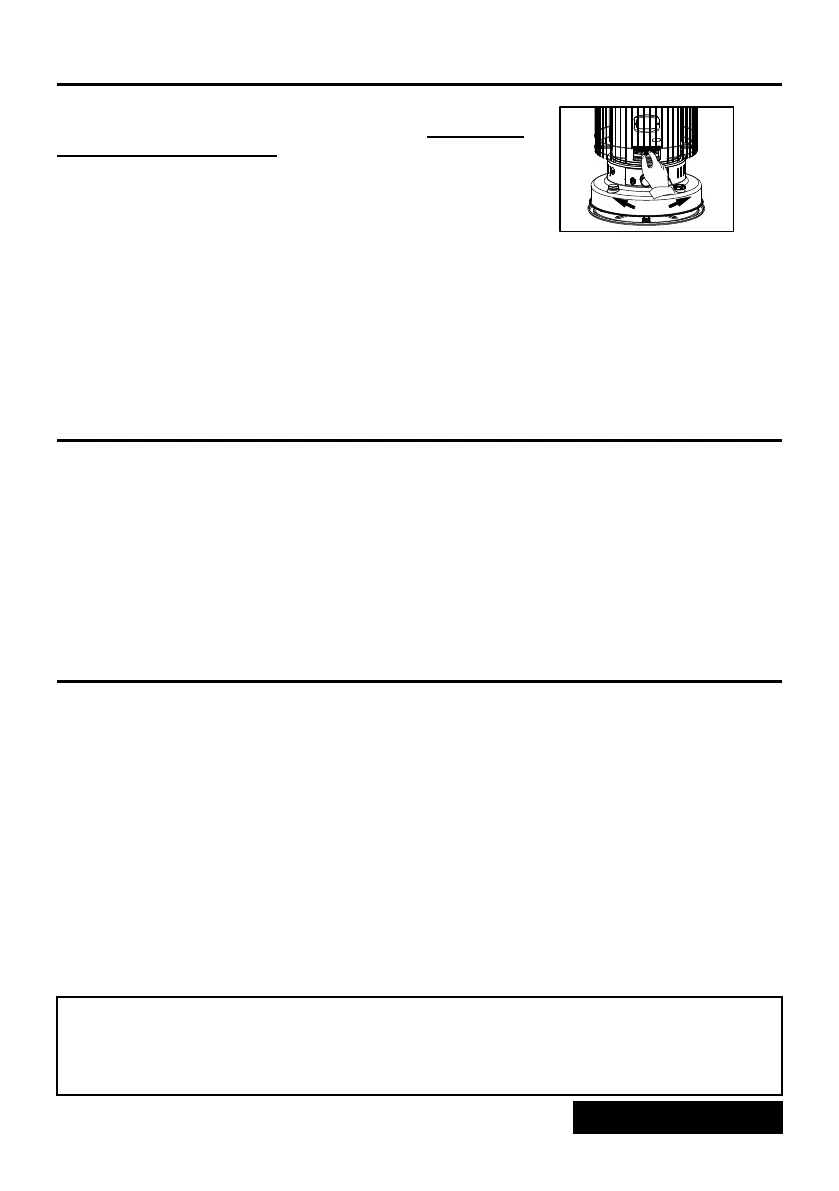
NOTE: During start-up, small adjustments to the ame can be performed
by using the burner knob on the front of the burner and MOVING THE
BURNER FROM SIDE TO SIDE until the ame at the top of burner is as
even as possible. DO NOT TOUCH THE BURNER KNOB ONCE THE
HEATER HAS REACHED NORMAL OPERATING TEMPERATURE
AND THE FLAME HAS STABILIZED. THE BURNER KNOB IS VERY
HOT DURING OPERATION.
IMPORTANT NOTE: This heater is designed to operate with a ame height of a 1/2” above the ame spreader
disk at the top of the burner. For proper combustion to occur, it is very important that the ame height be adjusted
so that it is neither too high, nor too low. Operating the heater at a wick setting below the minimum recommended
setting (the wick-stop setting) could result in the risk of re and / or carbon monoxide poisoning.
NOTE: If you nd that the wick will not raise, push the safety reset lever to engage the
safety shut-off device. Then dial the wick up via the wick adjuster knob.
WARNING: RISK OF INDOOR AIR POLLUTION AND FIRE, DO NOT OPERATE HEATER AT WICK
SETTING LOWER THAN MINIMUM WICK-STOP SETTING.
Fig.17
NOTE : During start-up, small adjustments to the flame can be performed
by using the burner knob on the front of the burner and MOVING THE
BURNER FROM SIDE TO SIDE until the flame at the top of burner is as
even as possible. DO NOT TOUCH THE BURNER KNOB ONCE THE
HEATER HAS REACHED NORMAL OPERATING TEMPERATURE
AND THE FLAME HAS STABILIZED. THE BURNER KNOB IS VERY
HOT DURING OPERATION.
IMPORTANT NOTE : This heater is designed to operate with a flame height of a 1/2" above the flame spreader disk
at the top of the burner. For proper combustion to occur, it is very important that the flame height be adjusted so that
it is neither too high, nor too low. Operating the heater at a wick setting below the minimum recommended setting
(the wick-stop setting) could result in the risk of fire and / or carbon monoxide poisoning.
NOTE : If you find that the wick will not raise, push the safety reset lever to engage the
safety shut-off device. Then dial the wick up via the wick adjuster knob.
WARNING : RISK OF INDOOR AIR POLLUTION AND FIRE, DO NOT OPERATE HEATER AT WICK
SETTING LOWER THAN MINIMUM WICK-STOP SETTING.
WICK MAINTENANCE / DRY BURN
Wick maintenance is necessary to prevent soot production, low heat output and performance issues. Carbon and tar
will build up on the top of the wick during regular use of this product. Wick maintenance is required within the first
seven (7) days of your first use of the heater and every 2 tankfuls of fuel and/or every week during the heating
season. If the wick feels hard and brittle, this indicates that wick maintenance is necessary in order to keep your
heater performing accordingly.
Check Your Wick Often!
If the wick is hard to light.
If the wick is hard to raise or difficult to adjust by turning the wick adjustment knob.
If the wick fails to drop completely when you press the shut-off knob.
If the top of the wick is stiff and hard.
Note: Poor fuel or fuel contaminated with water will also turn the wick hard.
PERFORMING WICK DRY BURN / REMOVING CARBON FROM THE WICK
"Dry burning" your heater will cause a strong odor. For this reason it is best to "dry burn" your heater outdoors on a day that is
completely calm and windless. If it
s too windy outside you can consider a porch, breezeway or other room with all of the windows
open to disperse the strong odor.
Step 1
With your fuel tank nearly empty, burn your heater (without refilling) until the flame starts to burn out then
raise the wick to its highest possible setting and leave it there until it burns out completely. Wait 60 minutes,
then re-light the wick (with a match if necessary) and allow it to burn out again. Once the heater is cool to the
touch, remove the cabinet and brush the top of the wick with an old tooth brush or other stiff bristle brush to
remove any remaining ash. A canister type vacuum cleaner may be a useful tool in removing this ash.
Step 2
The first step should remove most carbon and your wick should feel softer to the touch. If any part still feels
hard, you can use small pliers to pinch these hard spots and break up the carbon into pieces. After doing
this, replace the cabinet, add a small amount of fuel, wait at least one hour and then repeat step 1.
Carry out Carbon Removal / Dry Burning within (7) seven days after your first use of your new heater to reduce
carbon build-up on the wick’s burning surface, after every two tankfuls of fuel and/or every week during the heating
season. Afterwards, dry burn your heater anytime the wick appears to be hard. CHECK YOUR WICK OFTEN! Dry
burn your wick and remove all fuel from your heater at the end of the heating season.
Note: Burn your heater dry, as noted above, weekly during the heating season or necessary
thereafter. Check your wick often to see if CARBON REMOVAL / DRY BURNING is
necessary. Carbon removal will NOT be effective if your fuel has been contaminated by
water or any other liquid. In this case you must clean the fuel tank, replace the wick
and soak it for 60 MINUTES in fresh, K-1 Kerosene.


 To Next Page
 Loading...