33
AJUSTE DE LA MECHA
MANTENIMIENTO DE MECHA/QUEMADO EN SECO
REALIZAR QUEMADO EN SECO DE LA MECHA/QUITAR CARBONO DE LA MECHA
El mantenimiento de la mecha es necesario para evitar la producción de hollín, la baja producción de calor y
problemas de rendimiento. El carbono y el alquitrán se acumularán en la parte superior de la mecha durante
el uso regular de este producto. Se requiere mantenimiento de la mecha dentro de los primeros siete (7)
días de su primer uso del calentador y cada 2 tanques llenos de combustible o cada semana durante la
temporada de calefacción. Si la mecha se siente dura y quebradiza, esto indica que es necesario realizarle
mantenimiento para que el calentador siga funcionando adecuadamente.
Revise la mecha con frecuencia
• Si la mecha es difícil de encender.
• Si es difícil levantar o ajustar la mecha, gire la perilla de ajuste de la mecha.
• Si la mecha no cae completamente cuando presiona la perilla de apagado.
• Si la parte superior de la mecha está rígida y dura.
Nota: el combustible deciente o contaminado con agua también endurecerá la mecha.
El “quemado en seco” de su calentador provocará un olor fuerte. Por esta razón, es mejor “quemar en seco” el
calentador al aire libre en un día completamente tranquilo y sin viento. Si hay demasiado viento afuera, puede
considerar un porche, un corredor u otra habitación con todas las ventanas abiertas para dispersar el fuerte olor.
Paso 1
Con el tanque de combustible casi vacío, encienda el calentador (sin volver a llenarlo) hasta que la llama comience a
apagarse, luego levante la mecha a su posición más alta posible y déjela allí hasta que se apague por completo. Espere
60 minutos, luego vuelva a encender la mecha (con un fósforo si es necesario) y deje que se apague nuevamente. Una vez
que el calentador esté frío al tacto, retire el gabinete y cepille la parte superior de la mecha con un cepillo de dientes viejo
u otro cepillo de cerdas duras para eliminar los restos de ceniza. Una aspiradora con depósito puede ser una herramienta
útil para eliminar esta ceniza.
Paso 2
El primer paso debería eliminar la mayor parte del carbono y la mecha debería sentirse más suave al tacto. Si alguna
parte todavía se siente dura, puede usar unos alicates pequeños para pellizcar estos puntos duros y romper el
carbono en pedazos. Después de hacer esto, vuelva a colocar el gabinete, agregue una pequeña cantidad de
combustible, espere al menos una hora y luego repita el paso 1.
Realice la eliminación de carbono/quemado en seco dentro de los siete (7) días posteriores al primer uso de su nuevo calentador para reducir
la acumulación de carbono en la supercie de combustión de la mecha, después de cada dos tanques llenos de combustible o cada semana
durante la temporada de calefacción. Luego, queme en seco el calentador cada vez que la mecha parezca dura. ¡REVISE LA MECHA CON
FRECUENCIA! Queme en seco la mecha y retire todo el combustible de su calentador al nal de la temporada de calefacción.
Nota: queme su calentador en seco, como se indicó anteriormente, semanalmente durante la temporada de
calefacción o si es necesario a partir de entonces. Revise su mecha con frecuencia para ver si es
necesaria la ELIMINACIÓN DE CARBONO/QUEMADO EN SECO. La eliminación de carbono NO será
efectiva si su combustible ha sido contaminado por agua o cualquier otro líquido. En este caso debe
limpiar el tanque de combustible, reemplazar la mecha y remojarla durante 60 MINUTOS en queroseno K-1 fresco.
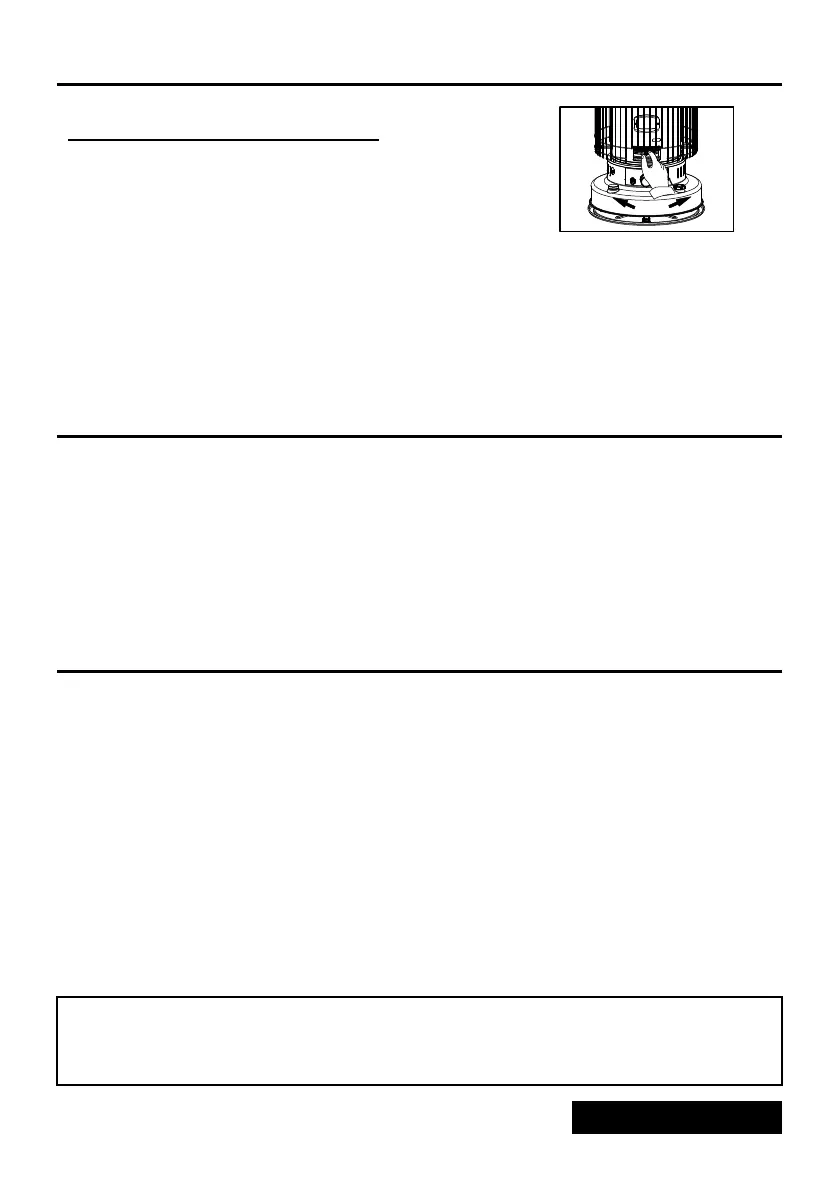
NOTA: durante el encendido, se pueden realizar pequeños ajustes a
la llama con la perilla del quemador en la parte frontal del quemador
y MOVER EL QUEMADOR DE LADO A LADO hasta que la llama
en la parte superior del quemador se apague lo más uniforme
posible. NO TOQUE LA PERILLA DEL QUEMADOR UNA VEZ
QUE EL CALENTADOR HAYA ALCANZADO LA TEMPERATURA
DE FUNCIONAMIENTO NORMAL Y LA LLAMA SE HAYA
ESTABILIZADO. LA PERILLA DEL QUEMADOR ESTÁ MUY
CALIENTE DURANTE EL FUNCIONAMIENTO.
NOTA IMPORTANTE: este calentador está diseñado para funcionar con una altura de ama de 1.27 cm (½”) sobre
el disco esparcidor de ama en la parte superior del quemador. Para que se produzca una combustión adecuada,
es muy importante que se ajuste la altura de la llama de manera que no sea ni demasiado alta ni demasiado baja.
Usar el calentador con una conguración de mecha por debajo de la conguración mínima recomendada (nivel del
tope de la mecha) podría generar riesgo de incendio o intoxicación por monóxido de carbono.
NOTA:
si descubre que la mecha no se levanta, presione la palanca de reinicio de seguridad para activar
el dispositivo de apagado de seguridad. Luego suba la mecha mediante la perilla de ajuste de la mecha.
ADVERTENCIA: RIESGO DE CONTAMINACIÓN DEL AIRE INTERIOR E INCENDIO, NO USE EL CALENTADOR CON UNA
CONFIGURACIÓN DE MECHA INFERIOR A LA CONFIGURACIÓN MÍNIMA DEL TOPE DE LA MECHA.
Fig.17
NOTE : During start-up, small adjustments to the flame can be performed
by using the burner knob on the front of the burner and MOVING THE
BURNER FROM SIDE TO SIDE until the flame at the top of burner is as
even as possible. DO NOT TOUCH THE BURNER KNOB ONCE THE
HEATER HAS REACHED NORMAL OPERATING TEMPERATURE
AND THE FLAME HAS STABILIZED. THE BURNER KNOB IS VERY
HOT DURING OPERATION.
IMPORTANT NOTE : This heater is designed to operate with a flame height of a 1/2" above the flame spreader disk
at the top of the burner. For proper combustion to occur, it is very important that the flame height be adjusted so that
it is neither too high, nor too low. Operating the heater at a wick setting below the minimum recommended setting
(the wick-stop setting) could result in the risk of fire and / or carbon monoxide poisoning.
NOTE : If you find that the wick will not raise, push the safety reset lever to engage the
safety shut-off device. Then dial the wick up via the wick adjuster knob.
WARNING : RISK OF INDOOR AIR POLLUTION AND FIRE, DO NOT OPERATE HEATER AT WICK
SETTING LOWER THAN MINIMUM WICK-STOP SETTING.
WICK MAINTENANCE / DRY BURN
Wick maintenance is necessary to prevent soot production, low heat output and performance issues. Carbon and tar
will build up on the top of the wick during regular use of this product. Wick maintenance is required within the first
seven (7) days of your first use of the heater and every 2 tankfuls of fuel and/or every week during the heating
season. If the wick feels hard and brittle, this indicates that wick maintenance is necessary in order to keep your
heater performing accordingly.
Check Your Wick Often!
If the wick is hard to light.
If the wick is hard to raise or difficult to adjust by turning the wick adjustment knob.
If the wick fails to drop completely when you press the shut-off knob.
If the top of the wick is stiff and hard.
Note: Poor fuel or fuel contaminated with water will also turn the wick hard.
PERFORMING WICK DRY BURN / REMOVING CARBON FROM THE WICK
"Dry burning" your heater will cause a strong odor. For this reason it is best to "dry burn" your heater outdoors on a day that is
completely calm and windless. If it
s too windy outside you can consider a porch, breezeway or other room with all of the windows
open to disperse the strong odor.
Step 1
With your fuel tank nearly empty, burn your heater (without refilling) until the flame starts to burn out then
raise the wick to its highest possible setting and leave it there until it burns out completely. Wait 60 minutes,
then re-light the wick (with a match if necessary) and allow it to burn out again. Once the heater is cool to the
touch, remove the cabinet and brush the top of the wick with an old tooth brush or other stiff bristle brush to
remove any remaining ash. A canister type vacuum cleaner may be a useful tool in removing this ash.
Step 2
The first step should remove most carbon and your wick should feel softer to the touch. If any part still feels
hard, you can use small pliers to pinch these hard spots and break up the carbon into pieces. After doing
this, replace the cabinet, add a small amount of fuel, wait at least one hour and then repeat step 1.
Carry out Carbon Removal / Dry Burning within (7) seven days after your first use of your new heater to reduce
carbon build-up on the wick’s burning surface, after every two tankfuls of fuel and/or every week during the heating
season. Afterwards, dry burn your heater anytime the wick appears to be hard. CHECK YOUR WICK OFTEN! Dry
burn your wick and remove all fuel from your heater at the end of the heating season.
Note: Burn your heater dry, as noted above, weekly during the heating season or necessary
thereafter. Check your wick often to see if CARBON REMOVAL / DRY BURNING is
necessary. Carbon removal will NOT be effective if your fuel has been contaminated by
water or any other liquid. In this case you must clean the fuel tank, replace the wick
and soak it for 60 MINUTES in fresh, K-1 Kerosene.
NUNCA DEJE EL CALENTADOR SIN
SUPERVISIÓN MIENTRAS ESTÉ ENCENDIDO.


 To Next Page
 Loading...