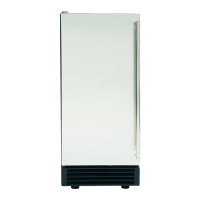
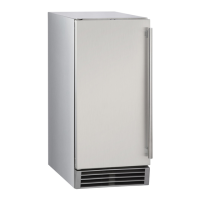
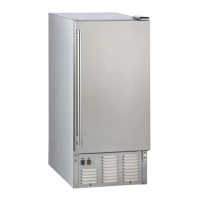
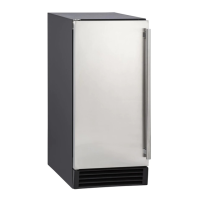
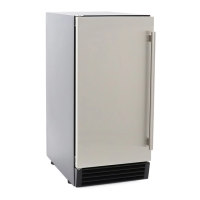
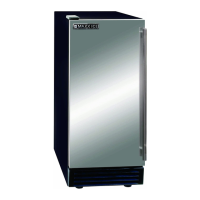
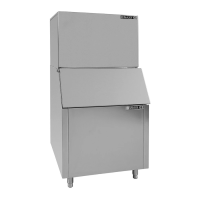
This document provides an instruction manual for the Maxx Ice MIM50 series ice makers, including models MIM50, MIM50-O, and MIM50V. These machines are designed to produce hard, gourmet cube ice and are suitable for homeowners, restaurants, and hotel guests. An insulated ice storage bin is built into each unit.
Function Description:
The Maxx Ice MIM50 series ice makers operate automatically to produce ice. They require a cold water supply and a gravity drain. The ice-making process involves two distinct cycles: freeze and harvest. During the freeze cycle, the compressor pumps refrigerant, the fan motor blows air, and the water pump circulates water over the evaporator surface. Water containing mineral impurities falls back into the water trough, while fresh water continuously enters the trough. Once a batch of ice is fully formed, the machine stops the freeze cycle and begins the harvest cycle. In the harvest cycle, the compressor continues to operate, but the water pump stops. A hot gas valve opens, diverting hot refrigerant gas into the evaporator, warming it and causing the ice cubes to slide as a unit into the storage bin. The freeze cycle restarts once all cubes are harvested. A complete cycle takes approximately 20 minutes, though this can vary based on temperature and operating conditions. The machine automatically stops making ice when the storage bin is full and restarts when ice is removed and the bin-full probe is freed.
Important Technical Specifications:
The MIM50 series ice makers are 50lb indoor or outdoor units.
- Voltage: 120V/60Hz/1Ph (also 220V/50Hz/1Ph for MIM50).
- Amps: 4.8.
- Ice Type: Slab Cube.
- Ice Cube Size: 3/4" x 3/4" x 1".
- Power Consumption: 13.2kWh per 100lbs of ice.
- Unit Weight: 83 lbs (37 kg) for MIM50/MIM50-O, 84 lbs (38 kg) for MIM50V.
- Maximum Ice Storage: 25 lbs.
- Ice-making Capacity: 50 lbs/day (actual quantity may vary with room and water conditions).
- Unit Dimensions: 14 5/8" W x 23 5/8" D x 33 1/2" H (MIM50/MIM50-O), 14 5/8" W x 23 3/8" D x 33 1/2" H (MIM50V).
- Shipping Weight: 93 lbs (42 kg).
- Shipping Dimensions: 17" W x 26 3/4" D x 38" H.
- Operating Ambient Temperature: 50°F (10°C) to 100°F (38°C).
- Operating Water Temperature: 41°F (5°C) to 90°F (32°C).
- Water Supply Pressure: Minimum 15 psig, maximum static pressure 80 psig.
- Electrical Connection: Standard 115V AC, 60Hz, 15A, 3-prong grounded outlet. A separate, dedicated circuit is recommended.
Usage Features:
- Installation: The ice maker can be installed as a mobile (free-standing) unit, enclosed under a cabinet, or built-in. Adequate ventilation is crucial, requiring at least 4" (102mm) clearance at the rear and 1" (25mm) at the top and sides. The unit must be leveled for proper water flow and ice production.
- Water Supply Connection: Requires a 1/4" (6.35mm) soft copper tubing cold water supply with a shut-off valve. A water filter is strongly recommended to remove taste, odors, and particles, and to address hard water issues.
- Drain Connection: A gravity drain is needed. The drain line should have a fall of 1/4" per foot and should not hang or loop higher than the floor of the ice storage bin. A condensate pump may be required if a floor drain is not available.
- Door Swing Reversal: The door swing can be reversed using a flathead and Phillips screwdriver.
- Control Panel (MIM50V/MIM50): Features ON/OFF, CLEAN, and MODE buttons.
- Control Panel (MIM50-O): Features an On/Off/Clean button.
- LED Indicators:
- Bin Full (Red) LED: Indicates the ice storage bin is full or the bin-full probe is blocked. The unit stops making ice when lit.
- Ice Making (Green) LED: Indicates the unit is in ice-making mode.
- Ice Harvest (Yellow) LED: Indicates the unit is in ice harvest mode.
- Mode Button: Primarily for service, allows changing between ice-making and ice harvest modes.
- Adjust Button: For use by authorized service technicians.
- First Batch Discard: The first batch of ice cubes produced after initial setup or long storage must be discarded due to potential impurities from transit and storage.
- Door Closure: Keep the door closed to reduce ice melting and ensure proper ice formation, except when taking ice.
Maintenance Features:
- Cleaning Before Use: After unpacking, the interior of the ice maker should be cleaned before initial use.
- Exterior Cleaning: The door and cabinet can be cleaned with a mild detergent and warm water solution. Avoid solvent-based or abrasive cleaners. For stainless steel panels, use a mild detergent and warm water solution with a damp cloth.
- Interior Cleaning: The ice storage bin should be sanitized occasionally. The water trough should be cleaned before first use and after extended periods of non-use. A sanitizing solution of 1 ounce of household bleach or chlorine per 2 gallons of hot water (95°F - 115°F) is recommended. Rinse thoroughly with clear water.
- Condenser Cleaning: The condenser should be cleaned at least once every six months to ensure proper airflow and maintain ice-making capacity. This involves unplugging the unit, removing the lower front louver, and using a vacuum cleaner with a brush attachment to remove dirt and lint.
- Water Distribution Tube Cleaning: If ice cubes are incompletely formed or output is low, the water distribution tube may be blocked. The holes in the tube can be dredged with a pointed object like a toothpick. For severe blockages, the tube can be removed and cleaned with a brush, warm water, and mild detergent.
- Ice-Making System Cleaning and Sanitizing: Mineral scale buildup should be removed regularly. The frequency depends on water hardness and filtration effectiveness (e.g., every 6 months for hard water). This involves removing all ice, pouring 8 oz. of Nickel-Safe Ice Maker Cleaner Solution into the water trough, and initiating the wash cycle via the ON/OFF and CLEAN buttons. The machine runs in Automatic Clean Mode for 30 minutes. This process should be followed by multiple rinses with clear water and a sanitizing cycle using a bleach solution, followed by another rinse. The first batch of ice after cleaning must be discarded.
- Long Storage Preparation: If the ice maker will not be used for an extended period, the water supply and electrical supply should be shut off, the water supply line disconnected, and all remaining ice and water removed from the storage bin and water trough. The door should be left open to prevent mold and mildew.


 To Next Page
 General