mcdsp.com
Page UMC27
McDSP 6060 Ultimate Module Collection
6060 Applications
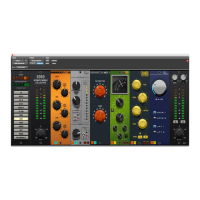
The 6060 Ultimate Module Collection offers the largest number of module-based
processing options of any plug-in on the market. To that end, the number of
applications are many. A few are listed in the sections below, and hopefully
serve as a basis for coming up with many more uses.
Parallel Processing
For fans of combining two versions of the same track in their mix (parallel
processing), the 6060 offers some great choices.
Putting the 6060 into Split Input mode, the user can choose one combination
of compression and EQ in channel “A”, and another combination in channel
“B”. For example, a very mid-range heavy, aggressively compressed (and
even distorted) sound could be created in “A”, and a more full-range, gently
compressed (maybe some tape compression with the TAPE module) in “B”.
The same approach could be applied to vocals, dialog, and plenty of other
applications. The Split Input mix controls are even automatable - useful for
creating a finely tuned mix.
Multi-Stage Processing
The six module slots can be useful for adding a small amount of compression in
several stages. Some of the gentler compression modules like the C671 or MT2
can be used in series for a very gradual compression effect.
Another variation is to place an aggressive dynamic range processing module
(GC-1, FRG446, D359) first in the signal chain to address some of the signal spikes
at higher levels (say spikes above -6 dB). After taking care of these signal spikes,
then apply the series of compressors. In this approach, the limiter-like action as
the first stage prevents the next stages from being triggered by these spikes.
Drums
The large number of equalizers, compressors, and signal saturators, plus the Split
Input mode of the 6060, offer a great number of unique processing approaches.
Starting with compression, because the 6060 lets you swap modules on the fly,
each compressor ‘tone’ can be auditioned quickly. Once a suitable compressor is
found, then the same approach can be applied to selecting an equalizer. If the
user is unsure if compression should be before or after the EQ, the module order
can be adjusted easily (and during playback).


 To Next Page