Using the Guard Terminal
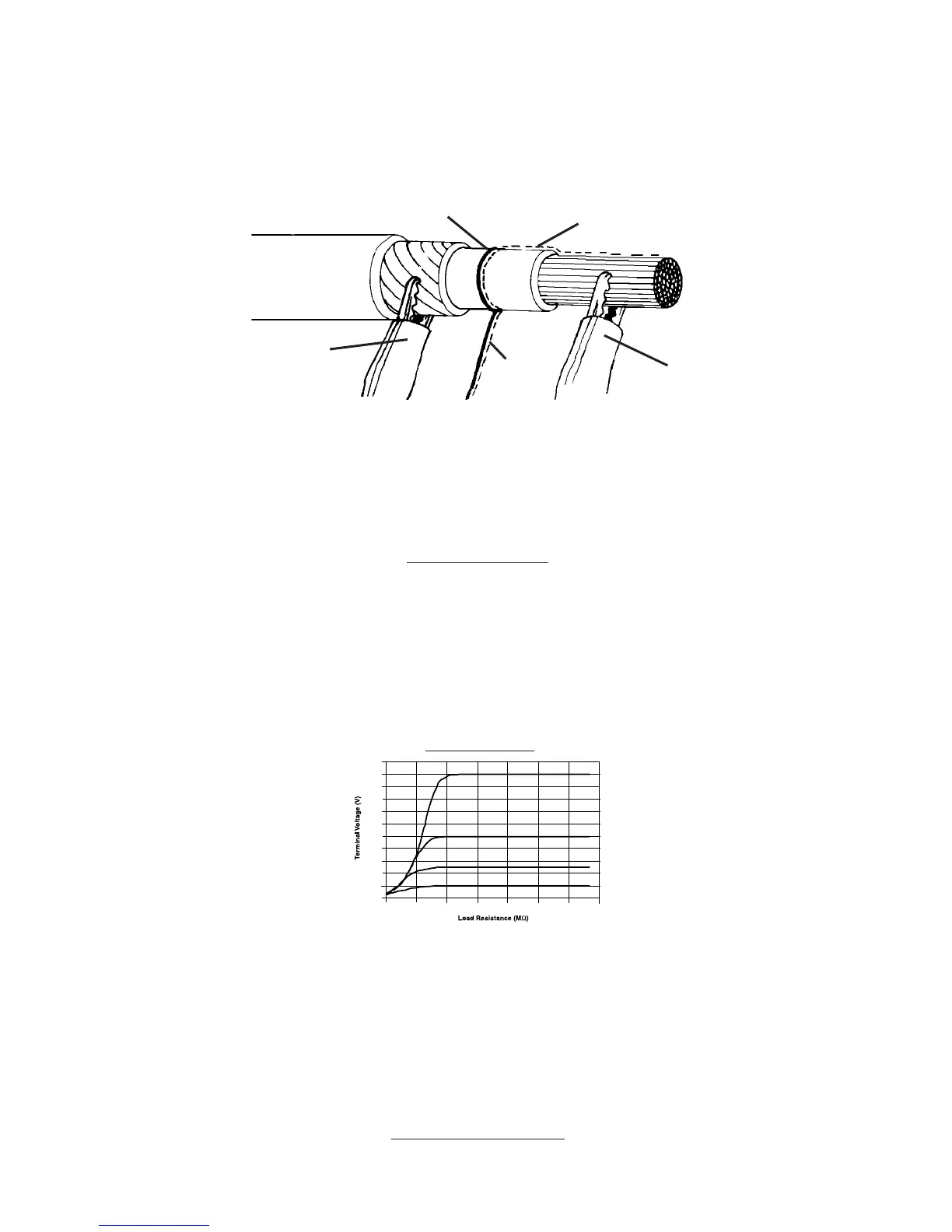
For basic insulation tests and where there is little possibility of surface
leakage affecting the measurement, it is unnecessary to use the guard
terminal. In cable testing, there may be surface leakage paths across the
insulation between the bare cable and the external sheathing due to the
presence of moisture or dirt. Where it is required to remove the effect of this
leakage, particularly at high testing voltages, a bare wire may be bound tightly
around the insulation and connected via the third test lead to the guard
terminal ‘G’.
The guard terminal is at the same potential as the negative terminal. Since the
leakage resistance is effectively in parallel with the resistance to be
measured, the use of the guard causes the current flowing through surface
leakage to be diverted from the measuring circuit. The instrument therefore
reads the leakage of the insulator, ignoring leakage across its surface.
SPECIFICATION
Insulation Ranges
Measuring Ranges: 0 - 1.999MΩ at all test voltages
19.99 MΩ at all test voltages
199.9 MΩ at all test voltages
1999 MΩ at 500 V and 1000 V d.c. test voltages
Fully auto - ranging at all voltages
Test Voltages (d.c.): 100 V; 250 V; 500 V; 1kV
Test V. Accuracy: ±5% at open circuit
Short Cct. Current: 1.2 mA nominal
Accuracy (73.4°F ± 3.6˚F): <500 MΩ: ± 3% ±2 digits
500 MΩ to 1999 MΩ: ± 5% ±2 digits
Temp. Co-efficient: <500 MΩ: ≤86˚F, ±0.06% per °F, >86˚F ± 0.14% per ˚F
500 MΩ to 1999 MΩ: ≤86˚F ± 0.11% per ˚F, >86˚F,
±0.28% per °F,
Hum Rejection: Within twice the normal accuracy if the noise current
does not exceed 1 mA for the 1 kV range, or 0.5 mA
for the other ranges and is within 45 Hz to 65 Hz.
Low resistance Range
Measuring Range: 0 - 1.999 kΩ
19.99 kΩ
Open Cct. Voltage: 4.3 V nominal
Accuracy (73.4°F ± 3.6˚F):± 2% of reading ± 1digit


 To Next Page