Need help?
Do you have a question about the Megger MFT1800 series and is the answer not in the manual?
Essential safety warnings and precautions for instrument operation and testing procedures.
Specific safety measures for working with 'live' earths, including protective equipment and procedures.
Explanation of safety and hazard icons found on the instrument's casing.
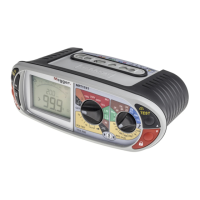
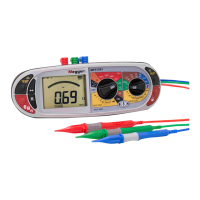
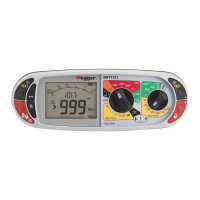
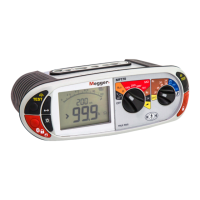
General introduction to the MFT1800 series multifunction tester and its capabilities.
Identification and description of the front panel controls and buttons of the MFT1800 series.
Details and explanations of the information presented on the instrument's display screen.
Explanation of various symbols and icons that can appear on the instrument's display.
Information regarding the disposal of the product in compliance with WEEE regulations.
Guidance on locating, fitting, and replacing batteries and fuses in the instrument.
Basic operational procedures applicable to all MFT1800 series models.
Instructions for powering on the MFT1800 series instrument.
Instructions for powering off the MFT1800 series instrument.
Details the functionality of the Mode button based on the selected test function.
Conditions under which testing will be inhibited for various test modes.
Step-by-step guide on how to perform voltage measurements using the instrument.
Procedure for measuring the frequency of a live circuit.
How to determine phase rotation on a 3-phase supply using the instrument.
Instructions for measuring leakage current using an optional clamp accessory.
Guide to measuring temperature with a thermocouple transducer.
Using the remote switch probe for measurements in V/mV/°C modes.
Procedure for nulling test lead resistance to ensure accurate continuity readings.
Step-by-step guide to performing continuity measurements.
Instructions for storing and downloading test results to compatible devices.
How to enable or disable the continuity test buzzer.
Using the SP5 switch probe for continuity/resistance measurements.
Setting the resistance threshold for the continuity buzzer.
Details on measurement methods and potential sources of error for continuity tests.
Step-by-step guide to performing insulation resistance measurements.
How to lock the insulation test ON for continuous testing.
Explains measurement methods and potential errors for insulation tests.
Selecting appropriate ranges and connecting test leads for loop impedance tests.
Procedure for performing phase-to-earth loop impedance tests.
Describes the three loop test options (3Lo, 2Hi, 2Lo) available in L-PE mode.
Procedure for performing loop impedance tests on L-N or L-L circuits.
Explanation of Z, Zmax, Zref, and R1+R2 values in loop impedance testing.
How to measure Ze (earth loop impedance) at the origin.
Performing Zs and Zdb loop measurements without RCDs.
Testing earth loop impedance on circuits with RCDs.
Performing phase-to-neutral or phase-to-phase loop impedance tests.
Calculating PFC and PSCC during loop impedance tests.
Understanding the Confidence Meter for non-trip loop impedance tests.
Procedure for performing 3Lo loop impedance measurements.
Methods and potential error sources for loop impedance testing.
Step-by-step guide to performing RCD measurements.
How to select the appropriate RCD type (AC, A, S, B) for testing.
Performing a no-trip test at half the rated RCD trip current.
Performing a tripping test at the rated RCD current.
Performing a 2xI tripping test on 30mA RCDs (MFT1825/1835).
Performing a 5xI tripping test on 30 mA RCDs.
Measuring RCD trip current by increasing test current incrementally.
Performing a faster ramp test with fewer current steps.
Testing Type A RCDs sensitive to pulsed DC fault currents.
Testing Type B RCDs sensitive to pure DC fault currents.
Testing RCDs with variable trip current settings.
Performing an automated sequence of RCD tests.
Procedure for testing RCDs in 3-phase installations.
Display and interpretation of touch voltage during RCD tests.
Measurement methods and potential errors for RCD testing.
General tips and recommendations for RCD testing.
Identification of the MFT's connection terminals for earth resistance testing.
Setting the touch voltage limit for earth resistance measurements.
Procedure for performing two-pole earth resistance measurements.
Procedure for performing three-terminal earth resistance measurements.
Performing three-terminal earth resistance using the ART method.
Performing stake-less earth resistance measurements using two clamps.
Displays and explanations for warnings shown during instrument startup.
Warning messages related to the instrument's battery status.
Warning messages related to the battery charging process.
Indicates when a fuse has blown in the instrument.
Error message for incorrect rotary switch configurations.
Warning messages specific to continuity testing.
Warning messages specific to insulation testing.
Warning messages related to RCD or GFCI testing.
Error messages for incorrect RCD range selections.
Warning messages encountered during loop testing.
Warning messages specific to earth testing.
Messages indicating why a test cannot be initiated.
Procedure for saving test results into the instrument's internal memory.
Steps for removing stored test results from the instrument's memory.
How to retrieve and view previously stored test results on the instrument.
Instructions for transmitting stored test data wirelessly via Bluetooth.
Method for sending specific test results for certification purposes.
Sending loop test results for L-L/L-N connections via Bluetooth.
Sending RCD test results via Bluetooth.
Sending earth test results via Bluetooth.
Steps for pairing the MFT with a PC or laptop via Bluetooth.
Explains the principle of three-terminal earth resistance measurement.
Explains the ART method for three-terminal earth resistance testing.
Explains the principle of two-clamp stake-less earth resistance measurement.
Details the accuracy specifications for various measurements.
Accuracy specifications for insulation resistance testing.
Accuracy specifications for continuity and resistance measurements.
Accuracy specifications for 2Hi loop impedance testing.
Accuracy specifications for 3Lo and 2Lo loop impedance testing.
Accuracy specifications for RCD testing procedures.
Accuracy specifications for voltage measurements.
Accuracy specifications for frequency measurements.
Accuracy specifications for earth resistance testing ranges.
Accuracy specifications for current measurements via clamp meter.
Accuracy specifications for mV sensor input.
Specifications for internal memory and Bluetooth communication.
Specifications detailing the instrument's power consumption.
Accuracy specifications for temperature measurement via module.
Environmental operating and storage specifications for the instrument.
Procedures and contact information for instrument calibration, repair, and spare parts.
 General
| Type | Multifunction Tester |
|---|---|
| Continuity Test Current | 200 mA |
| RCD Test Current | 10 mA, 30 mA, 100 mA, 300 mA, 500 mA, 1000 mA |
| RCD Trip Time Measurement | Yes |
| Frequency Measurement | Yes |
| IP Rating | IP54 |
| PSC/PFC Range | 20 kA |
| RCD Testing | Yes |
| Voltage Measurement | Yes |
| Voltage Measurement Range | 0 V to 600 V |
| Display | LCD |
| Power Source | Battery |
| Safety Standards | IEC 61010-1 |
| Insulation Resistance Test Voltage | 250V, 500V, 1000V |
| Insulation Resistance Range | 0.01 MΩ to 1000 MΩ |
| Continuity Measurement Range | 0.01 Ω to 20 kΩ |


 To Next Page