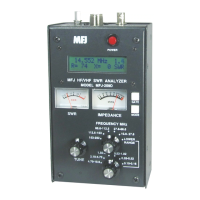
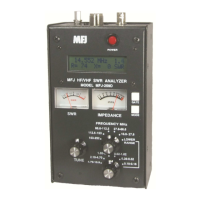
MFJ-269 Instruction Manual HF/VHF/UHF SWR Analyzer
18
Caution:
Some advanced menus present information in special or uncommon terms.
Advanced 1
includes impedance descriptions such as magnitude and phase of load impedance, series and
parallel equivalent impedance, reflection coefficient, and resonance. Most of these terms are
useful in special applications, such as in adjusting matching stubs.
The advanced menus also contain uncommon terms describing SWR, such as return loss and
match efficiency. These terms can be misleading because their name does not describe what
actually happens in most antenna systems. We strongly recommend persons unfamiliar with
such terms avoid using them, or at least read the section below that explains what the term
actually describes.
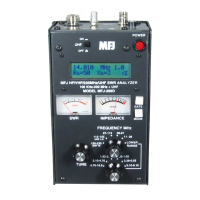
The MFJ-269 contains a 50 ohm bridge, with voltage detectors across each bridge leg. A twelve-bit
microcontroller processes these voltages and, by applying the proper formulas, displays useful information. The
basic calculations are resistance, reactance, SWR, and complex impedance. In some modes, the system cross
checks itself and displays a weighted average of the most accurate measurement methods, or searches for certain
impedance conditions. System resolution is limited mostly by diode linearity, calibration stability, and external
noise or signals.
While we have attempted to make this unit as accurate as possible, most formulas contain squares and other
complex functions. A certain amount of error is unavoidable, especially at high or low impedance values and
especially at higher VHF or UHF frequencies.
A basic understanding of transmission line and antenna behavior and terminology is very important in
understanding
Advanced mode
information provided by the MFJ-269. Many explanations are available in the
ARRL Handbooks, and they probably suffice for most amateur applications. Avoid unedited or self-edited
amateur handbooks or articles, or at least confirm their accuracy by checking the information against reliable
professional sources. For complex questions or critical information, we recommend using textbooks written,
reviewed, and edited by professional engineers.
5.2 Accessing Advanced Modes
CAUTION: THERE IS A ‘‘UHF’’ SWITCH LOCATED AT THE UPPER LEFT-HAND
SIDE OF THE ANALYZER. THIS SWITCH SHOULD BE PRESSED AND
LOCKED FOR UHF OPERATION ONLY WHEN UHF OPERATION IS DESIRED
AND ONLY AFTER THE UNIT IS POWERED UP. FOR INFORMATION ON
UHF OPERATION, SEE SECTION 3.4
The advanced mode is reached by pressing and holding the
GATE
and
MODE
buttons at the same time for
several seconds. After a delay of a few seconds, a series of
“ADVANCED”
messages numbered 1 through 3
appear. When you see the mode you want, quickly release the buttons. If you hold the buttons long enough, the
display will eventually loop back through the MAIN menu and repeat the cycle.
* HF/VHF operation
: The following modes are available from each of these
“ADVANCED”
menus:


 To Next Page