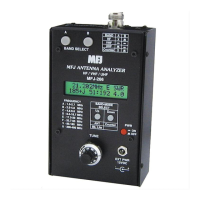
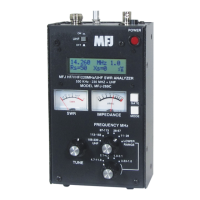
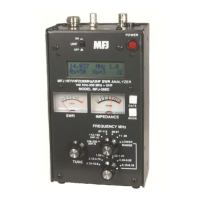
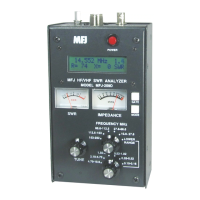
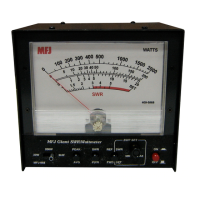
MFJ-269 Instruction Manual HF/VHF/UHF SWR Analyzer
34
The 75 ohm Zo SWR on the display is the true SWR on the 75 ohm cable, the SWR on the
meter is the SWR when a 50 ohm system is connected to the 75 ohm cable.
6.2 Verticals
Verticals are usually unbalanced antennas. Many antenna manufacturers incorrectly downplay the need for a
good radial system with a grounded vertical. With a good ground system, the SWR of a directly fed quarter-wave
vertical can be nearly 2 to 1. SWR often improves if the ground system (and performance) is poor, so a low
SWR with a directly fed Marconi might be a sign of inefficiency.
Verticals are tuned like dipoles, lengthening the element moves the frequency lower, and shortening the element
moves the frequency higher.
6.3 Tuning a simple antenna
Select any mode that indicates SWR. Tuning basic antennas fed can be accomplished with the following steps:
1.
Momentarily short the feedline center conductor and shield, then connect the feedline to the MFJ-269.
2.
Adjust the MFJ-269 frequency to the desired frequency.
3.
Read SWR, and adjust the MFJ-269 frequency until the lowest SWR is found. (Be sure cable Zo matches
Analyzer Zo).
4.
Divide the measured frequency by the desired frequency.
5.
Multiply the present antenna length by the result of step 4. This will be close to the antenna length actually
needed.
Note
:
This method of tuning will only work on full-size vertical or dipole antennas with uniform diameters.
This method will not work with antennas that employ loading coils, traps, stubs, resistors, capacitors or
capacitance hats, and these antenna types should be tuned according to the manufacturer’s instructions
while tested with the MFJ-269, until the
desired SWR is obtained.
7.0 Testing and Tuning Stubs and Transmission Lines
7.1 Testing Stubs
Resonant frequency of any impedance stub or transmission line can be measured. Select the first (or opening)
measurement mode in the
MAIN
menu, or use the protocol in
5.5 Advanced 2
.
Connect the stub under test to the "ANTENNA" connector of the MFJ-269 .
NOTE: The line must be
open circuited
at the far end
for odd multiples
of 1/4 wave stubs (i.e. 1/4, 3/4, 1-1/4,
etc.) and
short circuited
for all half-wave stub
multiples
(like 1/2, 1, 1-1/2, etc.).:
1.) If a balanced line is used, operate the MFJ-269
only
from internal batteries. Keep the MFJ-269 a few feet
away from other conductors or earth, and do not attach any wires (other than the feedline) to the unit. Use the
ANTENNA
connector’s shield for one lead and its center pin for the other. Two wire balanced lines
must
be
suspended in a fairly straight line a few feet away from metallic objects or ground.


 To Next Page