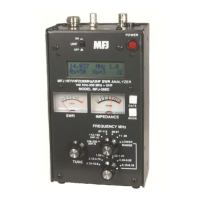
MFJ-269D Instruction Manual LF/HF/VHF/UHF SWR Analyzer
12
1. Connect the 50-ohm cable, attenuator, transmission line type balun, or transformer under test to the
Antenna connector. Confirm the distant end of the DUT isn't terminated by a resistance.
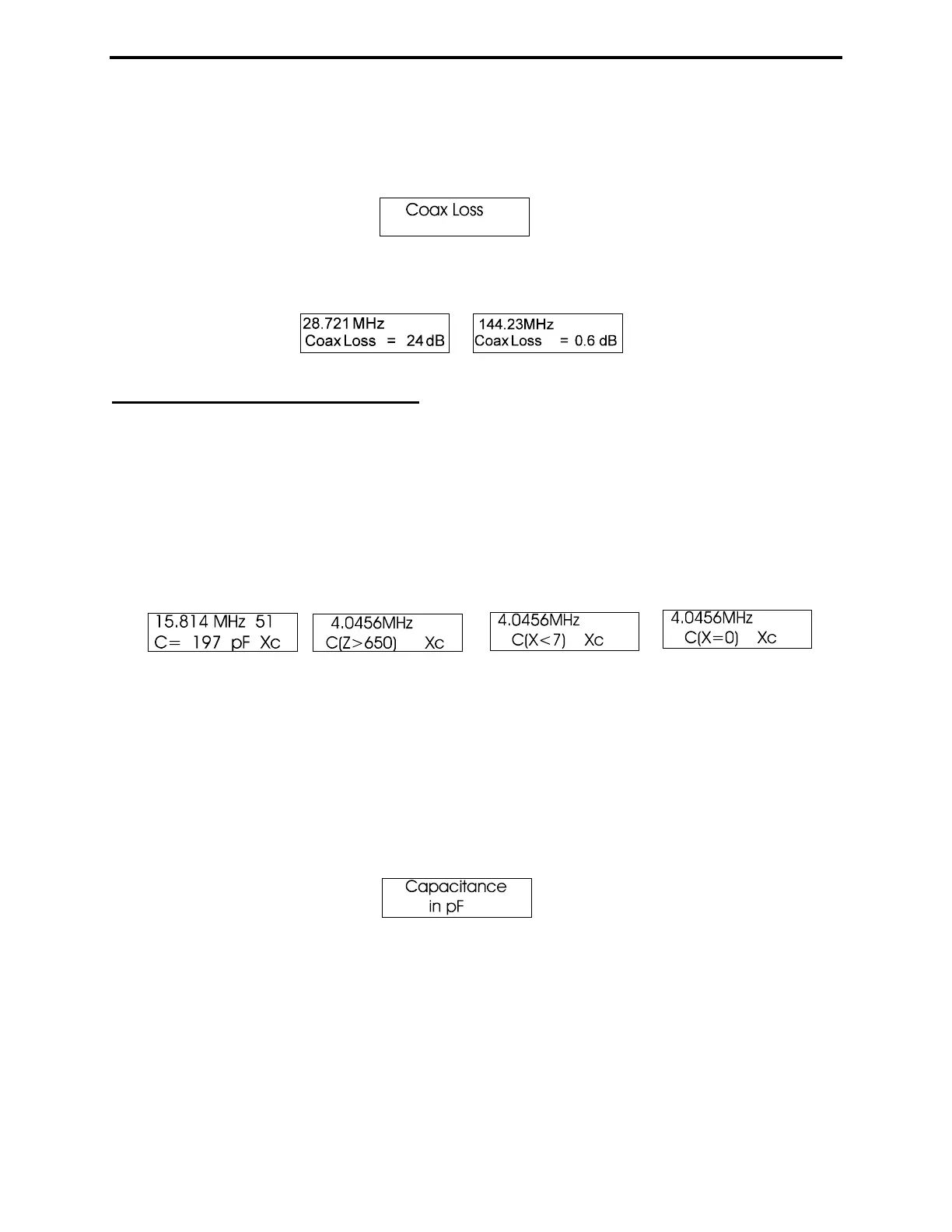
2. Turn the analyzer On and toggle the Mode switch once to the Coax Loss screen.
3. Tune the analyzer's VFO (Tune) to the frequency where you wish to measure loss. The loss in dB will
be displayed for any specific frequency you select between 0.53 and 230 MHz.
4.4 Capacitance (Function-3)
Access the capacitance mode by stepping to the Capacitance screen using the Mode switch. The top line
of the working display shows the Frequency in MHz and the Capacitive Reactance (Xc) of the DUT at
that specific frequency. The lower line displays the computed Capacitance in pF. Normally, the
measurement range is from a few pF to a few thousand pF.
Important Note: Capacitance measurements tend to become inaccurate below 7 ohms and above 650
ohms. If reactance falls into the inaccuracy range, C(X<7), C(X=0), or C(Z>650) will be displayed on
the screen as error messages. The MFJ-269D will not display "data" when the measurement accuracy is
questionable (see examples below):
Reactance Sign: The MFJ-269D measures the DUT's reactance (X) and mathematically converts it to a
capacitance value (Xc). However, the analyzer's processor can't determine if the reactance it measures is
actually capacitive or inductive. You can usually confirm the sign by simply adjusting the VFO. If tuning
down in frequency causes reactance to increase, the load is likely capacitive (-jX) because the reactance
of a capacitor normally increases with a decrease in frequency.
To measure a capacitor:
1. Turn on the analyzer and toggle the Mode switch twice to bring up the Capacitance identification
screen.
2. Connect the capacitor across the Antenna connector with the shortest leads possible, or include the
lead length normally used in the actual circuit to include stray lead inductance in your measurement.
3. Adjust the VFO (Tune) to your frequency of interest. If a range warning comes up, find the closest
frequency where no warning appears. Warnings are C(Z>650), C(X<7), and C(X=0) -- and the C(X=0)
warning indicates the capacitor appears as a near-perfect short.
When measuring a capacitor, it's displayed value in pF will typically change with the test frequency. This
change occurs because stray inductance inside the capacitor and in the wires leading to the analyzer


 To Next Page