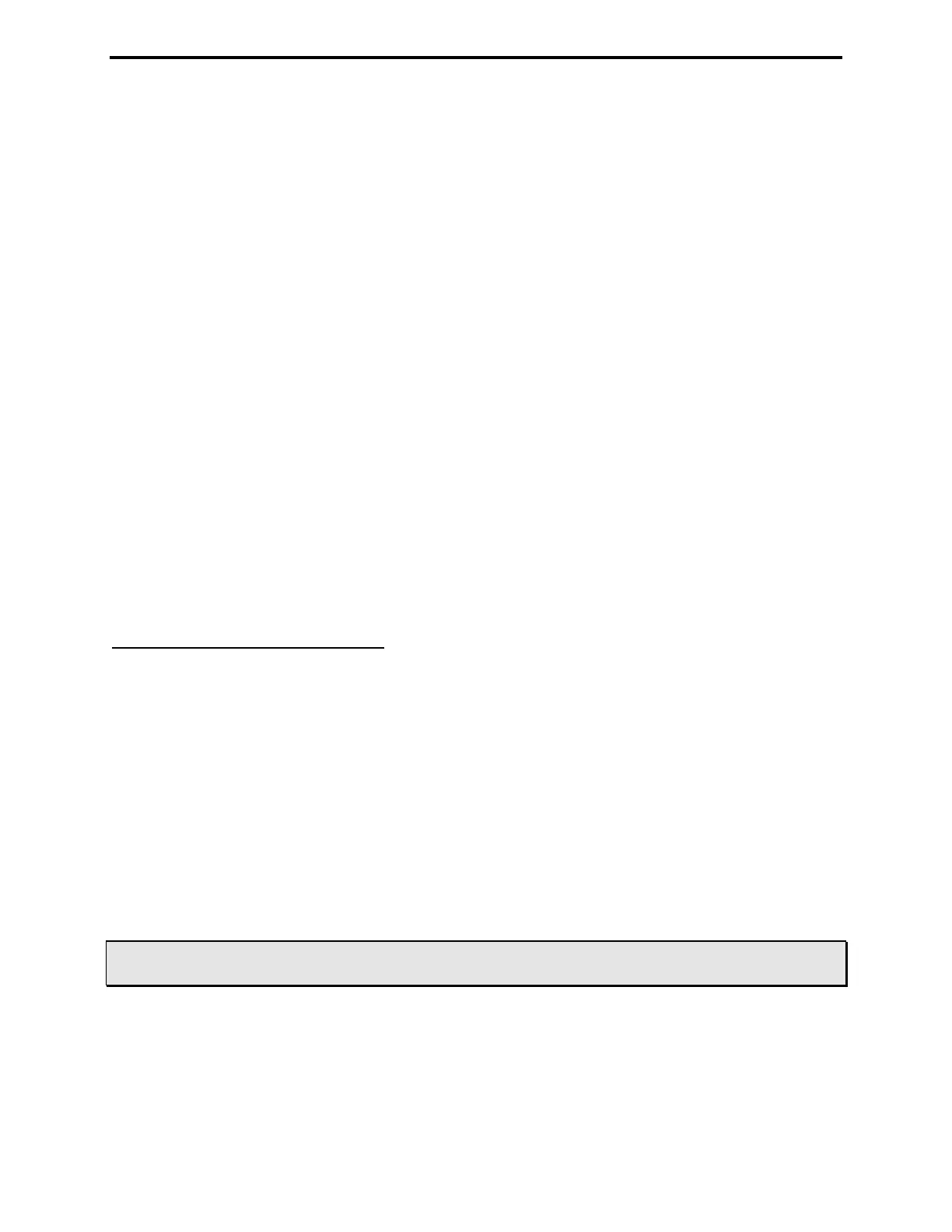
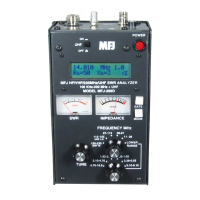
MFJ-269D Instruction Manual LF/HF/VHF/UHF SWR Analyzer
15
*LF/ HF/VHF operation: The following modes are available from each of these Advanced menus:
Advanced-1 Magnitude and phase of load impedance
(Section 5.4.1) Series and Parallel Equivalent Impedances
Return Loss and Reflection coefficient
Resonance
Match Efficiency
Advanced-2 Velocity Factor setup
(Section 5.5) Distance to Fault measurement
Line length in degrees calculation
Advanced-3 Characteristic Impedance setup
(Section 5.6) Normalized SWR impedance (display only)
Coax loss
* UHF operation: The following modes are available from each of these Advanced menus:
Advanced-1 Return Loss and Reflection coefficient
(Section 5.4.2) Match Efficiency
Advanced-2 Velocity Factor setup
(Section 5.5) Line length in degrees calculation
5.3 General Connections
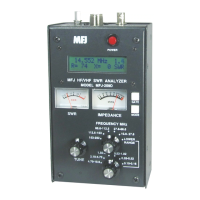
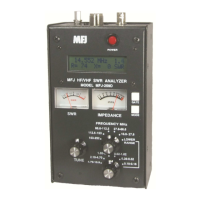
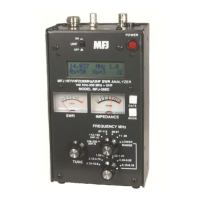
The Antenna connector (Type “N” female) on the top of the MFJ-269D provides the RF measurement
output connection. This port is used to measure SWR or perform other RF impedance measurements,
with the exception of the Frequency Counter mode.
The Antenna connector supplies about +7 dBm output into 50 ohms (~ .5 volts RMS), and appears like a
50 ohm source resistance (open circuit voltage ~1 volt RMS). Harmonics are at least 25 dB down over
the operating range of the MFJ-269D. While the VFO is not stabilized, it is useful as a crude signal
source.
The Antenna connector is not dc isolated from the load, external voltages will couple directly into
internal detectors.
When testing antennas, especially those that do not have a dc path to ground, discharge any static
electricity that may have built up on the antenna before connecting the MFJ-269D. Because the Antenna
connector is not dc isolated static electricity can damage the internal detectors.
WARNING: NEVER APPLY EXTERNAL VOLTAGES OR RF SIGNALS TO THE ANTENNA
CONNECTOR. ALSO, PROTECT THIS PORT FROM ESD.
Use proper RF connections. Keep leads as short as possible when measuring components or non-matched
systems. Interconnecting transmission lines or wires can modify readings, including impedance and
SWR. Use properly constructed coaxial cables of known quality matched to the analyzer impedance to
avoid introducing SWR errors.


 To Next Page